Diogenite
(4) Vesta/Vestoid origin
Norite
click on photo for a magnified view
Purchased 2021
26° 2' 20" N., 9° 16' 45" W.
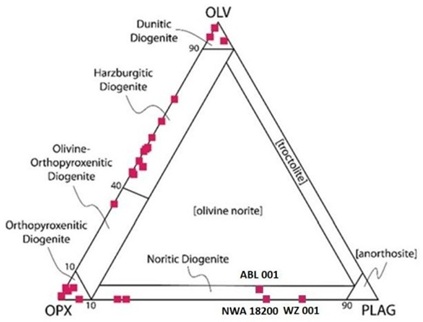
A single stone lacking fusion crust and weighing 12,400 g was found in Western Sahara close to the northern border of Mauritania (Google Earth image). The meteorite was subsequently purchased by Said Muftah Bachir and a sample was sent for analysis and classification to the University of New Mexico (C. Agee, A. Ross, and K. Ziegler) where Al Bir Lahlou 001 was classified as an ungrouped achondrite; specifically, a plagioclase-rich norite based on IUGS taxonomy.
Compared to the analyzed diogenites, Al Bir Lahlou 001 contains an anomalously high anorthitic plagioclase (An97.9 [±0.1]) content of 60 vol%, along with 35 vol% orthopyroxene and minor abundances of olivine (~100 µm inclusions in pyroxene), nearly pure Fe-metal, and Cr-spinel (Agee and Ross, MetBull 110). For example, the ABL 001 norite is unique compared to the noritic diogenite NWA 10388, described by Irving et al. (2016 #2264) as containing 72.2 vol% orthopyroxene and 25.1 vol% plagioclase as bytownite (An85.9–88.0). In addition, they identified a noritic clast in the shock-melted feldspathic diogenite NWA 8744 that has a high plagioclase content of 40 vol%, but which is still lower than that of ABL 001. In addition, Irving et al. (2014 #5199) analyzed other diogenites with relatively high modal abundances of calcic plagioclase, including noritic diogenite NWA 6928 and feldspathic diogenite NWA 8000 with 19 vol.% (An92.9–94.2) and ~10 vol.% (An88.1–89.0), respectively, and also a noritic clast in polymict diogenite NWA 6945 containing ~20 vol.% (An95.7–99.9) calcic plagioclase.
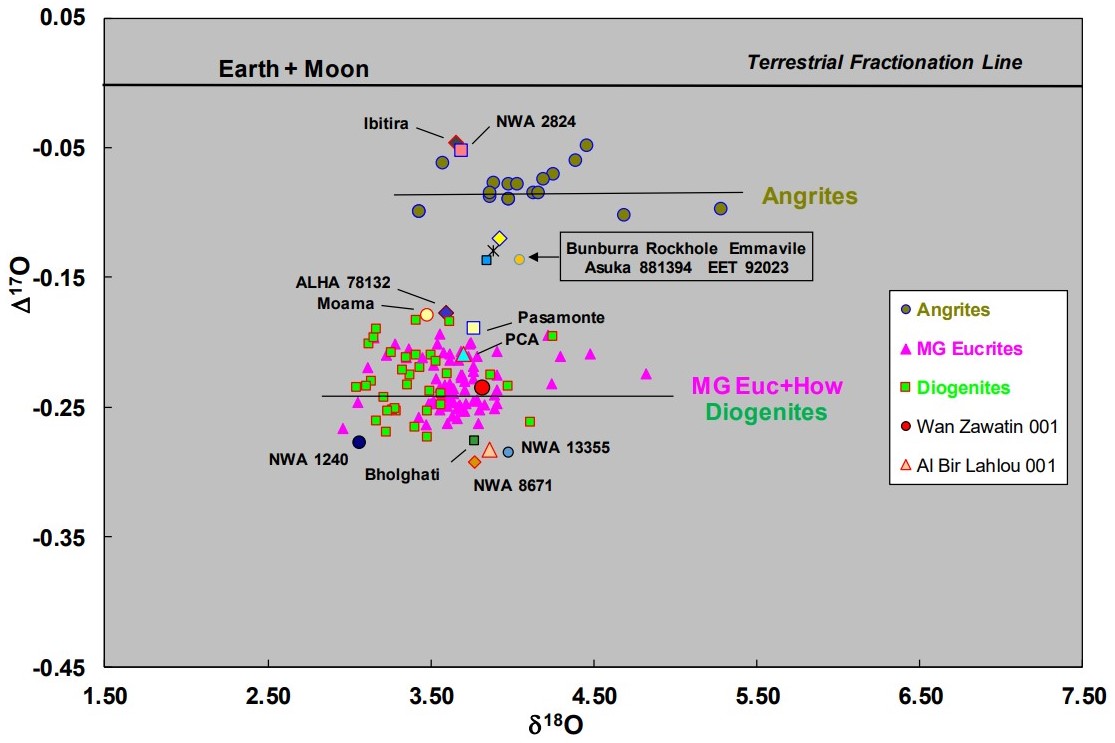
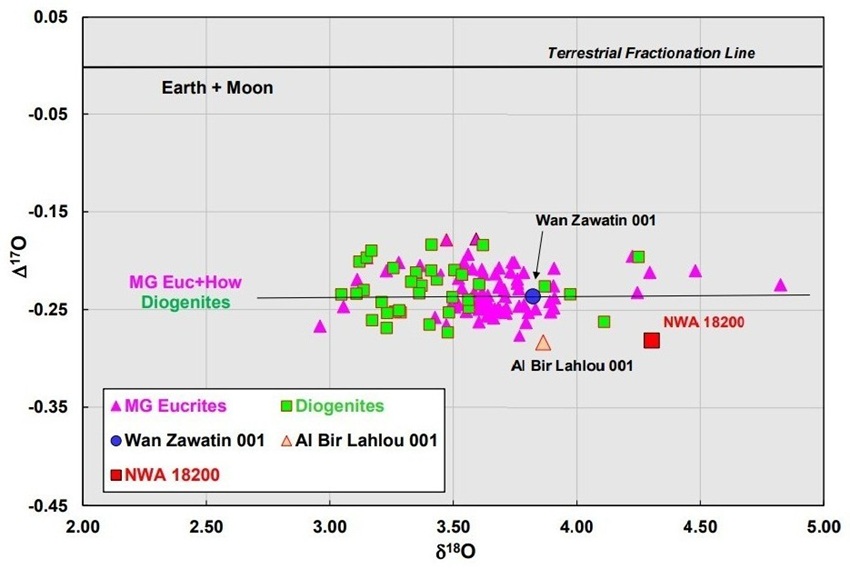
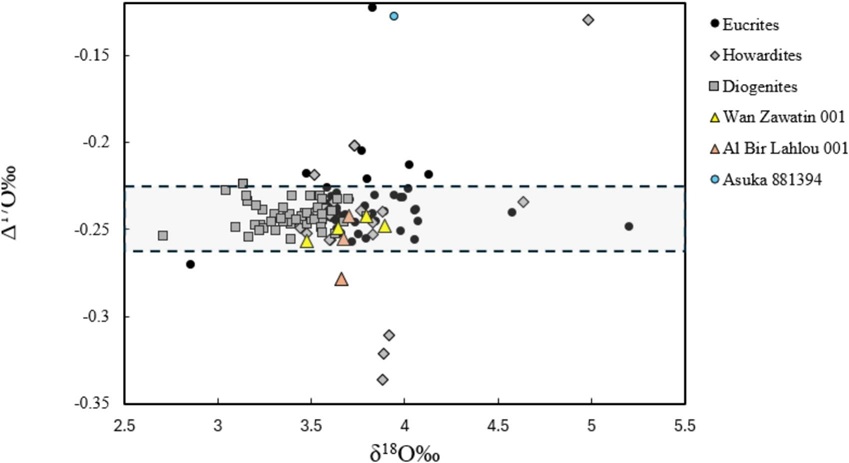
The oxygen isotopic composition of Al Bir Lahlou 001 (3 subsamples by K. Ziegler, UNM) plots very close to the anomalous eucrites NWA 8671 and NWA 13355, as well as the ungrouped achondrite NWA 13955, some or all of which may represent additional parent bodies (see diagram below). Interestingly, it has been postulated by Irving et al. that diogenites may not share a common parent body with the main group of eucrites (e.g., see 49th LPSC, 2018 #2247). Based on its mineralogy, geochemistry, and O-isotopic composition, Al Bir Lahlou 001 may derive from asteroid (4) Vesta or one of its Vestoid family members, or even from a separate parent body; an oxygen isotope comparison between ABL 001 and diogenites supports either presumption. Notably, the noritic diogenite NWA 18200 shares similar Δ17O values with Al Bir Lahlou 001, but has somewhat higher δ18O values (see oxygen isotope diagrams below).
Oxygen Isotope Plot For Al Bir Lahlou 001—I
click on image for a magnified view
Diagram credit: Carpenter et al., 54th LPSC, #2278 (2023)
Oxygen Isotope Plot For Al Bir Lahlou 001—II
click on image for a magnified view
Diagram credit: Irving et al., 57th LPSC, #1529 (2026)
Oxygen Isotope Plot For Al Bir Lahlou 001—III
click on diagram for a magnified view
Diagram credit: Rider-Stokes et al., Icarus, vol. 445, art. 116844, fig. 5 (2026, open accesslink)
'The Noritic mineralogy of V- and S-type objects and the links with asteroid (4) Vesta'
(https://doi.org/10.1016/j.icarus.2025.116844)
Despite its slightly anomalous mineralogy and oxygen isotope composition compared to the HED diogenites, Al Bir Lahlou 001 is consistent with many other HED trends. For example, the meteorite has spectral band characteristics that match the V-type classification under the Bus-DeMeo taxonomy. Al Bir Lahlou 001 is considered to be a good candidate to have originated from the depths of the Rheasilvia basin on asteroid (4) Vesta. Notably, ABL 001 provides the best spectral match (Vis–NIR) to asteroid (4) Vesta, and virtually as good a match to two other V-type asteroids—(6611) 1993 VW and (88188) 2000 XH44—based on a reference set of 714 asteroid spectra (Rider-Stokes et al., 2026 and references therein; see their Figs. 6b and 9a).
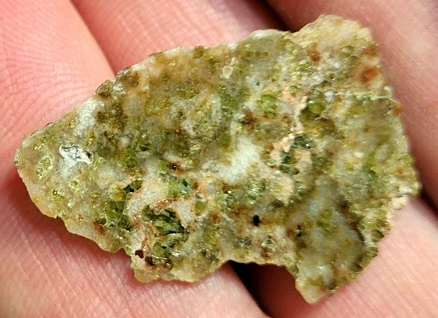
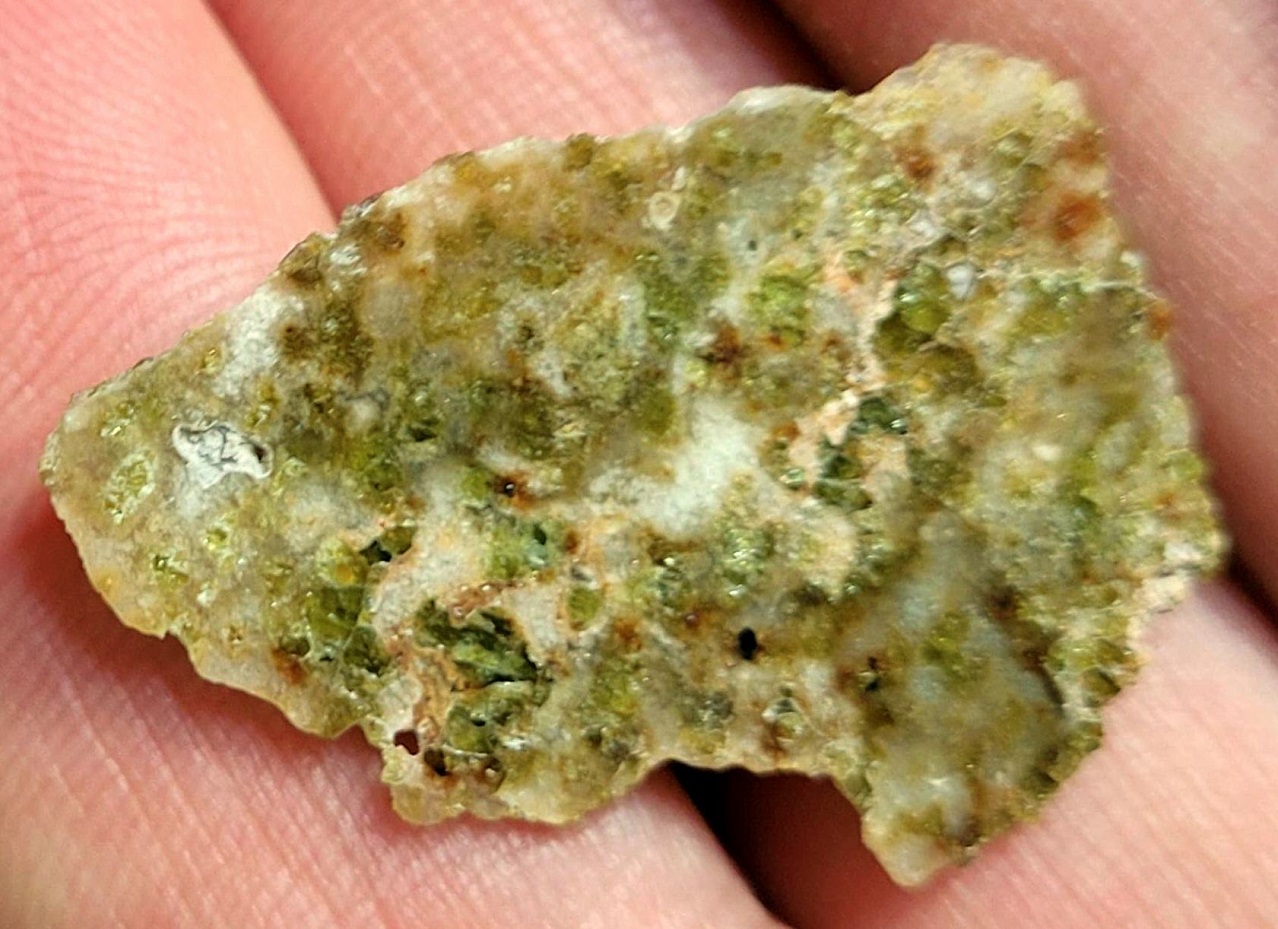
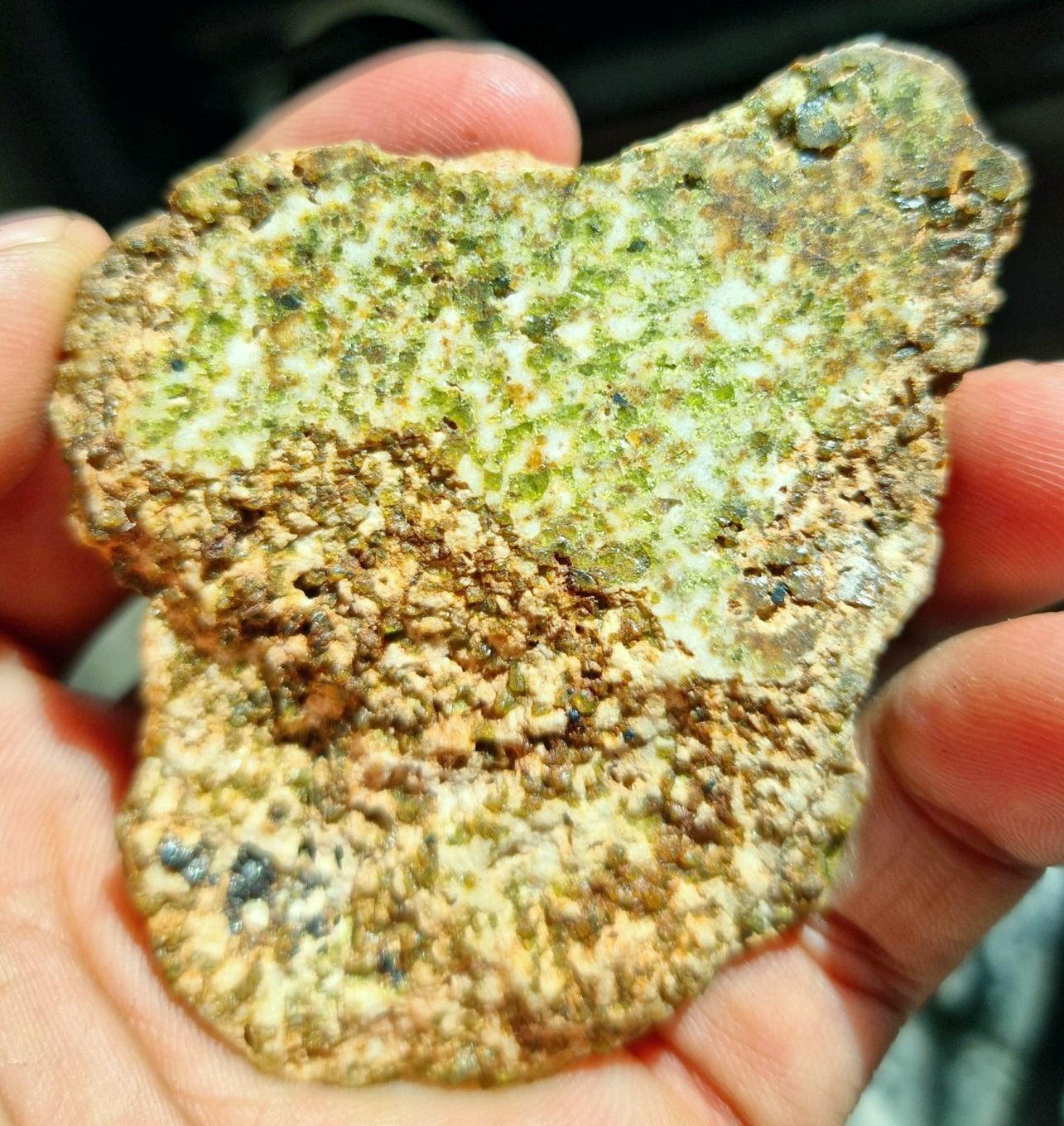
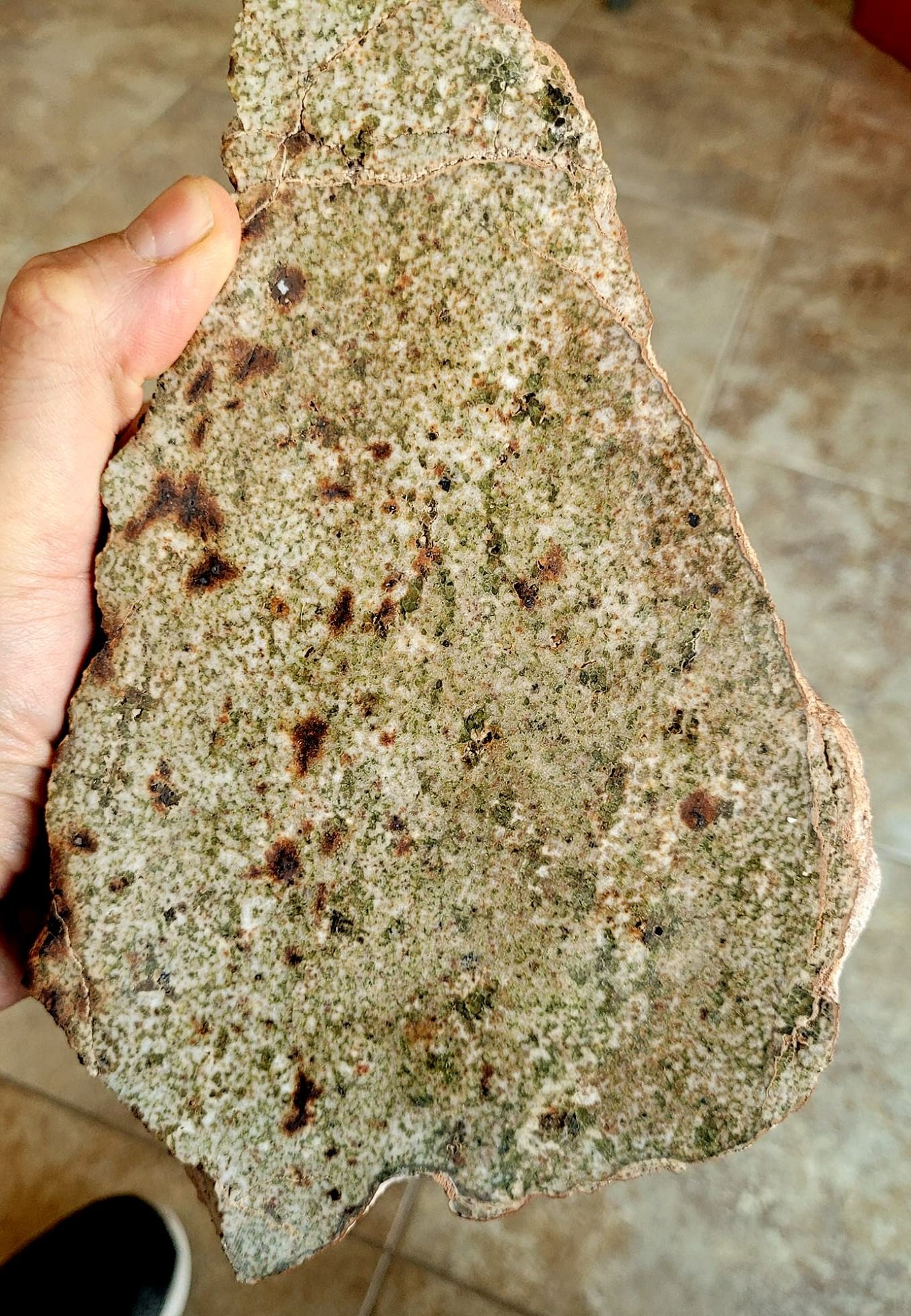
The question has been raised whether any of the many eucrite, anomalous eucrite-like, and diogenite meteorites which have been characterized actually derive from dwarf planet (4) Vesta, or instead represent numerous diverse parent bodies (e.g., Irving et al., 2018). The specimen of Al Bir Lahlou 001 shown above is a small representative 2.72 g slice sectioned by C. Zlimen, which features milky-white plagioclase grains intermixed with green orthopyroxene grains. The excellent photo of Al Bir Lahlou 001 below (top) shows a close-up of the natural exterior and cut face of the meteorite courtesy of S. Bachir, while the bottom photo shows a large complete slice in high-resolution courtesy of C. Zlimen.
click on photo for a magnified view
Photo courtesy of Said Muftah Bachir
click on photo for a magnified view
Photo courtesy of Craig Zlimen
See a YouTube video of a 116.24 g translucent slice of Al Bir Lahlou 001 shown by Marcin Cimala of PolandMet.