Iron, ungrouped
Ataxite
(South Byron Trio)
Found before 1842
36° 16' N., 82° 52' W.
An iron mass weighing 6 kg was plowed up near Babb's Mill, Greene County, Tennessee some time before 1842. Not until 1845 was the meteorite first described by Dutch-American scientist Dr. Gerard Troost, who was the first president of the Academy of Natural Sciences in Philadelphia, Professor of Mineralogy in the Philadelphia Museum, Professor of Chemistry, Geology, and Mineralogy in the University of Nashville, and State Geologist of Tennessee (see bio reference). A smaller 2.7 kg mass of this iron was possibly found in 1818 and described by Charles Upham Shepard, Sr. in 1847.
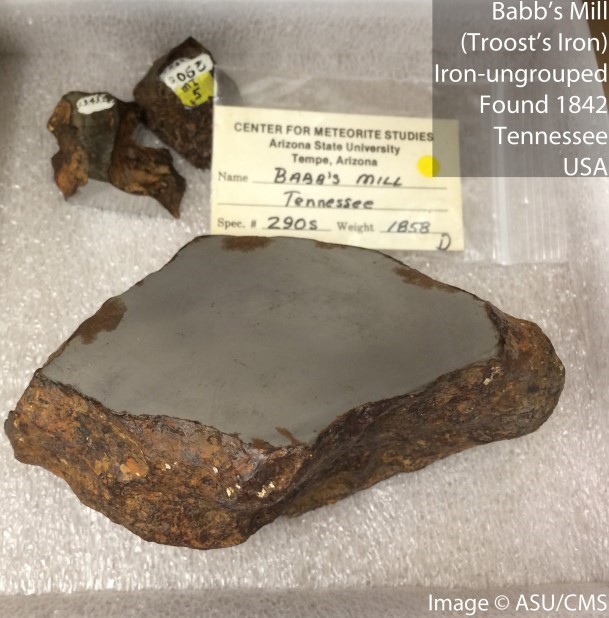
Babb's Mill (Troost's) iron is classified as an ungrouped nickel-rich (17.5%) ataxite. Although the 6 kg mass has been artificially heated, the 2.7 kg mass is undamaged. According to the 'Handbook of Iron Meteorites' (V. Buchwald, vol. 2, p. 286; photo), a 1.857 kg section from the 2.7 kg mass was included as part of the Shepard collection sold to Amherst College, Massachusetts. The 1.857 kg section was subsequently acquired by the Buseck Center for Meteorite Studies, Arizona State University in Tempe (see photo below).
Interestingly, another iron mass weighing 135 kg was plowed up in near proximity to the previous iron and described by W.P. Blake in 1886. However, it was subsequently determined that the two Babb's Mill ungrouped ataxite irons were unrelated, and they were given separate names of Babb's Mill (Troost's Iron) and Babb's Mill (Blake's Iron).
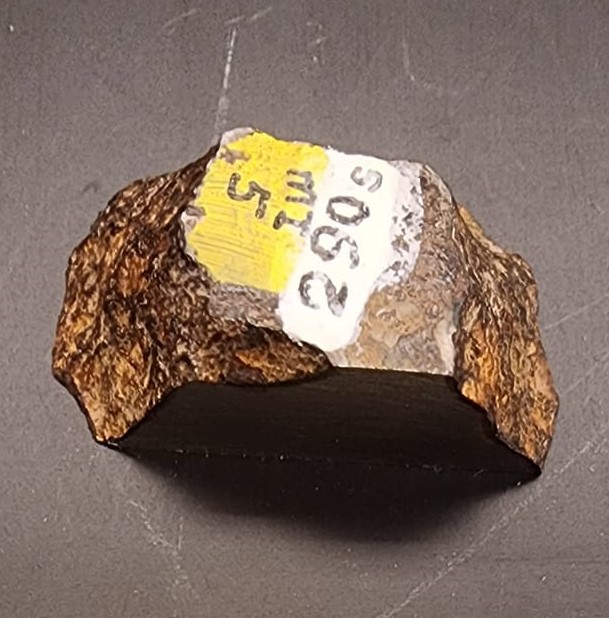
The South Byron iron is grouped with Babb's Mill (Troost's) and Inland Forts (ILD) 83500, and the grouplet of three irons is termed the South Byron Trio (SBT). More in-depth information regarding the SBT irons can be found on the South Byron page. The photo shown above is a 60.7 g cut section with a C.U. Shepard number applied in yellow paint (also shown in the ASU photo below). This sample was deaccessioned in a trade with M. Lyon and is currently in the D. Weir Collection.