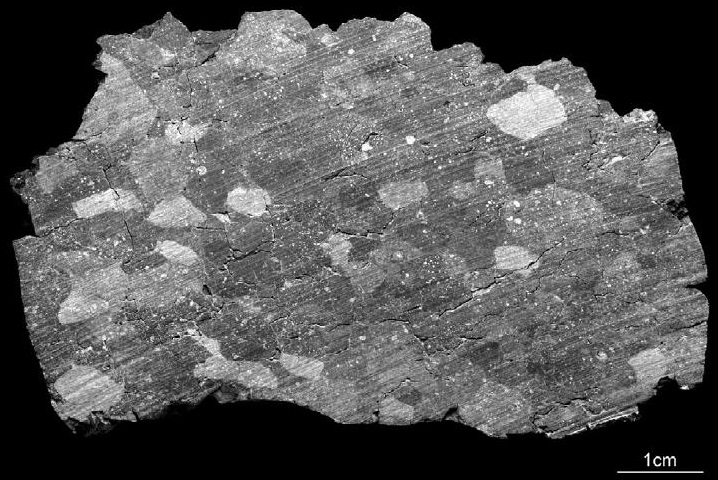
Images credit: Verdier-Paoletti et al., 80th MetSoc, #6081 (2017)
and Verdier-Paoletti et al., MAPS, vol. 54, #8 (2019)
Fujiya et al. (2016), Verdier-Paoletti et al. (2017), and Vacher et al. (2018) conducted O- and C-isotope analyses on Ca-carbonates in the CM2 chondrites Nogoyo and/or Boriskino. It was ascertained that low-temperature (~110°C) aqueous alteration processes occurred over an extended time period and precipitated Ca-carbonates of two different types: an earlier Type 1a population consisting of 16O-poor calcite grains, and a more altered Type 2a population consisting of 16O-rich calcite grains derived from an 16O-rich fluid (see top diagram below). Vacher et al. (2018) determined that the Type 2a calcite grains in Boriskino are variably enriched in 13C. It is considered likely that the parent fluid of the Type 2a calcite grains experienced a ~15–50% loss of 13C-poor carbon through its dissolution in methane and subsequent degassing, perhaps during an impact event. This resulted in the wide C-isotope range observed in the Boriskino calcites (see bottom diagram below).
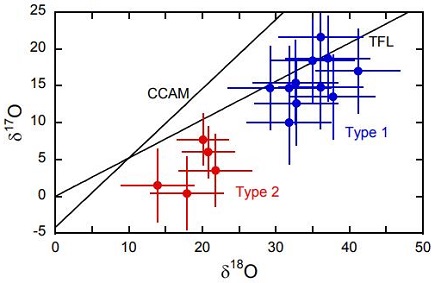
O- and C-isotopic values of Type 1 and 2 calcite grains in CM2 Boriskino

Diagram credit: Vacher et al., 81st MetSoc, #6004 (2018)
Similar to other CM chondrites, a presolar nanodiamond phase is present in Boriskino that contains the noble gases Xe and Ar, which were implanted at various energies corresponding to different interstellar events. A new noble gas component with intermediate characteristics has recently been identified in nanodiamond fractions from Boriskino (Fisenko et al., 2002).
Current studies suggest that both cometary dust and meteorites should be produced from the disruption of Jupiter-family comets which originate in the Kuiper belt. Studies have shown that Antarctic micrometeorites have a similar carbonaceous chondrite:ordinary chondrite ratio (~7:1) as the composition of zodiacal dust (M.M.M. Meier, 2014). Based on observational evidence and current modeling, it is thought that comets should be dark in color and have a low density and strength, a high porosity, a solar ratio of elements, an elevated ratio of C, H, O, and N, a high interstellar grain content, anhydrous and highly unequilibrated silicates, few to no chondrules, and a low cosmic-ray exposure age (<10 m.y.). Meteorites from both the CI and CM groups exhibit characteristics that are consistent with the above descriptions.
Orbital data obtained from several carbonaceous chondrites (e.g., CI Orgueil [eyewitness plotting]; CMs Maribo and Sutter's Mill [instrument recording]) are a good match to the orbits expected from the disruption of Jupiter-family comets, but are unlike the orbits of ordinary chondrites and most other asteroidal objects (M.M.M. Meier, 2014). Both the orbital eccentricity and the semimajor axis of Maribo are nearly identical to those of Comet Encke and the associated Taurid swarm of objects (Haack et al., 2011). On the other hand, a CRE age study of CM chondrites conducted by Meier et al. (2016) shows that a possible relationship exists to the asteroid breakup event ~8.3 m.y. ago which formed the Ch/C/Cg-type members of the Veritas family. In addition to the large abundance of 3He-enriched interplanetary dust discovered in 8.2 m.y.-old deep-sea drill cores, ~1/6 of all CM meteorites have 21Ne-based CRE ages that are consistent with derivation from this catastrophic breakup, while others with significantly younger CRE ages could represent secondary collisions among the Veritas fragments.
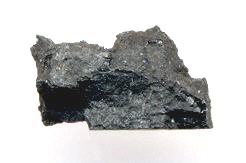
The main mass of Boroskino is curated at the Academy of Sciences in Moscow, while no more than 3.8 g is kept at other institutions (Macke et al., 2011). The photo above shows the interior of a 0.146 g fragment of Boriskino.