Iron, IID, octahedrite
Found 1923
29° 40' N., 111° 30' W.
A mass of 450 kg was found by cowboys on the Alamo Ranch, which is a station on the Southern Pacific Railroad located 40 miles W of Carbo, Mexico. This meteorite was sold to Harvard in 1928, with further distribution of many sections thereafter. Carbo is a low-Ni member of the IID group. The silicate cristobalite has been identified in Carbo.
Kruijer et al. (2012, 2014) conducted age studies utilizing noble gas and Hf–W chronometry for those irons that have the lowest CRE ages. Their data indicate core formation began for group IID and IVB irons ~2.0–3.0 m.y. after CAIs, which is later than for other groups. This is compared to ~1.5–2.0 m.y. after CAIs for groups IIIAB and IVA, and as early as ~1.0–1.5 m.y. after CAIs for groups IIAB and IIIAB. Using this Hf–W data along with metallographic cooling rates, Kaminski et al. (2020) estimated the size of the IID parent body to be 470 (±130) km in diameter.
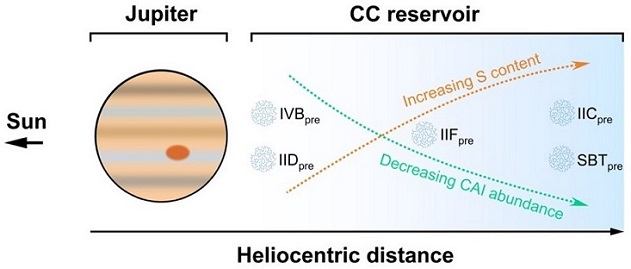
Zhang et al. (2022) used fractional crystallization modeling to determine that the initial bulk composition of the IID metallic core contained 0.5 (±0.5) wt% S and 1.9 (±0.1) wt% P. In addition, they established that the IID group members represent ≤84% crystallization of the parental core liquid. It is proposed by Zhang et al. (2022) that the compositional trends of the parent bodies of the early-formed CC irons, and those of the comparatively later-formed CC chondrites, were in large part established by an aerodynamic size-sorting process associated with a pressure bump (or gravitational instability such as the streaming instability; Simon et al., 2021 and references therein) sustained by a rapidly growing Jupiter. The coarser particles, including CAIs containing refractory metal nuggets with high abundances of HSE, were concentrated in the high-pressure region nearest to Jupiter, while the finer particles, including matrix material containing volatiles such as S, occupied the radial space progressively outward from Jupiter (see diagram below). For the CC irons there is an anticorrelation between the HSE abundances and the S concentrations. The composition of the CC planetesimals at any given heliocentric distance corresponds to the S/HSE ratio of the precursor size-sorted particles, and informs of their accretion location. As shown by Zhang et al. (2022), a similar systematic ordering by component size is observed for the CC chondrites, which are thought to have orbits located outward from Jupiter in the sequence CO ⇒ CV ⇒ CM ⇒ CI; similarly, they show a corresponding increase in their S/HSE ratios with distance. Based on the S/HSE ratios of the earliest CC planetesimals, now represented only by their iron cores (or fragments of local metal ponds; Kaminski et al., 2020), the IVB and IID parent bodies would have contained ~20 vol% CAIs.
Composition and Spatial Arrangement of CC-iron Precursors
Diagram credit: Zhang et al., Science Advances, vol. 8, #37, (2022, open accesslink)
'Compositions of carbonaceous-type asteroidal cores in the early solar system'
(https://doi.org/10.1126/sciadv.abo5781)
In a subsequent study by Zhang et al. (2024), including additional iron meteorites now representing all magmatic iron-meteorite groups, they used an improved modeling procedure (normalized to Co and to CI chondrites) to calculate HSE abundances, and then utilized this data (especially S and P concentrations) to estimate the CAI abundances in the precursor materials of iron-meteorite parent bodies. With this information, the relative formation locations of these parent bodies within the protoplanetary disk were ascertained (see diagram below). The S concentration was found to be related to the timing of parent body differentiation, with the lowest(highest) S concentrations being correlated to the latest(earliest) core–mantle differentiation.
Composition and Spatial Arrangement of Magmatic iron Precursors
Diagram credit: Zhang et al., PNAS, vol. 121, #23 (2024, open accesslink)
'Compositions of iron-meteorite parent bodies constrain the structure of the protoplanetary disk'
(https://doi.org/10.1073/pnas.2306995121)
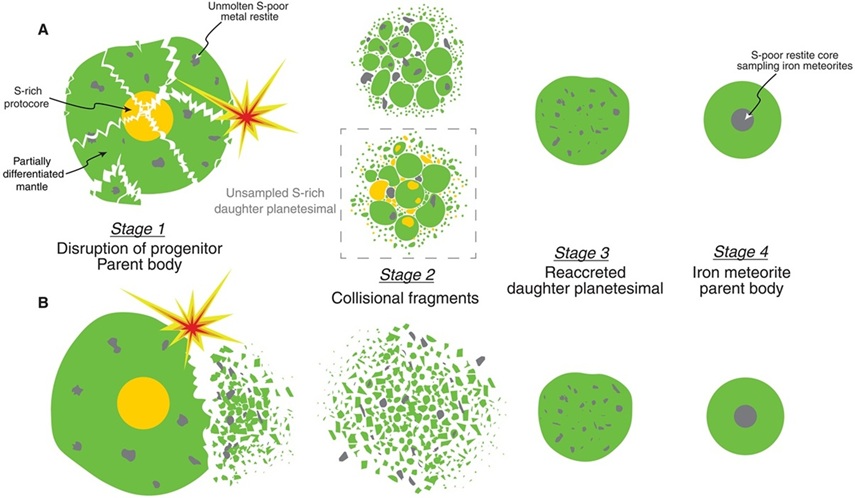
An alternate scenario was proposed by Grewal et al. (2025), in which early (~1–2.5 m.y. after CAIs) collisional shattering of the partially differentiated IID, IIF, IIIF, and IVB iron meteorite progenitor bodies occurred. This was followed soon thereafter by reassembly into respective daughter planetesimals, without inclusion of the S-rich protocore material, whereby each daughter body subsequently formed a second-generation S-poor core from which our meteorites ultimately derive (see schematic illustration below). Their scenario allows to make a reasonable comparison of the initial S content among these four CC iron meteorite groups to that of other groups, and disassociates HSE abundances of the iron meteorite parent bodies from their precursor CAI content.
Proposed Two-Stage Formation of IID, IIF, IIIF, and IVB Iron Meteorites
A. high-energy impact; B. hit-and-run collision
click on image for a magnified view
Schematic illustration credit: Grewal et al., Science Advances, vol. 11, #40, fig. 2 (2025, open accesslink)
'Protracted core formation and impact disruptions shaped the earliest outer Solar System planetesimals'
(https://doi.org/10.1126/sciadv.adw1668)
Noble gas studies by Ammon et al. (2008) have revealed details about the pre-atmospheric measurements of the Carbo meteoroid, the in situ geometry of Carbo, and its CRE age. Utilizing noble gas concentration data corrected for cosmogenic Ne production contributions from sulfide and phosphate inclusions, a depth profile was developed for Carbo which translates into a pre-atmospheric meteoroid that was generally spherical in shape. Through measurements of the activity of the radionuclide 36Cl, a diameter of 140 cm was inferred for the Carbo meteoroid. Using this more accurate corrected data, the team derived a 41K–40K-based CRE age for Carbo of 725 (±100) m.y.
From studies of the 3He distribution in Carbo, it was inferred that at least 5 cm of metal has been removed during atmospheric entry and subsequent terrestrial weathering. The 3He distribution was also utilized in a study by Markowski et al. (2006) to determine the initial tungsten isotopic systematics for Carbo and other irons, which revealed that some iron meteorites formed contemporaneously with CAIs within 1 m.y. of the coalescence of the Solar System.
Further details about the petrogenesis of the group-IID irons as proposed by Wasson and Huber (2006) can be found here. The specimen of Carbo pictured above is a 22.5 g deep-etched partial slice. An exquisite etched slice can be seen on display at the Smithsonian Institution, Washington D.C.