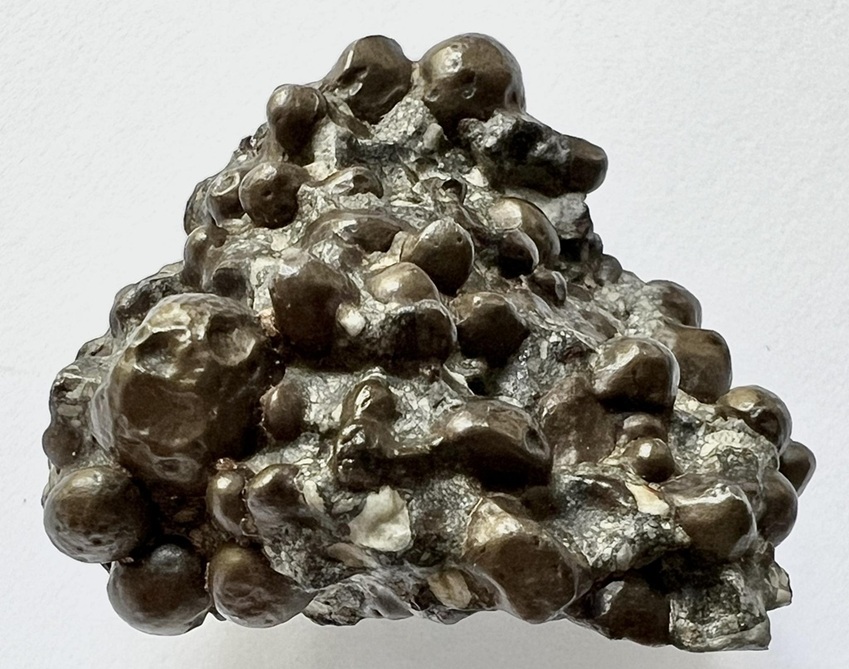
Numerous moderately weathered intact masses along with detached individual metal globules (photo courtesy of Mohamed Ali Loud) were found by meteorite hunters in Gao, Mali, and subsequently distributed to buyers in the collector community. Nearly half of the total mass of 1,457 g was acquired by J. Collins, who submitted a type specimen for classification to the Museum für Naturkunde, Humboldt University, Berlin (A. Greshake). Denader 004 was determined to be related to the becubbinite group of metal-rich carbonaceous chondrites; however, due to the unique nature of the components constituting this meteorite, the classification was published as 'CB' with no specific subgroup designation.
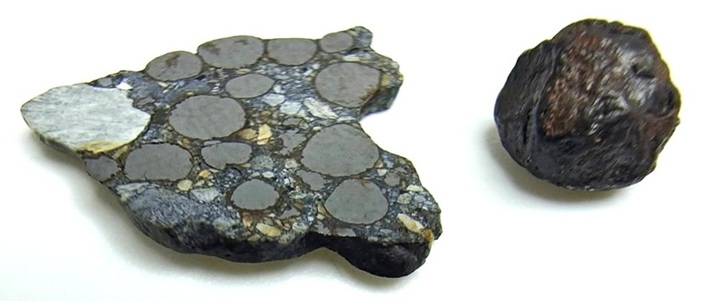
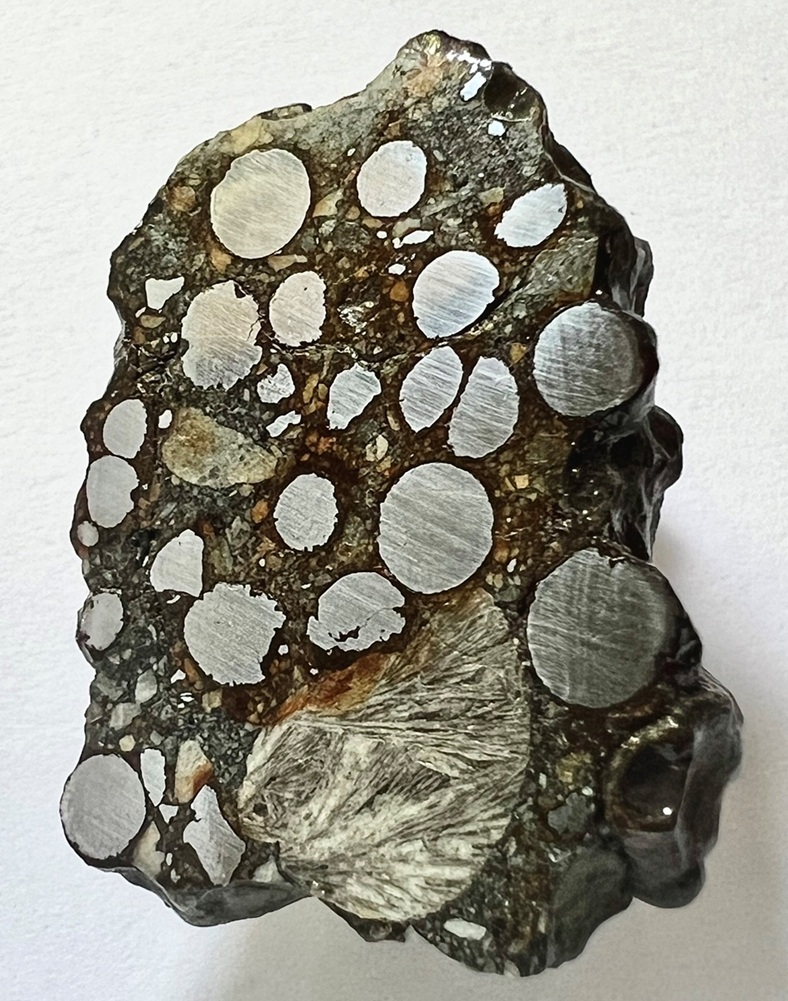
FeNi-metal globules (2.5 [±1.3] mm) constitute ~40 vol% of this bencubbinite, while the remainder is composed of silicates in the form of chondrules (up to 4 mm in size) and chondrule fragments embedded in a fine-grained comminuted mineral matrix consisting of Cr-bearing spinel, magnetite, troilite, kamacite, taenite, and schreibersite. Rare macrochondrules measuring in the cm range are also present (see a Denader 004 macrochondrule, courtesy of Craig Zlimen).
The CB, CH, and CR chondrites constitute the CR clan, comprising groups which likely formed in the same isotopic reservoir in the solar nebula. The best current evidence supports an origin for these late-formed metal-rich carbonaceous chondrites in an impact plume generated by a collision between planetary embryos (Krot et al., 2009). Following condensation of the various components, they were aerodynamically sorted according to their velocity, size, and density as they spread out into the nebular gas in a typical fan-shaped pattern. It was calculated by Morris et al. (2012) that in ~1% of the impacts the host planetesimal would travel in the direction of the impact plume, sweeping up some of the aerodynamically sorted ejecta within a short time period measured in weeks. They reasoned that this re-accreted material would have been mixed with existing crustal components to form a layer many meters thick. Stewart et al. (2019 #1251 and references cited therein) asserts that the melt droplet size-sorting process occurs in a collapsing vapor plume and is a function of the particle's ability to couple to the nebular gas, which is primarily controlled by the density of the gas. Based on precise I–Xe and U–Pb systematics, the chondrules in Gujba (CBa) and those in HaH 237 (CBb) were found to have formed simultaneously ~4.5621 b.y. ago (Pravdivtseva et al., 2016). See the HaH 237 page for a more detailed scenario of the CB group formation process ascertained by Fedkin et al. (2015) through kinetic condensation modeling.
The Denader 004 slice plus metal chondrule pictured above weigh together 2.21 g. The meteorite exhibits the typical features of this unique CB chondrite as demonstrated in a photo of multiple slices, shown courtesy of Mohamed Ali Loud. Two excellent high-resolution photos of Denader 004 are shown below, courtesy of Dr. Ansgar Greshake.
click on photos for a magnified view
Photos courtesy of Dr. Ansgar Greshake—Museum für Naturkunde, Humboldt University, Berlin