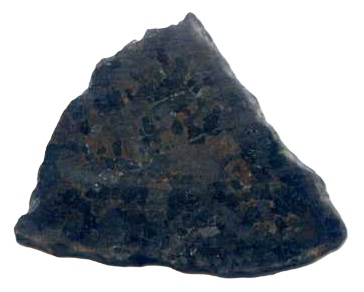
Ureilite
Monomict/Unbrecciated/Main Group
Olivine–augite (Hughes-type)
Found 17 Nov 2022
27° 18' 17" N., 33° 35' 11" E.
A single moderately weathered and shocked (U–4, ~15 GPa; Stöffler et al., 2018) stone meteorite weighing 75.23 g was found in the desert region 27.4 km northeast of Hurghada, Egypt. A type sample was sent for analysis and classification to the Appalachian State University in Boone, North Carolina (A. Love), and Hurghada 001 was determined to be a ureilite with similarities to the rare Hughes type.
Hurghada 001 consists of mm-sized olivines along with both low Ca and high Ca pyroxene, some with grain boundaries that form 120° triple junctions. These grains are separated by mostly oxidized metal-rich veins, but no interstitial graphite was identified. Also present are rare FeNi grains, rare feldspathic glass, troilite, and schreibersite. Mineral grains show indications of a high degree of shock including planar deformation features, mechanical twinning, exsolution lamellae, and melt inclusions. These features are consistent with peak shock pressures of at least 10–15 GPa (Stöffler et al., 1991; Rubin et al., 1997).
The olivine–augite type of ureilites comprises less than ~10% of the known ureilites. A third type, the olivine–orthopyroxene ureilites, has been identified in the ureilite classification scheme proposed by Goodrich et al. (2006). The olivine–augite ureilites formed as cumulates rather than residues, in late-stage, highly refractory melt pools. They crystallized at a range of depths in close association with the much more common olivine–pigeonite ureilites. The olivine–pigeonite type of ureilites, which exhibit the typical texture of residues of low degree fractional melts, constitute ~90% of the known ureilites. Two transitional members are also known, RKPA80239 and PCA 82506, which have textures that are intermediate between the typical and poikilitic groups. Ureilites in the small augite- and orthopyroxene-bearing subgroups were found to contain primary trapped melt inclusions, demonstrating a complex magmatic history (Goodrich et al., 2000).
The ureilites of the olivine–augite type define a broad range of Δ17O values, consistent with their formation at varied depths on the parent body. This subgroup of ureilites comprises a relatively small number of samples, including the following (after Goodrich et al., 2022):
1. 'Hughes group'
a. Archetypal Hughes-type samples
Hughes 009
FRO 90054/93008
FRO 90228
NWA 3222 (37–41 vol% augite)
NWA 11754
AhS clast #15 MS-MU-012
b. Other Hughes-type samples
EET 96293/96314/96331
NWA 2895
MIL 091004
Calama 001
EET 87720 clast Gr23
Hurghada 001
2. Other augite-bearing ureilites
HaH 064
ALH 82106/82130/84136
EET 87511/87523/87717
EET 87517
META78008
LEW 88774
LEW 85440/88012/88201/88281
Y-74130
Ramlat as Sahmah 530
NWA 11900
DaG 999 (single aug-bearing clast)
Y-74123 (aug within melt veins)
Y-790981 (aug within melt veins)
A cohesive model for the petrogenesis of the ureilites was presented by Goodrich et al., LPSC XXXIII, #1379 (2002), which was followed by important modifications in subsequent publications (e.g., Goodrich et al., 2007, 2022), some details of which can be found on the Kenna and Almahata Sitta pages. The specimen of Hurghada 001 shown above is a 2 g slice kindly contributed to the DWeir Collection by Fabien Kuntz.