Angrite
Quenched, Picritic
(Primitive melts "Group 1")
Purchased June 2019
no coordinates recorded
A relatively fresh 454 g stone was acquired from a Mauritanian dealer by R. and J. Chaoui and subsequently sold to M. Jost and K. Wimmer at the Ensisheim Show. A sample of the meteorite was analyzed at the University of Washington in Seattle (A. Irving) and at Washington University in St. Louis (P. Carpenter), and NWA 12774 was classified as a quenched, olivine-phyric angrite.
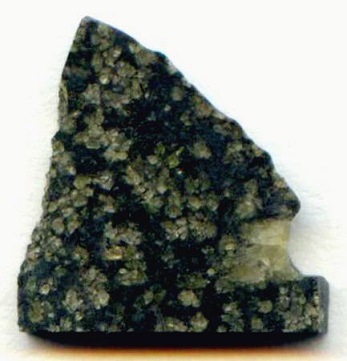
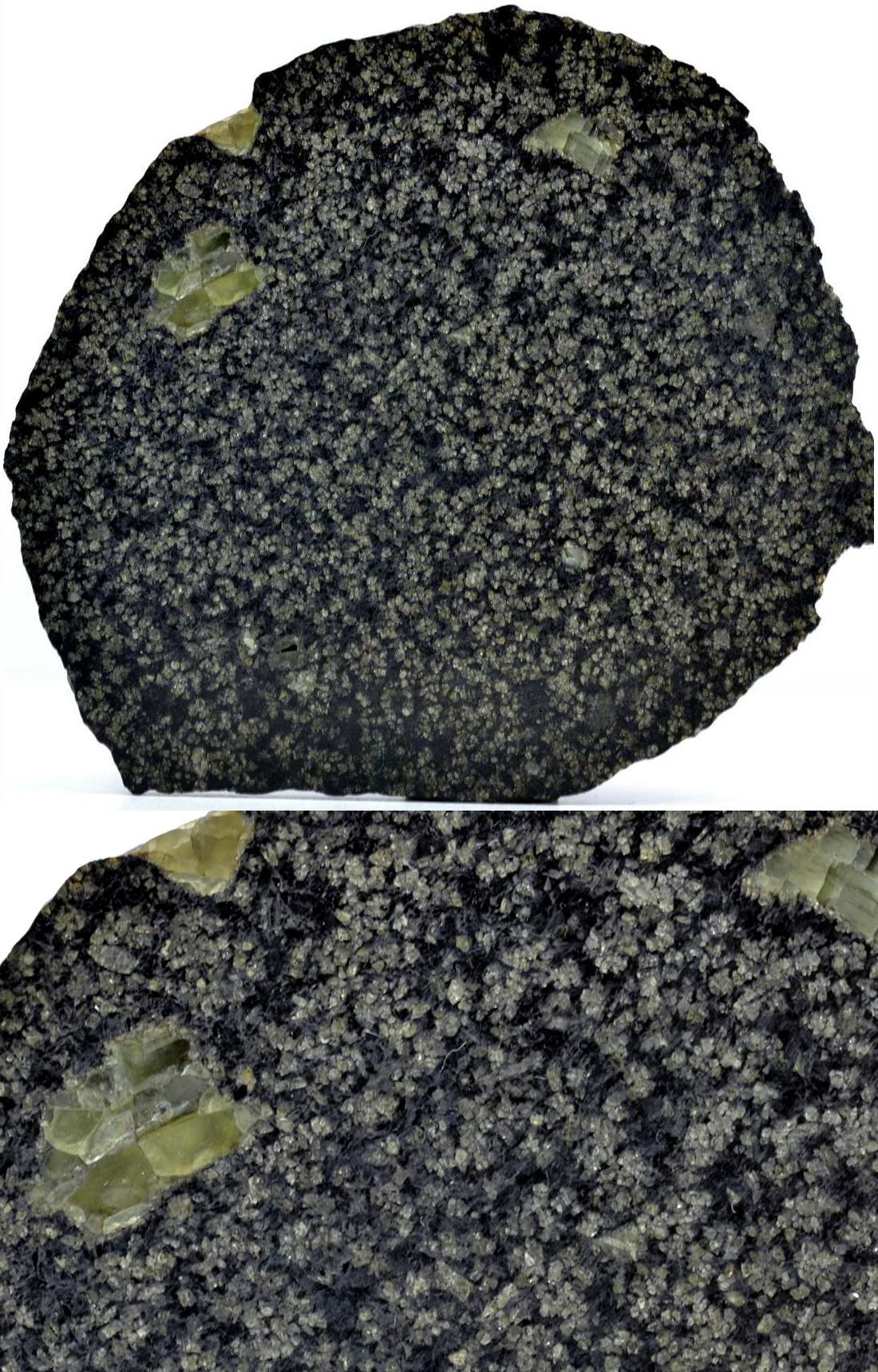
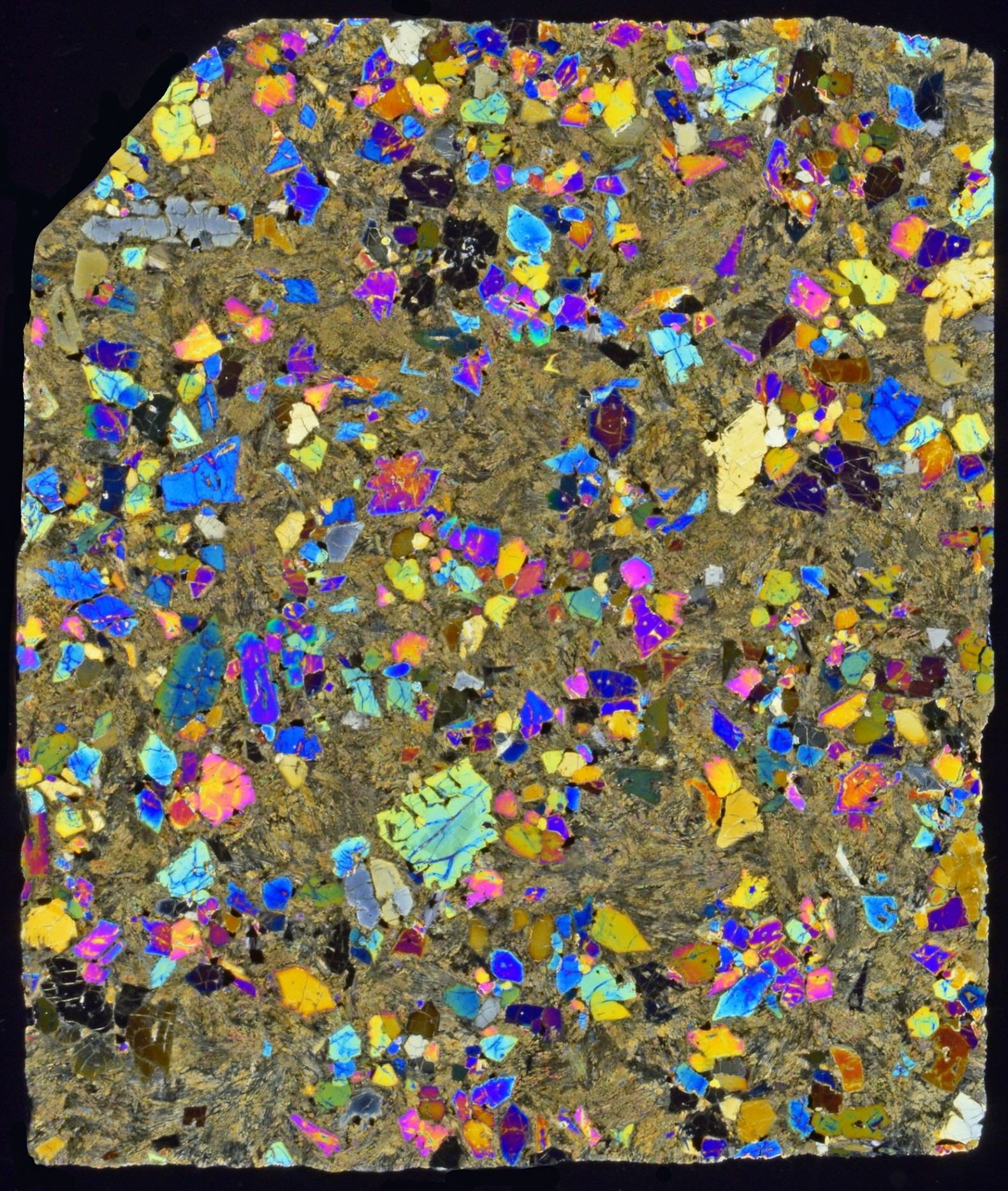
The meteorite has a porphyritic texture composed of compositionally-zoned, skeletal calcic olivine phenocrysts and high-Al (up to 18 wt%), Ti-bearing augite phenocrysts arrayed in a black, quenched groundmass (Hayashi et al., 2020, #2360). The groundmass is very fine-grained and consists of nearly pure anorthite (An>99.5), olivine, kirschsteinite, and Al–Ti augite, along with minor troilite and ulvöspinel and rare kamacite. Some larger olivine clusters (~3 mm) with more magnesian compositions (up to Fo92) are considered to be xenocrysts. As determined by Raman Spectroscopy, the silicate phenocrysts contain various tiny opaque inclusions such as Ti-bearing magnetite/spinel, pyrrhotite, kamacite, carbon phases, and silico-phosphate (Hoffmann et al., 2020, #2323).
A limited number of unique angrites are represented in our collections today which can be grouped as hypabyssal-/diabasic-intrusive, quenched volcanic, intermediate, plutonic-cumulate, or impact-melt rock. The quenched angrite NWA 7203 (photo courtesy of Labenne Meteorites) exhibits a striking variolitic texture. Portions of the angrite asteroid must be in a stable orbit (planetary or asteroid belt) from which spallation has occurred continuously over the past ~56 m.y. as indicated by the broad range in angrite CRE ages.
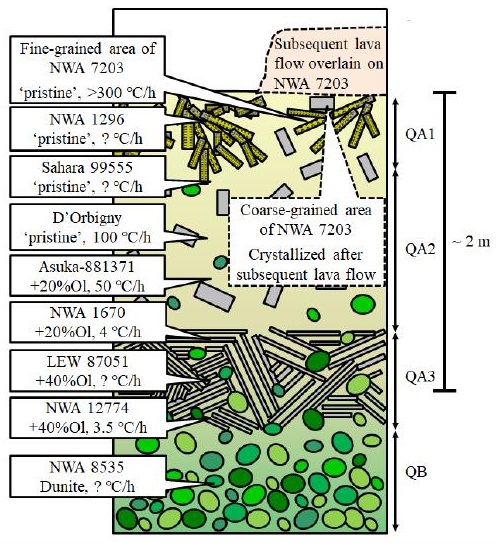
Northwest Africa 12774 has a similar texture and bulk composition to the 46.2 g NWA 7812, but mineralogical details are inconsistent with a fall pairing (Irving et al., 2020, #2399). Additionally, a petrographic comparison between NWA 12774, NWA 1670, and LEW 87051 shows that they are all closely related, but the differences that do exist suggest none are fall paired (Hayashi et al., 2020). The Fe–Mg diffusion profile for NWA 12774 was utilized by Hayashi et al. (2020) to calculate a cooling rate of 3.5°C/hr (1400°C to 900°C), which is nearly the same as 3°C/hr (1400°C to 900°C) calculated for NWA 1670 by Hayashi and Mikouchi (NIPR 2019). By contrast, they calculated a two-stage cooling rate for the quenched angrite NWA 7203; first a rapid cooling of 20°C/hr (variolitic texture), and thereafter ~1°C/hr (dendritic texture) possibly due to deeper burial by subsequent lava flows. Hayashi et al. (NIPR 2020) postulated that the quenched angrites may represent a single igneous unit in which the compositional trend is related to the volume of olivine xenocrysts incorporated in the original melt. The schematic illustration below shows a possible stratigraphic relationship for the quenched angrites in which variable cooling rates produced different textures analogous to a komatiite igneous unit.
click on photo for a magnified view
Schematic illustration credit: Hayashi and Mikouchi, 53rd LPSC, #2601 (2021)
It is commonly considered that the group of quench-textured angrites were formed by rapid cooling through either volcanism or as a shallow magmatic intrusion. Previously, high-precision oxygen isotope analyses were conducted by Rider-Stokes et al. (2021 #6071) for a suite of nine angrites, which led them to revise the mean Δ17O value and redefine the angrite fractionation line at –0.064 (±0.018) ‰ (excluding NWA 12320 with an anomalously high Δ17O value). Following that study, Rider-Stokes et al. (2022 #1420, #6101; 2023) conducted separate oxygen isotope analyses for the unmelted relict olivine grains and the host matrix in each of the quenched angrites, NWA 12320, A-12209, and A-881371. They discovered that a disparity exists in the Δ17O between these two components, which present values of –0.066 (±0.016) ‰ and –0.003 (±0.020) ‰, respectively. They reasoned that the difference in values was caused by an impact event which incorporated projectile material with a positive Δ17O value into angrite material with a negative Δ17O value, thus producing the quenched angrites as impact-melt rocks. The high bulk rock Δ17O value of NWA 12320 (uppermost black dot in diagram below) is due to its low abundance of relict angritic olivine grains compared to the other quenched angrites in the study. Further evidence for such an impact event was revealed in the relict olivine grains which exhibit two different textural types: one that retains its primary unaltered crystallization texture, and another that exhibits a granular recrystallized texture which attests to a post-crystallization heating event.
Diagram credit: Rider-Stokes et al., 53rd LPSC, #1420 (2022)
'Mixing in the early Solar System as evidenced by the quenched angrite meteorites'
To address the origin of the impactor that Rider-Stokes et al. (2022 #1420, #6101; 2023) have suggested contaminated the surface matrix component of the quenched angrites, Zhu et al. (2025 #5248, 2026) conducted Cr-isotopic analyses for the olivine and matrix components in the quenched angrites A-12209 and A-881371, as well as for the olivines in the dunitic angrite NWA 8535. They also conducted bulk Cr-isotopic analyses for NWA 8535 and the plutonic angrites NWA 14758 (possible igneous cumulate) and Rafsa 005 (metal-rich, paired with NWA 2999). They found that the olivines in each of these angrites have similar average ε54Cr values of –0.40 (± 0.03), and that they are also similar to values obtained from the literature; however, the ε54Cr values for the A-12209 and A-881371 matrix components are significantly higher at –0.15 (± 0.08) and 0.27 (± 0.06), respectively. Given that this isotopic disparity reflects impact-mixing on the angrite parent body, Zhu et al. (2025 #5248, 2025, 2026) employed a binary mixing model using the mean of the Δ17O and ε54Cr values obtained for matrix samples derived from A-12209 and A-881371. Results of this modeling are best exemplified by the incorporation of 6.29 (±1.97) % CI1T material into the APB surface, accompanied by a devolatilization process (see their Fig. 3). Zhu and Yokoyama (2025 #5206) revealed evidence of impact-heating and dehydration on the CI1T parent body, which can be observed in the corresponding changes to the normal release pattern for ε54Cr in sequential meteorite fractions, as shown in their Fig. 1 (Y-86029 = CY1). Zhu et al. (2026) suggest that the lack of any volatile enrichment on the surface of the angrite parent body by a CI-like projectile is likely due to loss through evaporation in the aftermath of a high-energy impact event. In a similar context, they posit that the impact heating transformed portions of the CI-like projectile into CI1T material.
In addition, utilizing Mn–Cr chronometry and the acquired angrite Cr data (excluding that for the contaminated quenched angrites), Zhu et al. (2025 #5248) dated the APB mantle melting event to an absolute age of 4.5610 (±0.0009) b.y. when anchored to D'Orbigny, which corresponds to 6–7 m.y. after CAIs. Zhu et al. (2026 #5037) determined that a revision of the differentiation age for angrites was necessary due to CI chondrite contamination affecting the accuracy of the Mn–Cr chronometer; i.e., skewing the isochron to a younger age. Instead, they utilized the more appropriate Al–Mg chronometer to obtain a new isochron age for olivines of 0.16 (±0.07) m.y. after Solar System formation, which likely dates the initial onset of parent body differentiation. In contrast, they posit that a bulk angrite Al–Mg absolute age (anchored to D'Orbigny) of 4.5644 (±0.0005) b.y. probably dates a subsequent crust–mantle re-differentiation following a significant impact event.
U–Pb age dating was conducted on NWA 12774 by Amelin et al. (2026 #5279) employing precise 238U/235U values. However, because these values vary slightly between the untreated bulk rock measurement and that of the acid-soluble and the insoluble minerals, the resulting Pb–Pb isochron ages span a range from the oldest to the youngest of 4.56414 (±0.00039) b.y. to 4.56271 (±0.00025) b.y., respectively. In a corroborative study, data-driven thermal evolution models informed Neumann et al. (2026 #5058) about several parameters of the angrite parent body, including its accretion timing and its size. Best-fit criteria indicate a very early APB accretion dated at ~0.6–0.8 m.y. after CAIs, reaching a size of at least 200 km in diameter, but possibly becoming a very large Moon-to-Mars-sized body. The best-fit depths for the angrites in their study, from the shallowest to the deepest, are NWA 1670 at ~2.3 km (cooling at ~80 K/m.y.), Angra Dos Reis and LEW 86010 at ~9.5 km (cooling at ~50 K/m.y.), and NWA 8535 at ~19 km (cooling at ~10 K/m.y.).
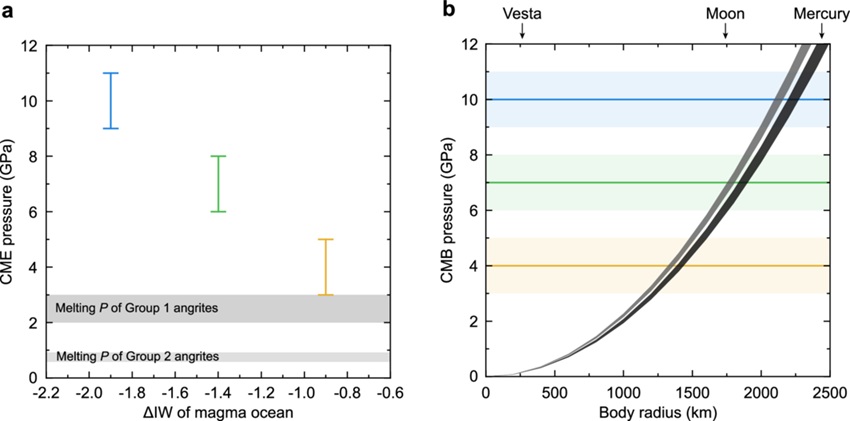
U–Pb age dating was conducted on NWA 12774 by Amelin et al. (2026 #5279) employing precise 238U/235U values. However, because these values vary slightly between the untreated bulk rock measurement and that of the acid-soluble and the insoluble minerals, the resulting Pb–Pb isochron ages span a range from the oldest to the youngest of 4.56414 (±0.00039) b.y. to 4.56271 (±0.00025) b.y., respectively. In a corroborative study, data-driven thermal evolution models informed Neumann et al. (2026 #5058) about several parameters of the angrite parent body, including its accretion timing and its size. Best-fit criteria indicate a very early APB accretion dated at ~0.6–0.8 m.y. after CAIs, reaching a size of at least 200 km in diameter, but possibly becoming a very large Moon-to-Mars-sized body. The best-fit depths for the angrites in their study, from the shallowest to the deepest, are NWA 1670 at ~2.3 km (cooling at ~80 K/m.y.), Angra Dos Reis and LEW 86010 at ~9.5 km (cooling at ~50 K/m.y.), and NWA 8535 at ~19 km (cooling at ~10 K/m.y.). A concordant study utilizing thermodynamic data together with a new angrite clinopyroxene-liquid geobarometer led Bell et al. (2026) to estimate the crystallization pressure of NWA 12774 to be >17 kbar, consistent with an APB diameter of at least 2,000 km and possibly a Moon-scale protoplanet. Likewise, Kuwahara et al. (2026) calculated a size for the APB based on a model for its redox state involving internal magma self-oxidation and fractional crystallization. The proposed change in redox state from the primitive reduced Group 1 angrites to the evolved oxidized Group 2 angrites requires commensurate high pressures consistent with a parent body potentially as large as, or even larger than the Moon (see their Fig. 5 below).
Size of the APB as a Function of Both the Redox State and CMB Pressure
CME = core-mantle equilibration; CMB = core-mantle boundary
click on diagram for a magnified view
Diagram credit: Kuwahara et al., The Planetary Science Journal, vol. 7, #8, p. 9, fig. 5 (2026, open accesslink)
'Constraints on Magma Self-oxidation in Angrites and the Role of Parent-body Size'
(https://doi.org/10.3847/PSJ/ae8ba4)
The photo of NWA 12774 shown above is a 0.32 g part slice, while the top photo below is an impressive 17.196 g full slice of this visually striking angrite, shown courtesy of Tom Stalder. The bottom photo is an excellent petrographic thin section micrograph of NWA 12774 shown courtesy of Peter Marmet.
click on photo for a magnified view
Photo courtesy of Tom Stalder—Sahara Gems
click on photo for a magnified view
Photo courtesy of Peter Marmet