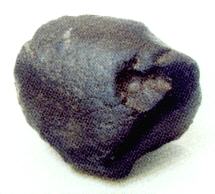
Angrite
Quenched
(Evolved melts "Group 2")
Found spring 2001
no coordinates recorded
A single 810 g stone was found in the Moroccan Sahara and subsequently sold to a dealer in Bouarfa, Morocco. The dark-gray, shiny fusion crust is very thin but well-preserved, suggesting a relatively recent fall. Northwest Africa 1296 was analyzed at multiple laboratories in France (Université d'Angers and Université Pierre & Marie Curie) and determined to be a member of the rare angrite group (Jambon et al., 2002).
An account of the mineralogy and petrology of NWA 1296 was published by Jambon et al. (2005). The major minerals in NWA 1296 include anorthitic plagioclase (32 vol%), strongly zoned grains of the clinopyroxene Al,Ti–diopside-hedenbergite, formerly known as fassaite (34 vol%), strongly zoned Ca-rich olivine (28 vol%), and kirschsteinite (3 vol%)—a characteristic mineral present in most angrites. Other minor constituents include pyrrhotite, F-bearing apatite, ulvöspinel, and possibly Ca silico-apatite similar to that found in D'Orbigny, Sah 99555, NWA 4590, and Asuka 881371. Calcium enrichment is a common feature of this group. Trace element and REE data for NWA 1296 are similar to that for the other quenched angrites, indicating a common magmatic origin (Sanborn and Wadhwa, 2010). The average Pb–Pb date of 4.56420 (±0.00045) b.y. for NWA 1296 provides a minimum estimate for its crystallization age, which is also consistent with the ages derived for D'Orbigny and Sahara 99555 (Amelin and Irving, 2011).
Zhu et al. (2026 #5037) determined that a revision of the differentiation age for angrites was necessary due to CI chondrite contamination affecting the accuracy of the Mn–Cr chronometer; i.e., skewing the isochron to a younger age. Instead, they utilized the more appropriate Al–Mg chronometer to obtain a new isochron age for olivines of 0.16 (±0.07) m.y. after Solar System formation, which likely dates the initial onset of parent body differentiation. In contrast, they posit that a bulk angrite Al–Mg absolute age (anchored to D'Orbigny) of 4.5644 (±0.0005) b.y. probably dates a subsequent crust–mantle re-differentiation following a significant impact event.
In a corroborative study, data-driven thermal evolution models informed Neumann et al. (2026 #5058) about several parameters of the angrite parent body, including its accretion timing and its size. Best-fit criteria indicate a very early APB accretion dated at ~0.6–0.8 m.y. after CAIs, reaching a size of at least 200 km in diameter, but possibly becoming a very large Moon-to-Mars-sized body. The best-fit depths for the angrites in their study, from the shallowest to the deepest, are NWA 1670 at ~2.3 km (cooling at ~80 K/m.y.), Angra Dos Reis and LEW 86010 at ~9.5 km (cooling at ~50 K/m.y.), and NWA 8535 at ~19 km (cooling at ~10 K/m.y.).
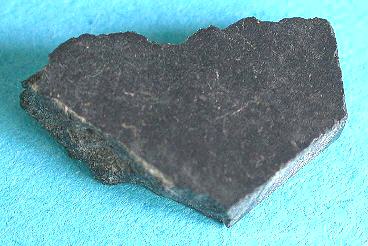
Although it has a mineralogy that is typical of the angrite group, this angrite exhibits a very fine-grained texture that is different from the other angrites, one which is consistent with rapid quenching (see texture comparison photos). Northwest Africa 1296 consists of µm-sized, branched olivine crystals that form the cores of mineral chains, with anorthite crystals associated with these olivines. These chains are incorporated into later crystallizing clinopyroxene crystals. Other polycrystalline olivines, associated with kirschsteinite, formed outside of the mineral chains as the crystallization sequence culminated with clinopyroxene and accessory phases such as the opaques. Some pyrrhotite globules contain exsolved metal, while others contain inclusions of quenched Ca-carbonate melt. Small vugs are present among these final crystallization phases, some of which contain this primary Ca-carbonate similar to that present in D'Orbigny vesicles.
The composition and texture of NWA 1296 is consistent with an origin involving ~15% partial melting of a peridotite influenced by a high carbonate content, which resulted in low silica contents and high Ca to Al ratios characteristic of angrites. Fractional crystallization occurred followed by secondary impact-melting, loss of volatiles, and mixing of olivine xenocrysts into some angrite members (rare or absent in NWA 1296); thereafter, rapid cooling ensued.
Because the end path of crystallization is kirschsteinite rather than silica, Jambon et al. (2005) argue that angrites cannot be considered basaltic rocks. In addition, they demonstrate that derivation from a CV- or CM-like source cannot be reconciled with angrite compositional factors, such as core formation, the presence of highly magnesian olivines in some members, low silica and alkali contents, the presence of carbonates in the melt, and unique oxygen isotope ratios. A contrary conclusion based on partial-melting experiments and Rb–Sr systematics supports the derivation of angrites from CV3-type precursor material. A different scenario for the petrogenesis of the angrites has been presented by Kurat et al. (2004), a brief synopsis of which can be found on the D'Orbigny page. They provide compelling evidence for a non-igneous origin of the angrites on a very early-formed parent body, one which was composed primarily of refractory condensate material.
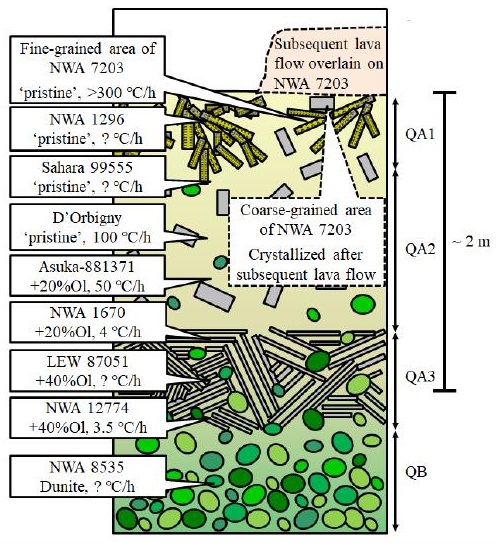
The number of unique angrites represented in our collections today is still limited, and these have been grouped by some investigators into five categories: 1) Hypabyssal-/diabasic-intrusive, 2) Quenched volcanic, 3) Intermediate, 4) Plutonic-cumulate, and 5) Impact-melt rock; a sixth category may be constructive to designate samples from multiple primary angrite parent bodies, based on a scenario proposed by Rider-Stokes et al. (2025) and Honda et al. (2025 #5222) for angrite Bir Zar 011. The quenched angrite NWA 7203 (photo courtesy of Labenne Meteorites) exhibits a striking variolitic texture in certain fine-grained regions. It was proposed by Hayashi et al. (2019) that this meteorite reflects an initial crystallization stage under rapid cooling conditions (~20°C/hr) at the surface producing the variolitic texture. It was then overflowed by a more Mg-rich lava which slowed the final cooling rate (~1°C/hr) producing a more coarse-grained dendritic texture (Hayashi and Mikouchi, NIPR 2019). Pervasive shock melt veins in NWA 7203 are consistent with such a near-surface location (Hayashi et al., 2018). Hayashi et al. (NIPR 2020) postulated that the quenched angrites may represent a single igneous unit in which the compositional trend is related to the volume of olivine xenocrysts incorporated in the original melt. The schematic illustration below shows a possible stratigraphic relationship for the quenched angrites in which variable cooling rates produced different textures analogous to a komatiite igneous unit.
click on photo for a magnified view
Schematic illustration credit: Hayashi and Mikouchi, 53rd LPSC, #2601 (2021)
Portions of the angrite asteroid must be in a stable orbit (planetary or asteroid belt) from which spallation has continued to occur over the past ~56 m.y. as indicated by the broad range in angrite CRE ages.
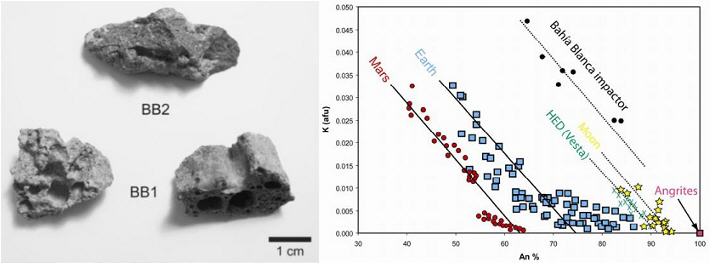
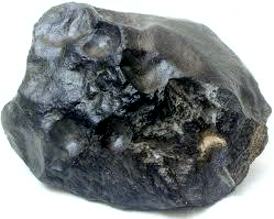
Interestingly, small fine-grained basalt clasts exhibiting textures and mineralogy generally consistent with a quenched angrite-like impactor are preserved in impact melt glass fragments recovered from the significant impact event that occurred ~5.28 m.y. ago near Bahía Blanca, Argentina (Schultz et al., 2006; Harris and Schultz, 2009, 2017; see top photo below). The photo of NWA 1296 shown above is a 1.1 g partial slice, while those below show the main mass.
Photo credit (left): Schultz et al., MAPS, vol. 41, #5, p. 755 (2006) (http://dx.doi.org/10.1111/j.1945-5100.2006.tb00990.x)
Diagram credit (right): Harris and Schultz, 40th LPSC, #2453 (2009)
Photo credit: A. Jambon
Photo credit: Jambon et al., MAPS, vol. 40, #3, p. 362 (2005)