Achondrite-ungrouped
click on photos for a magnified view
Purchased July 2020
no coordinates recorded
Eight relatively fresh stones having a combined weight of 807 g were purchased by D. Baidari from a dealer in Tindouf, Algeria. The stones were subsequently acquired by L. Labenne, and samples were sent for analysis and classification to the University of Washington in Seattle (A. Irving), Washington University in St. Louis (P. Carpenter), and the University of New Mexico (oxygen isotopes; K. Ziegler), and NWA 13921 was determined to be an ungrouped achondrite.
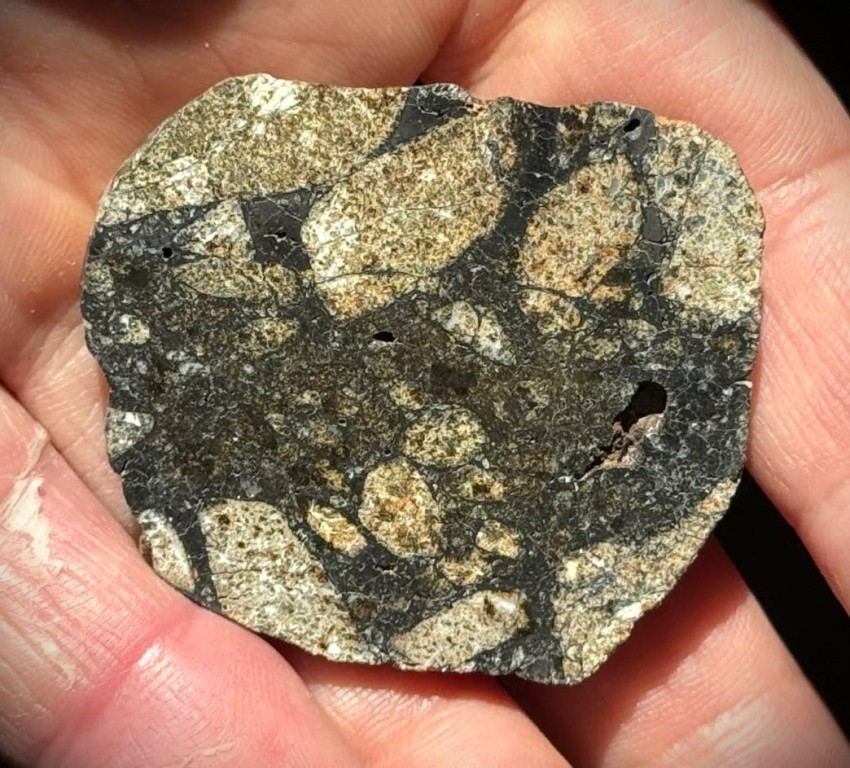
As described by Irving et al. (2022, MetBull 110), the meteorite is a partial melt which contains remnant coarse-grained gabbroic assemblages consisting of olivine, pyroxene (orthopyroxene and pigeonite), and calcic plagioclase (An87.3–93.1), along with accessory FeNi-metal, Ti-chromite, and troilite. Partially resorbed mineral grains are present, consisting of olivine, low- and high-Ca pyroxene, silica polymorph, and calcic plagioclase.The groundmass exhibits a quenched texture consisting of zoned, radiating needle-like (acicular) pyroxene crystals, with accessory phases including FeNi-metal, troilite, pentlandite, and ilmenite (Ti–Fe oxide).
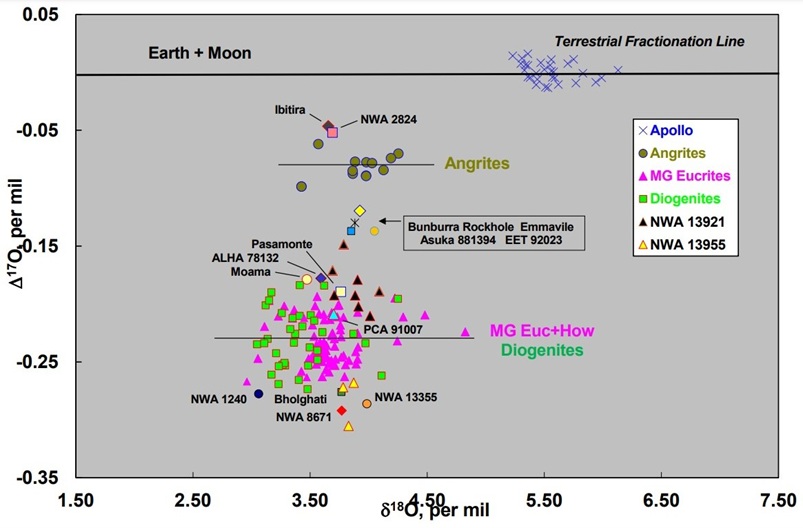
An oxygen isotope analysis conducted at the University of New Mexico (K. Ziegler) shows that NWA 13921 plots closer to the TFL compared to typical diogenites and eucrites. Its O-isotopic composition overlaps with that of the anomalous eucrites Pasamonte, Moama, and ALHA78132 (see diagrams below).
O-isotope Plots for Ungrouped Achondrite NWA 13921
click on diagram for a magnified view
Diagram from the Meteoritical Bulletin Oxygen Isotope Plots—The Meteoritical Society
click on diagram for a magnified view
Diagram credit: Irving et al., 84th MetSoc, 2021 #6221
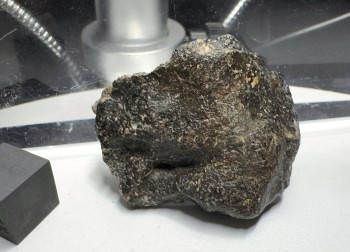
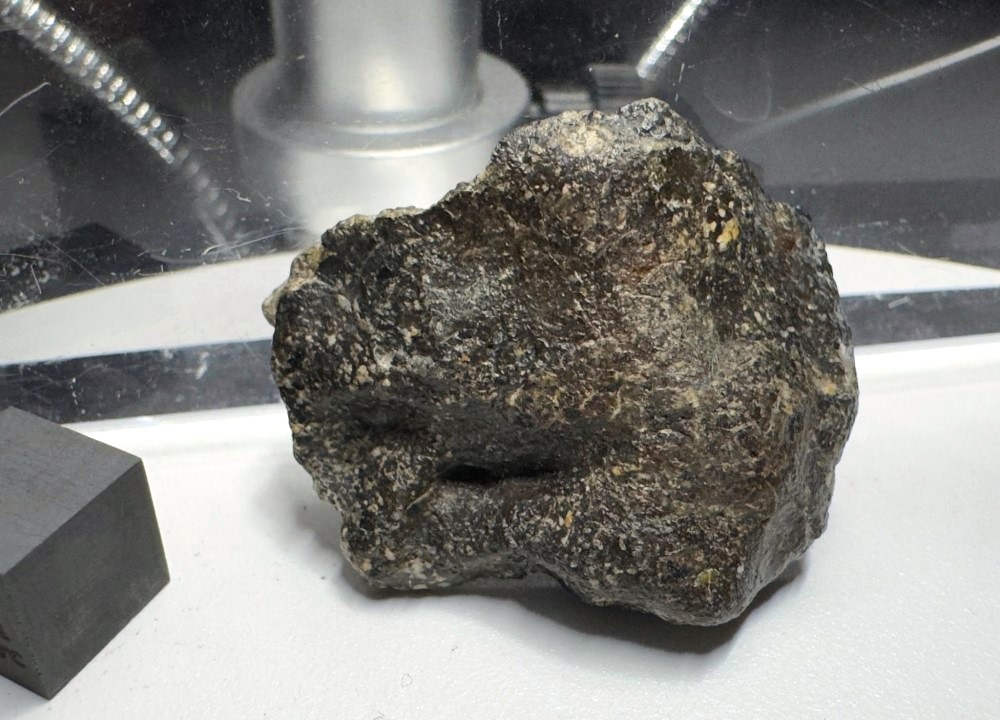
Further information about the anomalous eucrite-like meteorites and their proposed origin from multiple distinct parent bodies can be found on the Pasamonte page. The specimen of NWA 13921 shown above is a 13.75 g end section acquired from the Lyon Bros. The photo below shows a 39.7 g complete slice with both melted and unmelted phases.