Primitive Achondrite, ungrouped
Olivine-websterite
Purchased March 2022
no coordinates recorded
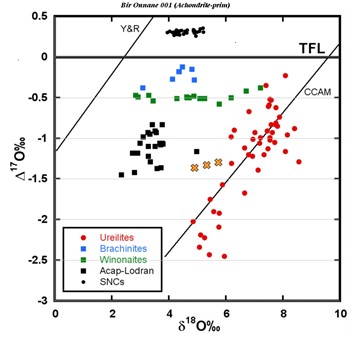
In February of 2022, ninety-seven fragments of a highly weathered meteorite, having a combined weight of 5,722 g, were found by Saharawi meteorite hunters south of Taoudenni in northern Mali. These meteorite fragments were purchased by Mohamed Ali Loud, and a type specimen was provided to the Institut für Planetologie, University of Münster (K. Metzler) for analysis and classification. Based primarily on petrographic and mineralogic analyses, Northwest Africa 15061 was initially published in MetBull 111 as a winonaite. However, following an oxygen isotopic analysis conducted at the University of Göttingen (T. Di Rocco), it was determined that the meteorite is paired with the ungrouped primitive achondrite Bir Ounane 001. Additional paired stones include Bir Ounane 003/004 and NWA 16639/17131/17483, with all fragments of this meteorite recovered so far having a combined weight of 108,900 g.
Meteoritical Bulletin Oxygen Isotope Plots—The Meteoritical Society
A petrographic and geochemical analysis of Bir Ounane 001 was conducted at the University of New Mexico (A. Ross and C. Agee) and published in MetBull 111. The meteorite is composed of forsterite (30–40 vol%; Fa1.2 [±0.1]), enstatite (40–50 vol%), and diopside (10–20 vol%), along with andesine plagioclase (5–10 vol%) and substantially oxidized FeNi-metal (~5–10 vol%). Minor phases identified are troilite, daubréelite, and schreibersite. Bir Ounane 001 is an olivine-pyroxenite, which was classified specifically as an olivine-websterite according to IUGS nomenclature due to its modal composition consisting of olivine (5–40%) together with both orthopyroxene and clinopyroxene (60–95%).
An in-depth analysis was conducted on a sample of Bir Ounane 004 by Nicklas et al. (2026 #1003). Their findings were similar to those reported by Ross and Agee (2022, MetBull 111) in their analyses of Bir Ounane 001, in that the meteorite was formed under highly reducing conditions and has a chemical composition unique to all other primitive achondrites. They found that Bir Ounane 004 shows some similarity to winonaites in having very Fe-poor silicates, and that it also shows some similarity to brachinites with respect to CaO–Na2O systematics of plagioclase. The oxygen isotopic composition is also unique in comparison to other meteorite groups. Further studies will help elucidate its petrogenetic history and gain better knowledge of its parent body.
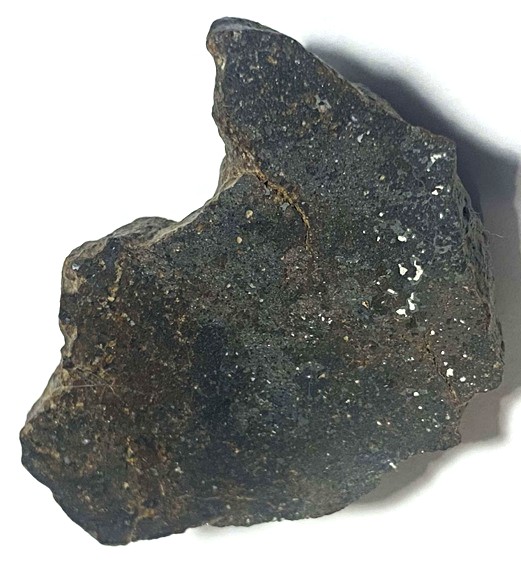
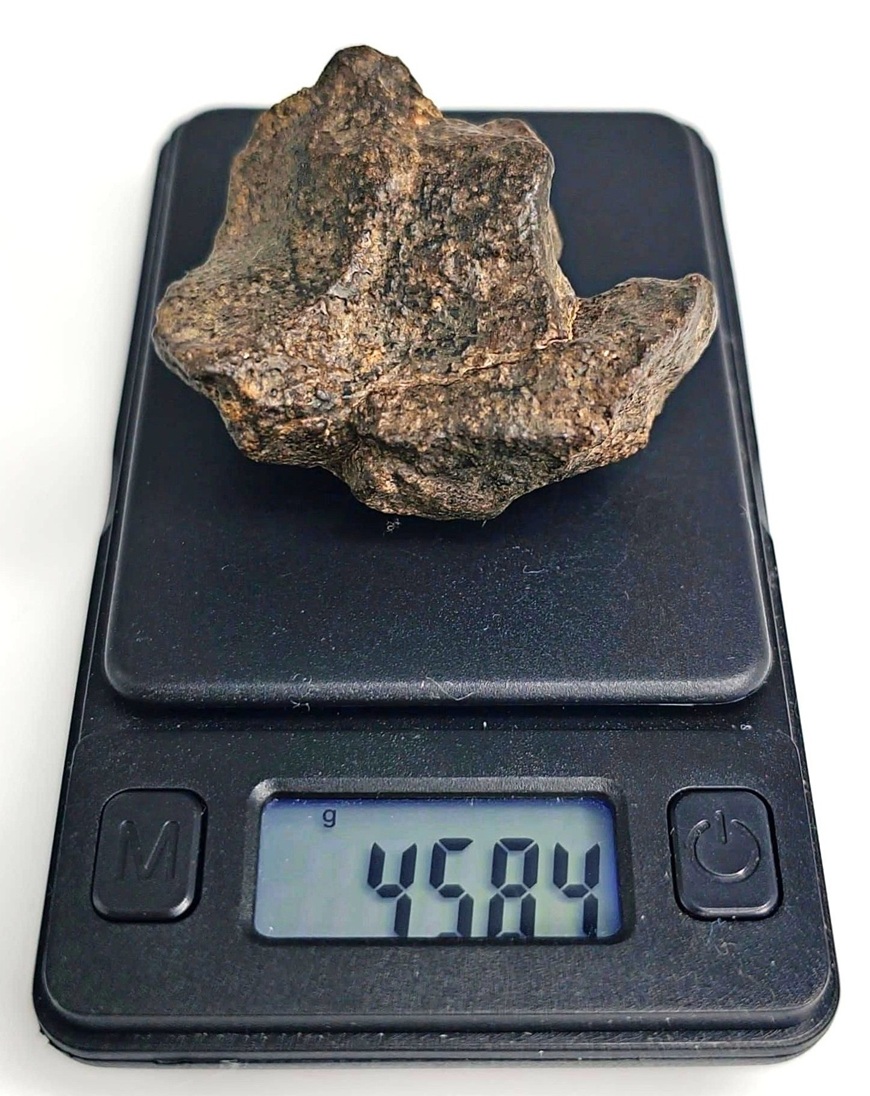
The specimen of NWA 15061 shown above was sectioned by M. Kelly from a 45.84 g individual acquired from Mohamed Ali Loud. The complete individual fragment from which it was cut is shown below.