Pallasite, ungrouped
Purchased February 2024
no coordinates recorded
Numerous small stones with a combined weight of 186.1 g were found in an undisclosed location in the Sahara Desert, and they were subsequently purchased in Tindouf, Algeria by F. Kuntz. A type sample was submitted to CEREGE (European Centre for Research and Teaching in Environmental Geosciences) for analysis and classification (J. Gattacceca, C. Sadaka, D. AuYang), and NWA 16734 was classified as an ungrouped pallasite.
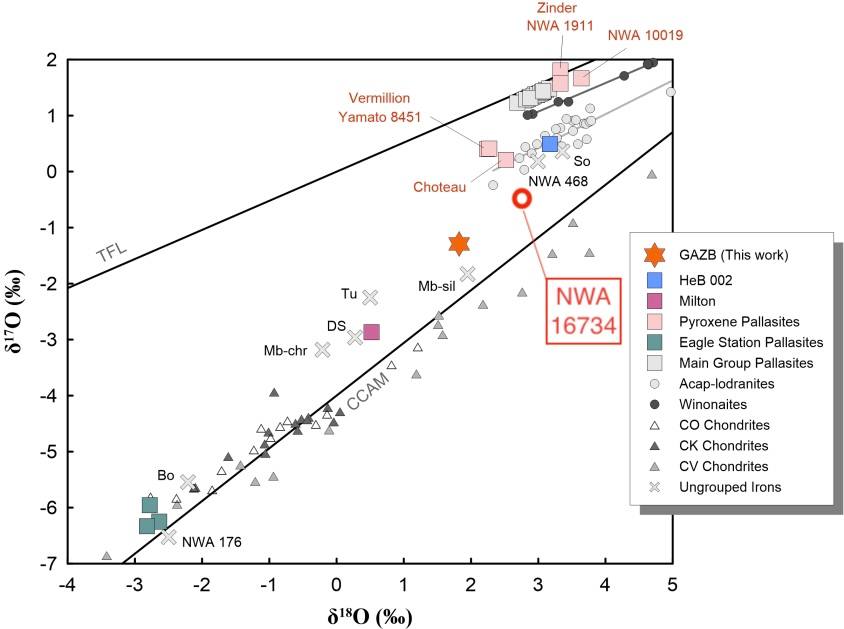
The NWA 16734 pallasite is composed of cm-sized olivine embedded in an FeNi-metal host, each distributed in approximately equal proportions, along with minor chromite, Ca-phosphate, and troilite. Olivine contains aligned inclusions measuring ~10 µm and composed of an assemblage of metal, troilite and spinel. Other minor and accessory mineral phases commonly present in other pallasites were not observed. Northwest Africa 16734 contains the most ferroan olivine of any other pallasite measured to date, with a fayalite value of Fa29.75 [±0.32] mol%. The oxygen isotope composition (Δ17O = –2.032 ‰) indicates that the parent body was formed in the CC reservoir.
Triple Oxygen Isotopes for Ungrouped Pallasites and Irons
click on image for a magnified view
Diagram credit: Jerome Gattacceca (CEREGE)/Fabien Kuntz—WWMeteorites
Adapted from Jiang et al., 54th LPSC, #1183 (2023)
Zhao and Bouvier (2026 #5178) obtained high-precision HSE abundance data from FeNi-metal phases in various meteorites, including NWA 16734. The values determined for NWA 16734, including Ir (= 6.8 [±0.2] ppm), Au (= 3.3 [±0.1] ppm), and Ni (≈ 24.24 wt%) , as well as the average Al2O3 content in chromite (= 26.4 [±0.6] wt%), indicate that the pallasite derives from a unique parent body.
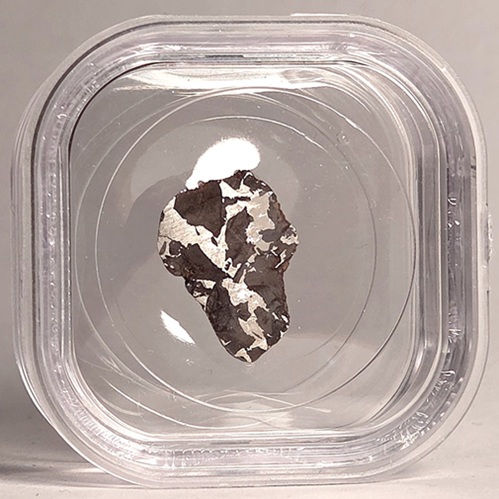
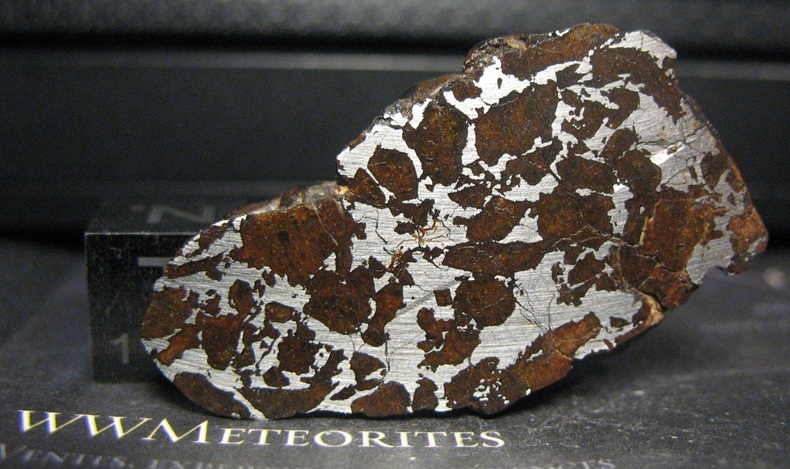
Some proposed scenarios for pallasite formation can be found on the Imilac page. The specimen of NWA 16734 shown above is a 1.6 g end section, while that below is a 14.24 g end section shown courtesy of Fabien Kuntz.