Ureilite
Diorite, cumulate
(Achondrite, ungrouped in MetBull 113)
Purchased January 2024
no coordinates recorded
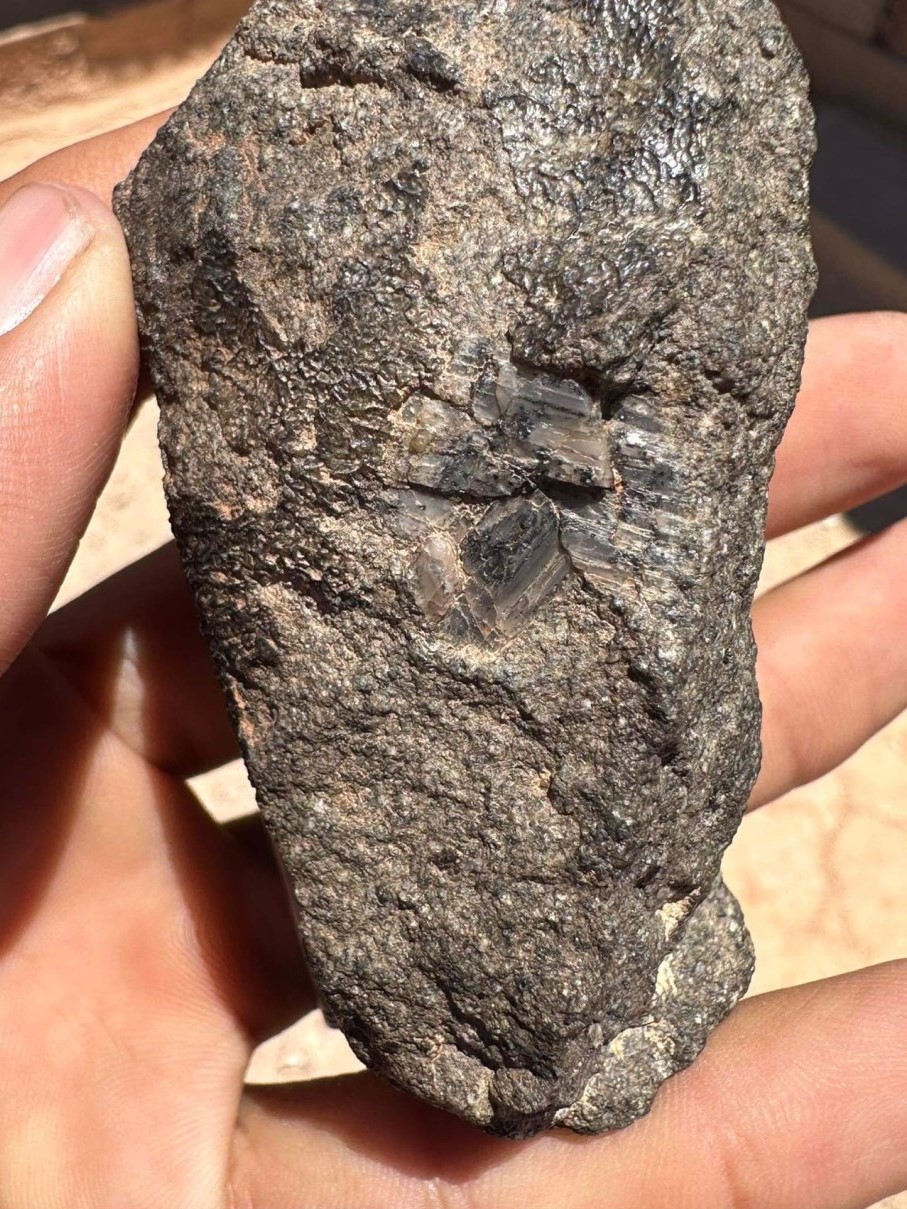
Two semi-fresh, partially fusion-crusted stones weighing 150 g and 11 g were acquired from an Algerian meteorite dealer by S. Yang and M. Cimala, respectively. A type sample was sent for analyses and classification to the Cascadia Meteorite Laboratory at Portland State University in Oregon (D. Sheikh). Based on his complete analysis, NWA 16789 was determined to be an ungrouped achondrite likely paired with NWA 6698. An additional likely closely related stone is the 269.4 g NWA 15820. It has a very similar mineralogic and oxygen isotopic composition to NWA 16789, and the two meteorites have closely matching spectrographic characteristics (Rider-Stokes et al., 2026; see their Fig. 2 and Fig. 3B).
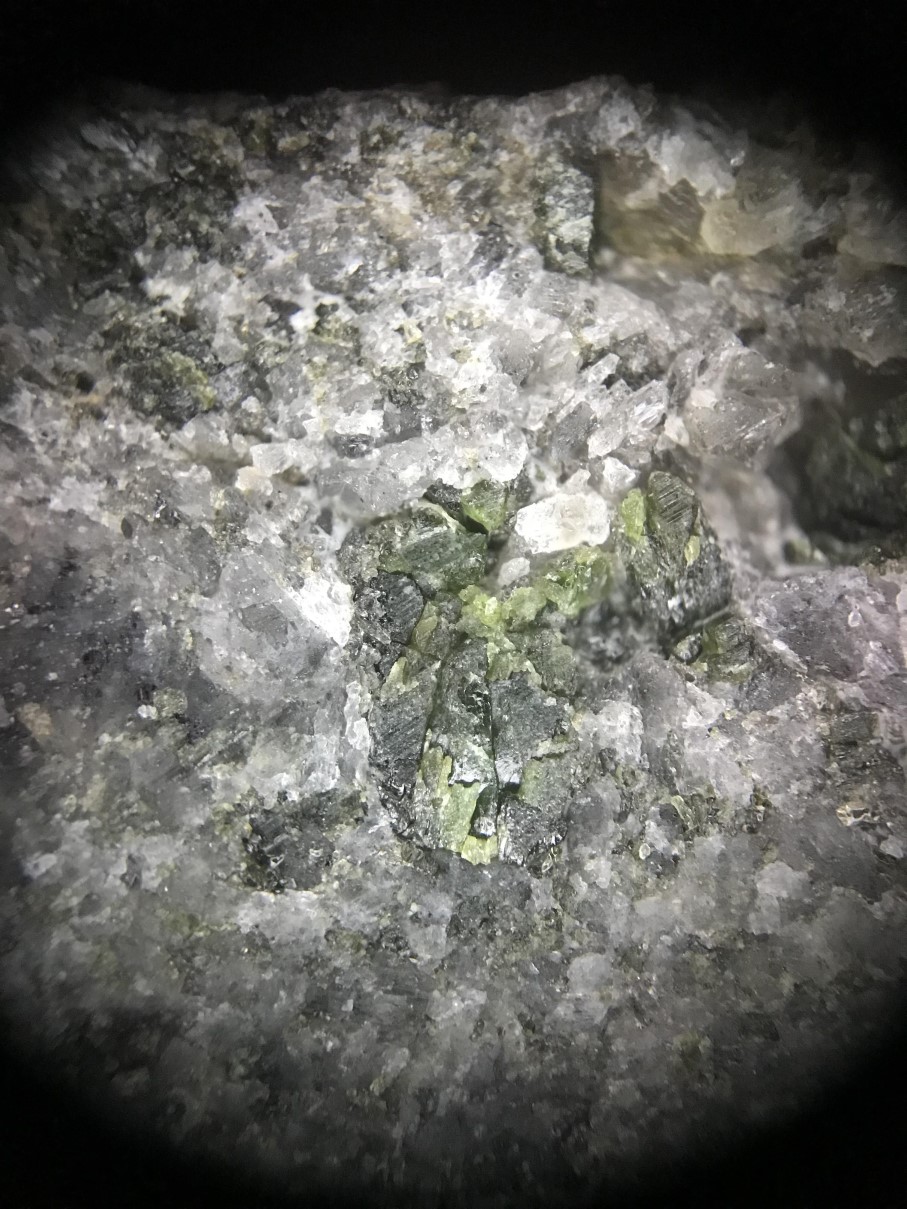
Northwest Africa 16789 is a cumulate poikilitic rock consisting of mm-scale plagioclase oikocrists (An5.9–54.7, albitic to labradoritic) enclosing smaller pigeonite and augite chadacrysts. Accessory troilite, ilmenite, merrillite, and chromite are present along with ubiquitous interstitial microlitic glass, the latter attesting to rapid quenching of the residual melt. The mineralogy and geochemistry of this meteorite are nearly identical to the description of the 38.4 g ungrouped achondrite NWA 6698 presented in 2011 (#5224) by the Northern Arizona University team of T. Bunch and J. Wittke, together with A. Irving at the University of Washington in Seattle and D. Rumble (oxygen isotopes) at the Carnegie Insitution in Washington, D.C.
A similar description for NWA 6698 was provided by Vaci et al. (2026) following precise analyses, with the modal composition given as "... andesine to oligoclase feldspar (61%), pigeonite (18%), augite (11%), interstitial microlitic glass (6%), phosphates including apatite and merrillite (2%), Ti-rich chromite (1%), and trace FeNi metal grains associated with Fe-sulfides.". They also calculated a 21Ne CRE age for bulk NWA 6698 of 5.4–8.2 m.y., and presented a consistent model for a small meteoroid of ≤20 cm in diameter. Furthermore, K isotopic systematics of NWA 6698 led Vaci et al. (2026) to conclude that the UPB was likely too small to have undergone a magma ocean stage. In a contrary scenario based on thermal modeling of the UPB, Tomkins et al. (2026 #5286) propose a very early accretion (<1 m.y. after CAIs) to a size of ~1,000 km in diameter, including the development of a shallow magma ocean. After impact-stripping of its crust and mantle, the UPB would now be a remnant metallic core identifiable as an M-type asteroid. They suggest that asteroid (16) Psyche (~222 km-diameter) or (22) Kalliope (~150 km-diameter) could be the extant UPB.
Very small feldspathic mineral clasts previously found in polymict ureilites (regolith breccias) have been determined by mineralogy and oxygen isotopes to be indigenous to the ureilite body likely sampling the UPB crust. These clasts generally fall into two distinct populations: an albitic lithology (An~1–25) and a labradoritic lithology (An~35–60) (Goodrich and Wilson, 2014). Four individual feldspathic clasts (trachytic/syenitic) designated MS-MU-011 (aka ALM-A; 24.2 g), MS-MU-035 (26.9 g), MS-MU-065 (54.7 g), and MS-277 (11.03 g) were recovered from the Almahata Sitta strewn field and have been the subjects of in-depth studies. These clasts are from the more common albitic lithology and consist of 70 vol% oligoclase (An10–30, ave. An15), 20 vol% augite, and 5 vol% pigeonite, along with trace Ni-poor metal and K-rich glass (Collinet and Grove, 2020). These feldspathic clasts could represent a low-degree melt (10–15 wt%) of an alkali-undepleted ([Na+K]/[Ca+Na+K] = 0.5) chondritic composition (Collinet and Grove, 2020). This early buoyant melt phase was the first to migrate from the shallowest source region to the surface through veins and dykes.
Results of a trace element study of a suite of unbrecciated ureilites led Barrat et al. (2016) to propose a revised melting history for the UPB. They concluded that following the segregation of a S-rich metallic core, ureilite precursor material experienced two successive steps of melting and melt extraction. The initial extracted melts were low-density feldspathic lavas containing high abundances of Al, alkalis, and silica, comparable to some clasts identified in polymict ureilites and to the two trachyandesitic lithologies known at the time, MS-MU-011 and MS-MU-035. A presumed scenario was presented in which this relatively buoyant silicic liquid was extracted, leaving behind an olivine and pigeonite residue, ultimately reaching the surface to form a crust of some extent. A representative of the next sequential melt to be extracted has not yet been identified among known meteorites, but it is inferred to have been an Al-poor, alkali-depleted liquid possibly more dense than the resulting ureilitic residues. Consequently, this melt material may have been located deeper in the mantle of the UPB where sampling would be a less likely event. Regardless of the actual density of this second-stage melt, the model scenario infers a partial melting degree of ~17–28% which was sustained throughout the entire melting event, and therefore the mass of this second-stage melt would be proportionately less than that represented by the rare trachyandesitic lithologies.
The Al–Mg age determined for the ALM-A trachyandesite sample indicates that the disruption of the ureilite parent body occurred no earlier than ~6.5. m.y. after CAIs (Bischoff et al., 2014). An Ar–Ar isochron age of 4.556 (±0.015) b.y. was obtained for pyroxene in MS-MU-011 by Turrin et al. (2015), while a Pb–Pb isochron age of 4.5620 (±0.0034) b.y. was obtained by Amelin et al. (2015) based on an assumed 238U/235U ratio of 137.79. Whether this Pb–Pb age represents the slow crystallization of an extruded lava or the rapid quenching of an intrusive magma, it attests to a basaltic crustal formation at least by 5.3 (±3.4) m.y. after CAIs; this pre-dates the catastrophic breakup of the UPB (Barnes et al., 2019).
Vaci et al. (2025 #5112) calculated an Al–Mg age for NWA 16789. They derived a 26Al isochron that corresponds to an absolute age of 4.56416 (± 0.00037) b.y. when anchored to D'orbigny, which is ~3 m.y. older than the absolute age calculated for ALM-A by Bischoff et al. (2014). Their study provides evidence for a very early onset of silica-rich volcanism on the ureilite parent body. Vaci and Amelin (2026 #5288) again used the 238U/235U ratio of 137.79 to calculate a Pb–Pb isochron age for NWA 16789 of 4.56137 (± 0.00044) b.y. They explain the discrepancy between the Pb–Pb isochron age and the Al–Mg isochron age as being due to a later isotopic closure for Pb in phosphate than for Mg in plagioclase while the host rock underwent slow cooling at depth.
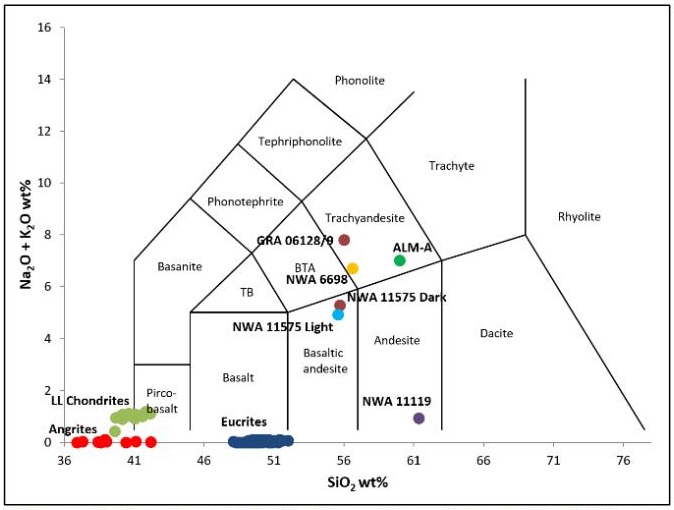
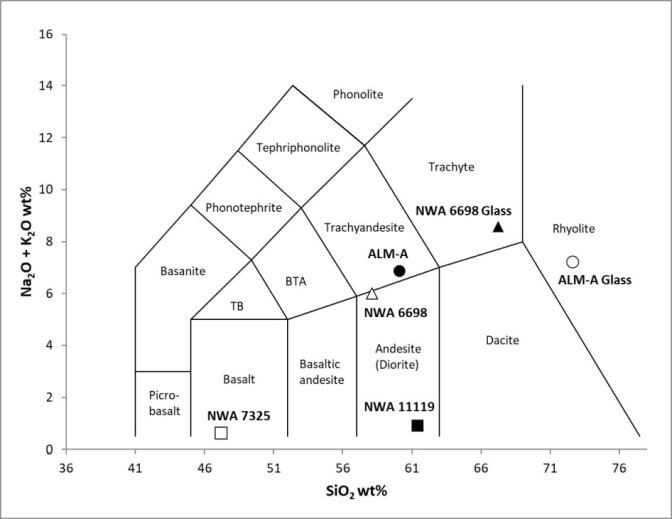
Notably, the classification of the ungrouped achondrite NWA 6698 was revised in Vaci et al. (2021 #2378) based on 7 new oxygen isotopic data points obtained at the University of New Mexico (K. Ziegler; O-isotopic plot). This meteorite is now recognized as a ureilite-related dioritic cumulus phase produced in a magma chamber, which is closely related to the extrusive, rapidly-cooled MS-MU-011/035/065 and MS-277 trachyandesite lithologies associated with the Almahata Sitta fall (see diagram below).
Total Alkali vs. Silica (TAS) Plot I
click on diagram for a magnified view
Diagram credit: Vaci et al., 51st LPSC, #1697 (2020)
Total Alkali vs. Silica (TAS) Plot II
click on diagram for a magnified view
Diagram credit: Zoltan Vaci, University of New Mexico, Earth and Planetary Sciences ETDs
'Petrology and Geochemistry of Evolved Achondrites: Planetesimal Mantles and Crusts', p. 66, Fig. 4,
Ph.D. Dissertation by Zoltan Vaci, University of New Mexico (July 15, 2021)
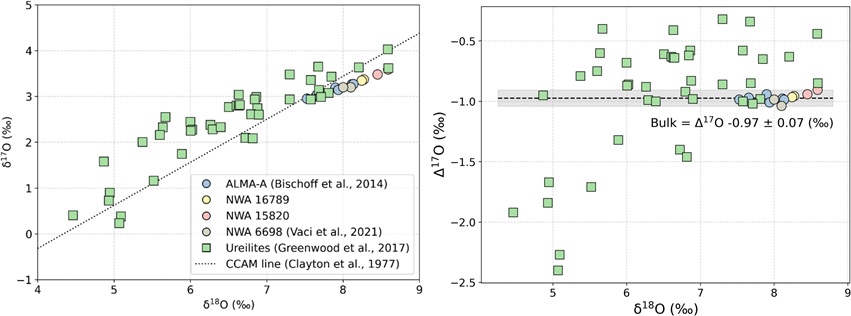
Rider-Stokes et al. (2026) conducted detailed analyses on NWA 16789 and the closely related NWA 15820, and compared these data to the trachyandesite MS-MU-011 (ALM-A) and the cumulus diorite NWA 6698. The results demonstrated that they each share nearly identical Δ17O compositions (see oxygen isotope diagrams below), very close pyroxene Fe/Mn values, similar major element compositions of silicates, and they have overlapping anorthite contents in plagioclase. Pb–Pb isotopic dating of phosphates in NWA 15820 using two different regression standards (Canyon Diablo Troilite [CDT] and Modern Terrestrial Pb [MT]) gave overlapping isochron dates of 4.5589 (±0.0029) b.y. and 4.5600 (±0.0036) b.y., respectively. Their data are consistent with the pairing of NWA 16789 and NWA 6698, and the supposition that NWA 16789 (+ NWA 6698) was derived from a common or similar fractionated trachyandesitic melt as NWA 15820 and ALM-A. However, NWA 16789 and NWA 6698 originated at a greater depth under slower cooling conditions, which resulted in larger pyroxene grain sizes measuring ~1 mm compared to ~300 µm for those in NWA 15820 and ALM-A. Other concordant data between NWA 16789, NWA 15820, and ALM-A include noble gas systematics and CRE ages. Bulk H2O contents and δD values for NWA 16789 and NWA 15820 are also similar (see their Fig. 8). From their analysis of NWA 16789 pyroxene, they adopted a best estimate for δD of 83 (±79) ‰, which represents the original H isotopic composition of the ureilite parent body. Furthermore, from their analysis of the interstitial glass component in NWA 15820, they calculated a minimum bulk H2O content for the ureilite parent body of 13–30 ppm, potentially ranging up to ~3,800 ppm under various degassing and mass-balance models.
Oxygen Isotope Systematics for Ureilite-Related Meteorites
click on diagram for a magnified view
Diagram credit: Rider-Stokes et al., GCA, vol. 429, p. 213, fig. 5 (2026 open accesslink)
'The hydrogen isotopic composition and content of the ureilite parent body: constraints from new ungrouped achondrites'
(https://doi.org/10.1016/j.gca.2026.07.047)
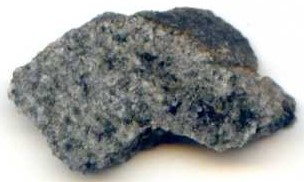
Goodrich and Collinet (2026 #1237) studied NWA 16789 along with several other trachyandesite meteorites which are considered likely crustal samples of the ureilite parent body, and they suggest these meteorites could represent disaggregated clasts from polymict ureilite falls. The specimen of NWA 16789 shown above is a 1.0 g cut fragment acquired from S. Yang. The excellent photos shown below are public domain images from the NWA 16789 MetBull record, courtesy of D. Sheikh.
NWA 16789 Main Mass Views
click on image for an alternate view
NWA 16789 Magnified Interior Views
click on image for an alternate view