Martian Shergottite
pyroxene-phyric ∗
click on photo for a magnified view
Purchased April 2026
no coordinates recorded
Four relatively fresh fragments with a combined weight of 642 g were found in Mali and subsequently purchased by C. Zlimen and M. Stream. A type specimen was provided for classification to the University of New Mexico (C. Agee and T. Shisseh), and NWA 18601 was determined to be a pyroxene-phyric martian basalt.
A petrographic and geochemical description of NWA 18601 published in MetBull 115 reveals it to be primarily composed of clinopyroxene (Fs51.7 [±18.3] Wo24.0 [±6.0]) and maskelynite (An57.4 [±0.4] Ab42.0 [±0.5]), along with minor ilmenite, silica, Cl-rich apatite, symplectites, and alkali feldspar. The pyroxenes are described as strongly zoned, exhibiting cores of Ca-poor augite with Fe-rich pigeonite rims. These zoning features are consistent with rapid cooling of a more evolved magma source region, and were said to be comparable to zoning features present in the depleted, mafic, pyroxene-phyric shergottite QUE 94201.
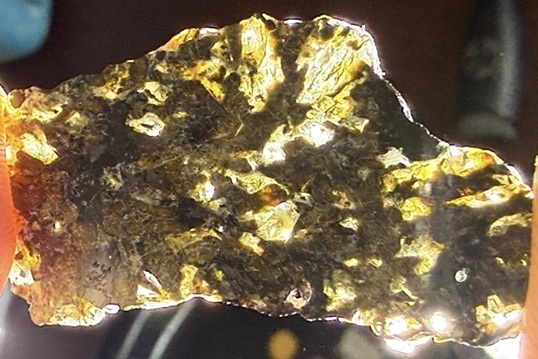
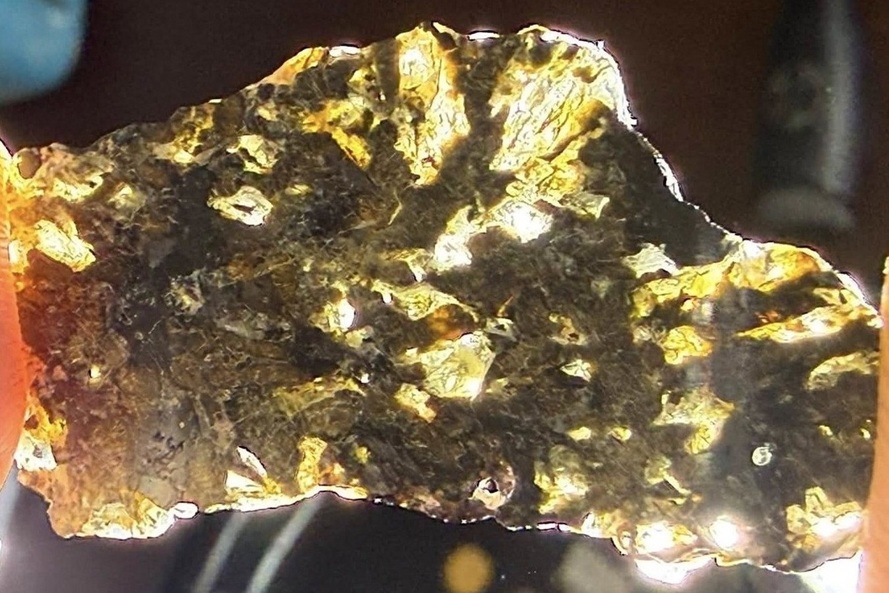
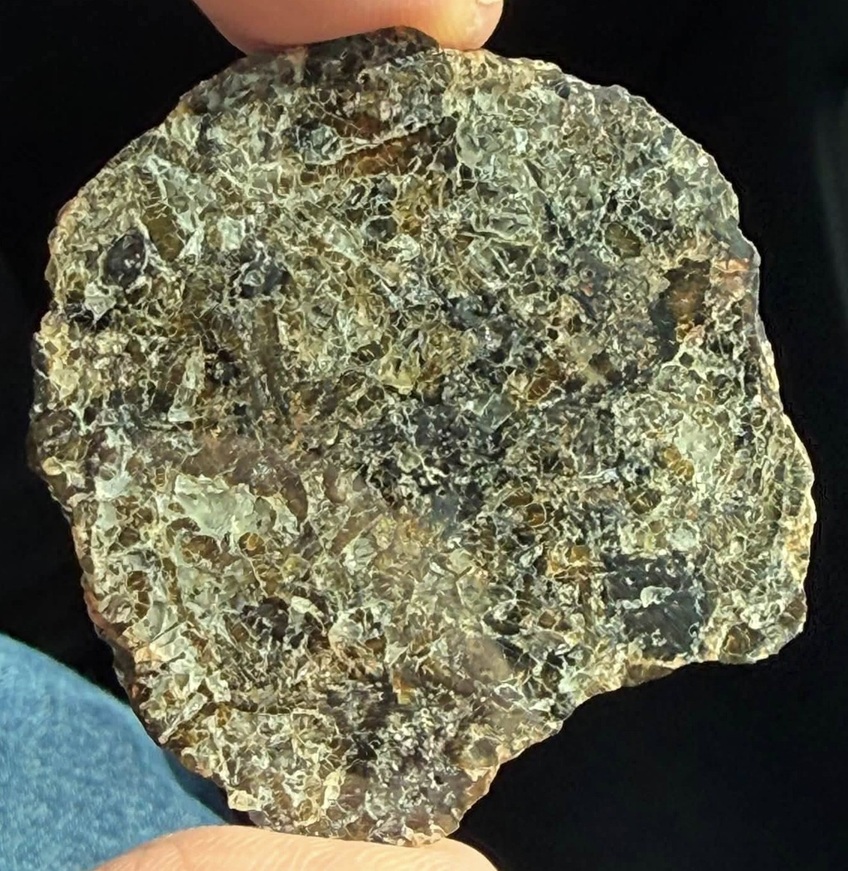
The photo of NWA 18601 shown above is a 3.3 g thin slice demonstrating the translucency of the abundant maskelynite crystals. The photo below is a larger 8.5 g slice revealing the interior texture of this rare shergottite type, shown courtesy of Craig Zlimen. The meteorite comprises dark pyroxene crystals intermixed with shocked plagioclase transformed into maskelynite.
click on photo for a magnified view
Photo courtesy of Craig Zlimen—Minnesota Meteorites
∗ Recent geochemical research on the martian shergottites has led to new petrogenetic models and classification schemes. read more >>