CVox3 or ungrouped
(CK3 in MetBull 102)
click on photo for a magnified view
Found 2009
no coordinates recorded
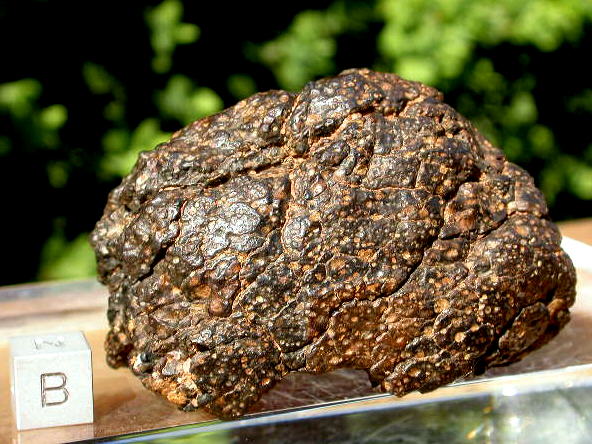
A single 264 g meteorite was found in Northwest Africa and subsequently purchased by M. Jost of Space Jewels Switzerland. A sample was sent for analysis and classification to the Museum für Naturkunde in Berlin, Germany (A. Greshake), and based on mineralogical analyses NWA 6047 was determined to be a rare unequilibrated CK3 chondrite.
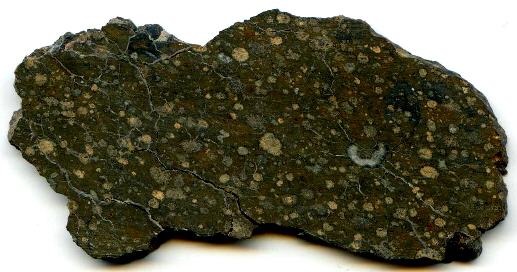
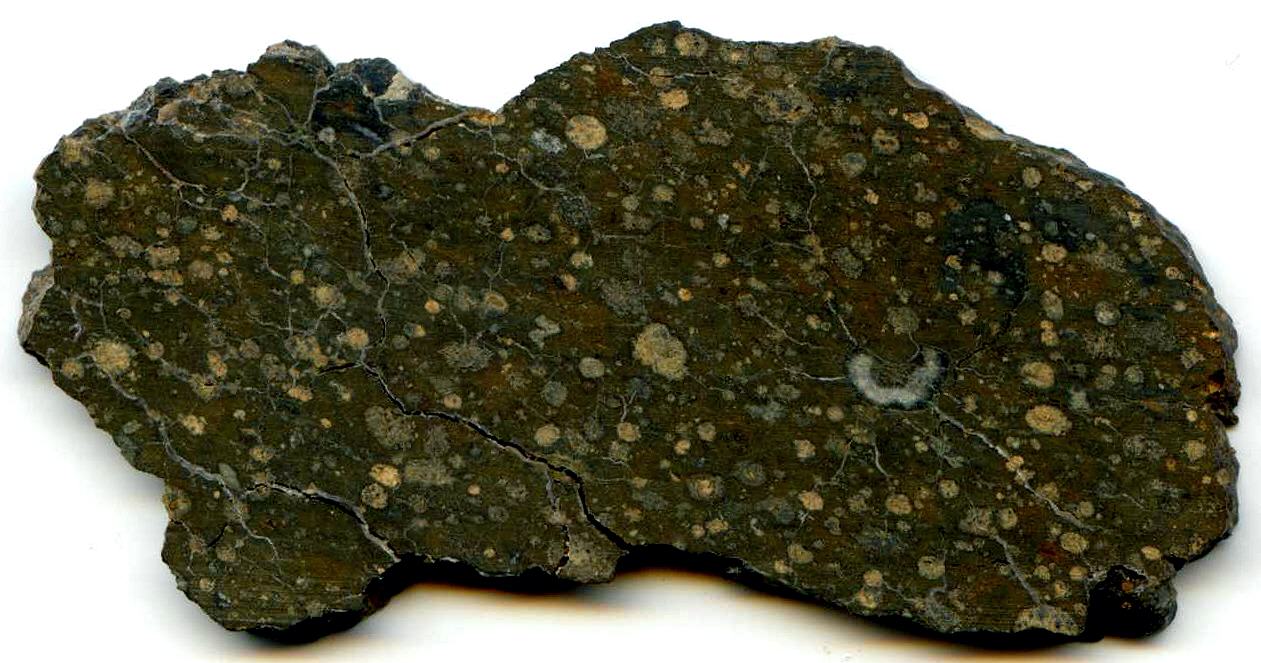
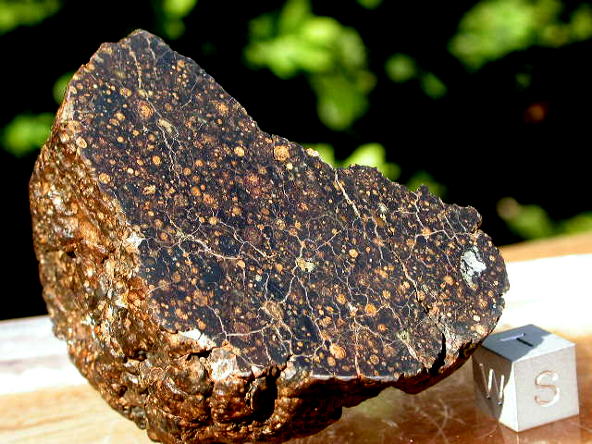
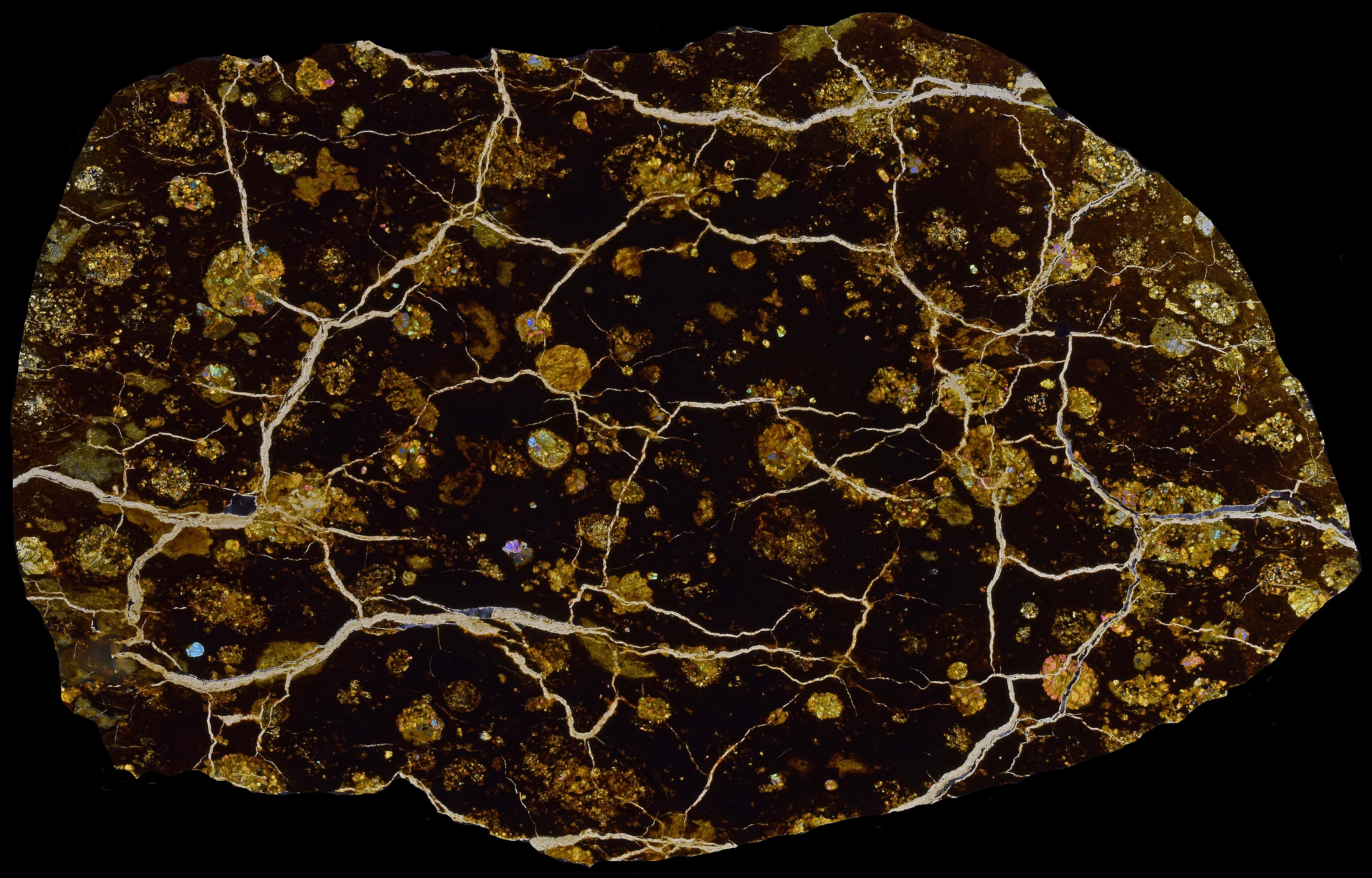
This meteorite has a dark-brown, fine-grained matrix with large, well-defined chondrules, and its silicates preserve a wide compositional range, features which are indicative of a low degree of thermal metamorphism consistent with a classification of type 3. This carbonaceous chondrite exhibits an unusually high matrix to chondrule ratio with an almost complete lack of FeNi-metal. Minor phases include Ni-rich sulfides, Cr-bearing magnetite, and rare CAIs. It is unshocked to very weakly shocked (S2) and has experienced significant terrestrial weathering (W3).
Comparatively, the CK group has a high oxidation state which has resulted in a very low content of FeNi-metal and a correspondingly high content of magnetite and sulfides. The dispersion of these sub-µm- to µm-sized magnetite and sulfide (pentlandite) grains within vesicles of like size has caused pronounced silicate darkening in all metamorphic grades. In addition, CK chondrites generally have high matrix to chondrule ratios, with the matrix composing ~50–70 vol%. Chaumard and Devouard (2016) reported a large range in chondrule abundances among CK chondrites in their study, which they attributed to re-equilibration during metamorphism.
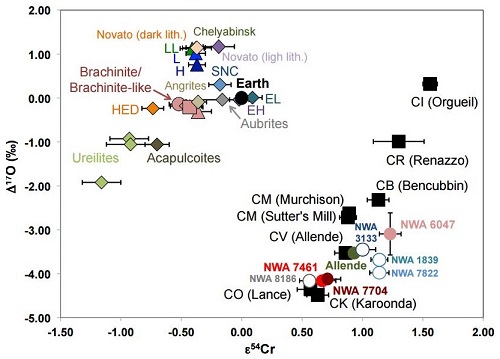
Previous studies (e.g., Sanborn et al., 2014) have established that a coupled Δ17O vs. ε54Cr diagram is one of the best diagnostic tools for determining genetic relationships among meteorites. New Cr- and O-isotopic analyses were conducted by Yin et al. (2017) for two new equilibrated CK chondrites (NWA 7461 and NWA 7704) as well as for unequilibrated NWA 6047 and CV3 Allende. When combined with previous analyses, it was determined that CK chondrites have an average ε54Cr value of +0.66 (±0.06), while the CV chondrites have an average value of +0.88 (±0.06). The significantly higher ε54Cr (+1.23 [±0.09]) and the Δ17O values determined for NWA 6047 indicate that it could represent a unique parent body separate from that of CK, CV, and CO chondrites (see diagrams below).
Diagrams credit: Yin et al., 48th LPSC, #1771 (2017)
Chromium vs. Oxygen Isotope Plot
click on diagram for a magnified view
Diagram credit: Sanborn et al., 49th LPSC, #1780 (2018)
A petrographic and mineralogical study of NWA 6047 (and other CK3 meteorites) was conducted by Dunn and Gross (2017) to better resolve the group classification, CV vs. CK. They determined that the magnetite composition of NWA 6047 is consistent with that of CV chondrites with respect to minor elements Cr2O3, TiO2, NiO, MnO, and CaO abundances; however, the abundance of Al2O3 was found to be lower than that of CV chondrites. They also found that the Fa content in matrix olivine is most similar to CV chondrites, as are the minor element abundances with the exception of Cr2O3 (higher than in CV) and MnO (lower than in CV). In addition, the average Fa content of chondrule olivine in NWA 6047 (Fa1.9) is much lower than that in the FeO-rich chondrules of CK chondrites (typically as high as ~Fa34), but is similar to the chondrule Fa values of CV chondrites (typically <Fa15) (Torrano et al., 2020 and references therein). With respect to petrographic observations, they found that the chondrule abundance in NWA 6047 (~30 vol%) is lower than that in CV chondrites (~40 vol%) but higher than that in CK chondrites (~22 vol%). Furthermore, CAIs are present in both NWA 6047 and CV chondrites, but are rare in CK chondrites. Based on the combined results of their analyses, Dunn and Gross (2017) suggest that NWA 6047 be reclassified as a member of the CVox group.
In an effort to further resolve differences between the CV and CK chondrite groups, Yin and Sanborn (2019) analyzed Cr isotopes in a significant number and broad range of meteorites. Their study included samples from each of the three CV subgroups (oxA, oxB, Red), two anomalous CV3 (NWA 6047 and NWA 7891), a C3-ungrouped (Ningqiang), several CK members, and other potential CV-related meteorites (see top diagram below). It is demonstrated that the CV and CK meteorites are clearly resolved into two distinct isotopic reservoirs. In addition, it is shown in the top diagram below that the ε54Cr value for NWA 6047 puts it in a distinct location compared to other CV group meteorites, and therefore it may represent a separate carbonaceous chondrite parent body. Furthermore, despite the varied classification history of Ningqiang, it can now be assigned to the CK group. That said, high-precision Cr isotope data obtained for Ningqiang by Zhu et al. (2021) were able to resolve the CK and CV groups with ε54Cr values of 0.51 (±0.15) and 0.89 (±0.30), respectively. Therefore, under this constraint the ε54Cr value for Ningqiang of 0.75 as determined by Zhu et al. (2022) would be a better fit to the CV group. A coupled Δ17O vs. ε54Cr diagram plotting all of the meteorites in the Yin and Sanborn (2019) study is shown in the bottom diagram below. Notably, anomalous CV3 NWA 7891 (Δ17O = –7.7 [±4.5] ‰) plots far below the range considered in the bottom diagram.
ε54Cr Isotope Weighted Average For CV and CK Chondrites
click on diagram for a magnified view
O–Cr Diagram For CV and CK Chondrites
CK: orange shades; CV: green shades; Achondrites: open
click on diagram for a magnified view
Diagrams credit: Yin and Sanborn, 50th LPSC, #3023 (2019)
Using a high-precision Cr isotope analysis, Zhu et al. (2021) presented a chart showing the ε54Cr variations in different groups of chondrites. It can be seen that the CV and CK groups have disparate values consistent with their formation on separate parent bodies (see diagram below).
ε54Cr Difference Between CV and CK Groups
Diagram credit: Zhu et al., 52nd LPSC, #2131 (2021)
See also the GCAarticle (2021)
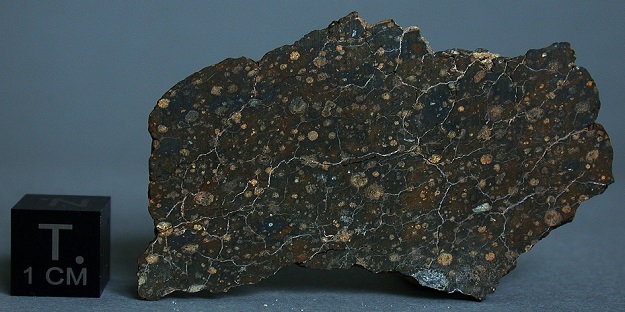
The photo of NWA 6047 shown above is a 6.92 g slice measuring 5 cm across with a small portion of a CAI visible. The photos below show a nice slice of NWA 6047 in the collection of Stephan Kambach, along with a photo of the main mass. The bottom image is an excellent petrographic thin section micrograph of NWA 6047 shown courtesy of Peter Marmet.
Photo courtesy of Stephan Kambach
Photos courtesy of Marc Jost
click on photo for a magnified view
Photo courtesy of Peter Marmet