



 |
|
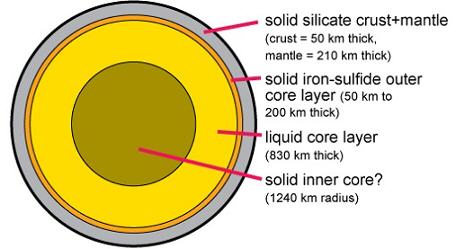
This diagram illustrates the comparative scale of the differentiated layers of Mercury as revealed by the MESSENGER spacecraft. The core makes up ~85% of the planet. The solid FeS outer core layer is thought to be responsible for the negligible magnetic field on the surface. Credit: Nick Strobel's Astronomy Notes |
 |
|
1. Rapid growth of an embryo by pebble accretion to reach a mass of 2.25 × Mercury in 1–3 m.y. 2. Differentiation of proto-Mercury to form an upper mantle, lower mantle, and core. 3. A severe impact with another planetary embryo due to the migration of Jupiter within 5 m.y., prior to nebula gas dissipation and mantle overturn on proto-Mercury. 4. The two cores merged, the larger fragments derived from the volatile-rich upper mantle of proto-Mercury were re-accreted, and the Mg-rich lower mantle material was vaporized and lost to the Sun due to aerodynamic drag. 5. Si was redistributed from the core to the mantle due to the lower pressures. |

