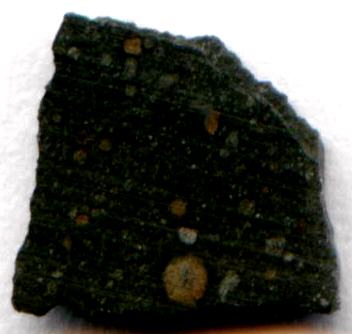
Eight fragments of a single meteorite having a combined weight of 38 g were found in the desert region of Northwest Africa. The pieces were sold at the 2013 Tucson Gem and Mineral Show to G. Hupé. A type sample was submitted for analyses and classification to the University of Washington at Seattle (A. Irving and S. Kuehner), and NWA 7821 was determined to be a new ungrouped C2 chondrite, or alternatively, an anomalous member of the CM chondrite group.
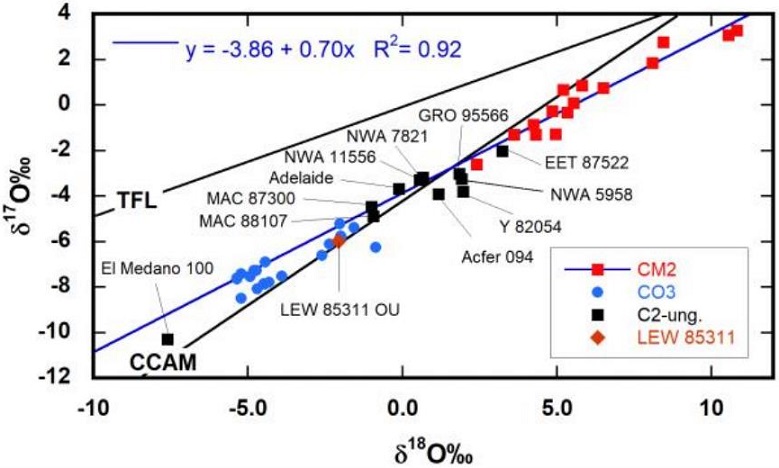
Northwest Africa 7821 is a low-density carbonaceous chondrite containing scattered granular chondrules ranging in size from 0.1 to 0.4 mm. CAIs are present in a fine-grained matrix having a composition similar to that of CM chondrites. The meteorite has been shocked to S2 and terrestrially weathered to a grade of W2. On an oxygen three-isotope diagram, NWA 7821 plots along the CM trend line but has a higher than normal 16O content (Carnegie Institution, Washington D.C. (D. Rumble, III; see O-isotopic diagram).
Although terrestrial alteration in cold and hot deserts is a factor that needs to be considered, several CM-like meteorites were identified by Greenwood et al. (2019) that might be related and perhaps represent a separate CM-like parent body. Along with NWA 7821, these include EET 87522, GRO 95566, LEW 85311, MAC 87300, MAC 88107, NWA 5958, NWA 11556 and Y-82054. In another study, Prestgard et al. (2022 #6184) found that ungrouped MAC 87300/301 and MAC 88107, together with ungrouped NWA 13689, share similar petrographic characteristics and oxygen isotopic compositions, which supports the conclusion of Weisberg et al. (2006, [p.30]) that these three meteorites represent a unique grouplet. However, recent results from O, Cr, and Ti isotopic analyses (Torrano et al., 2021), as well as from noble gas analyses (Alosius et al., 2023 #6247), indicate that MAC 88107 formed on a different parent body from that of MAC 87300/301. On the other hand, a single large isotopically-heterogeneous CM parent body could be the source for all of these meteorites, and the variability in aqueous alteration that is observed among them may be attributed to differences in their water:rock ratio, temperature, and/or other factors.
CO–CM Oxygen Isotope Gap
click on image for a magnified view
Diagram credit: Greenwood et al., 50th LPSC, (2019 #3191)
The specimen of NWA 7821 shown above is a 0.056 g partial slice. The photo below is one of the larger slices photographed by G. Hupé.