CVred4 (3.95?)
(C3 in MetBull 104 [2017])
Purchased April 2014 to March 2015
no coordinates recorded
A relatively fresh meteorite weighing 466 g, along with an additional nine smaller stones found at the same site having a combined weight of 4,262 g, were purchased from a Moroccan dealer over an extended time period (April 2014 to March 2015) by D. Pitt. A type sample from each stone was sent for analyses and classification to the University of Washington in Seattle (A. Irving and S. Kuehner), with oxygen isotope analyses being conducted at the University of New Mexico Institute of Meteoritics (K. Ziegler). Based on the petrography and geochemistry results, and also on the O-isotopic composition values which plot on the CV–CK array, NWA 8418 (466 g) and NWA 10191 (4,262 g) were determined to be paired, and the material was classified as a C3 carbonaceous chondrite with affinities to the CV group. An unusually high abundance of chlorapatite present both within the matrix and rimming large CAIs was noted as an anomalous feature.
A petrographic description of NWA 8418 provided by Kuehner et al. (2015 #5244) states that it consists of granular-textured chondrules 0.5–3 mm in size set within a fine-grained matrix. Also present in the matrix is kamacite, chlorapatite, and rare merrillite. Results of an O-isotope analysis indicate the meteorite is a CV type chondrite.
A more in-depth study of NWA 8418 conducted by Mallozzi et al. (2018 #2555) demonstrated a higher degree of metamorphism compared to all other CV3 chondrites studied up until then. Some of the indications of metamorphism through high-temperature metasomatism include the replacement of primary melilite within large CAIs by fine-grained secondary phases, the occurrence of thick chlorapatite mantles on CAIs as well as a high abundance of chlorapatite in the matrix, and the presence of ferroan olivine in most chondrules (Fa30–40) and in the matrix (Fa35–50, but generally Fa~38), although relict forsteritic (Fa0–5) olivine remains in some porphyritic chondrule cores. These unique petrographic features and others prompted Mallozzi et al. (2018) to classify NWA 8418 as the first oxidized CV4 chondrite.
Continued studies of NWA 8418 by MacPherson et al. (2021 #6104) utilizing new oxygen isotope data for various components of the meteorite support the inference that NWA 8418 is related to CV3 chondrites, and that it experienced high-temperature metasomatism on its parent body. Ultimately, an in-depth investigation of NWA 8418 was conducted by MacPherson et al. (2023), in which all available criteria were examined and compared to the CVoxA, CVred, and CL chondrite groups; they concluded that NWA 8418 should be reclassified as CVred4. This classification is based on both the similarities of NWA 8418 to the CV chondrites (e.g., see diagram below) and on the differences, the latter including the Mg-rich character of the NWA 8418 matrix olivine relative to olivine in CV3 chondrites (Fa~38 and Fa~50, respectively), and the ubiquitous presence of high-temperature (>600 °C) secondary phases such as coarse-grained chlorapatite, plagioclase, and troilite. The Mg-rich character of the matrix olivine in NWA 8418 compared to other CV3 chondrites was attributed to the meteorite's initial lower matrix/chondrule ratio, which allowed a higher depletion of iron to occur in the matrix olivine during metasomatic and metamorphic equilibration of primary forsteritic chondrule olivine.
MnO vs. FeO in NWA 8418 Metamorphic Olivine
circle delineates CV3 matrix olivine field of Weisberg and Prinz (1998)
Diagram credit: MacPherson et al., MAPS vol. 58, #1, pp. 135–157 (2023)
'Northwest Africa 8418: The first CV4 chondrite'
(https://doi.org/10.1111/maps.13943)
In the ground-breaking article by Jacquet and Doisneau (2024), 'The secondary classification of unequilibrated chondrites', the C3 chondrite NWA 8418 is noted to be composed of a matrix which averages Fa38 along with chondrule olivines which average Fa20 (±14). According to the new proposed metamorphic scheme, NWA 8418 is consistent with metamorphic grade M0.5 and would be classified as CV3.5 (see diagram below).
Metamorphic Scale For CV Chondrites
Diagram credit: Jacquet and Doisneau, MAPS, vol. 59, #12, tab. 6 (2024, open accesslink)
'The secondary classification of unequilibrated chondrites'
(https://doi.org/10.48550/arXiv.2409.07838)
Alevy and Dunn (2023 #6054) and Dunn and Alevy (2024 #6430) reported on two other reduced CV3 chondrites with unusually high metamorphic features—NWA 13784 and "lithology C" in the CV/CK breccia Camel Donga (CD) 003. Both of these meteorites have similar petrographies to NWA 8418, including equilibrated matrix olivine with similar fayalite values (Fa39 and Fa42, respectively), but also lacking homogeneity within chondrules; chondrule olivine remains unequilibrated with values of Fa1–41 and Fa1–26 (±10.7), respectively. They argue that matrix olivine equilibrates faster than chondrule olivine, and as reported by MacPherson et al. (2023), some olivine in NWA 8418 chondrule cores remains unequilibrated (Fa1–38); this is comparable to chondrule olivine in some CK3.8 and CK3.9 chondrites.
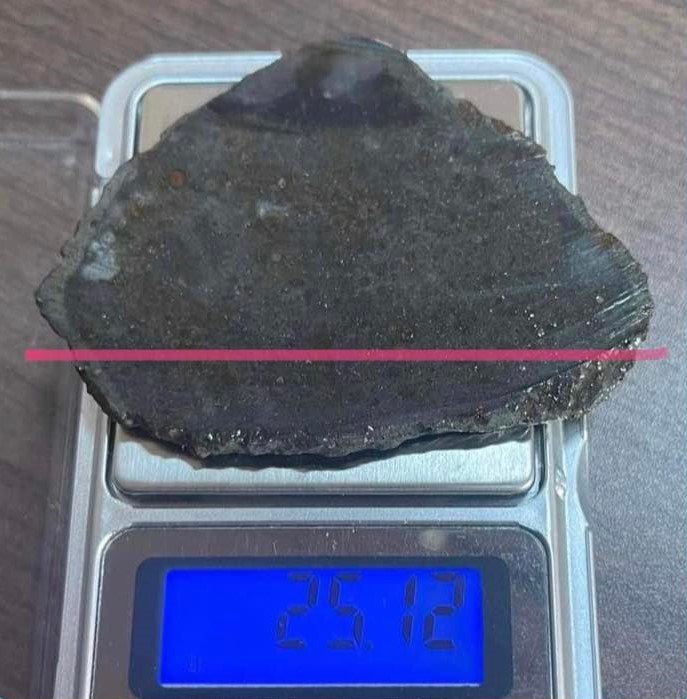
Perhaps a further division of the metamorphic scale would be justified to better distinguish the border between unequilibrated and equilibrated chondrites, which might be accomplished by the addition of a petrologic grade 3.95 in the case of meteorites like those mentioned above. The specimen of NWA 8418 shown above is a 1.4 g cut section from one of the nine NWA 10191 stones. The top photo below shows the original full slice indicating the bottom portion that was to be taken off. The 1.4 g cut section was derived from this bottom portion of the slice. The bottom photo below shows the provenance for the NWA 10191 slice in the collection of J. Collins.