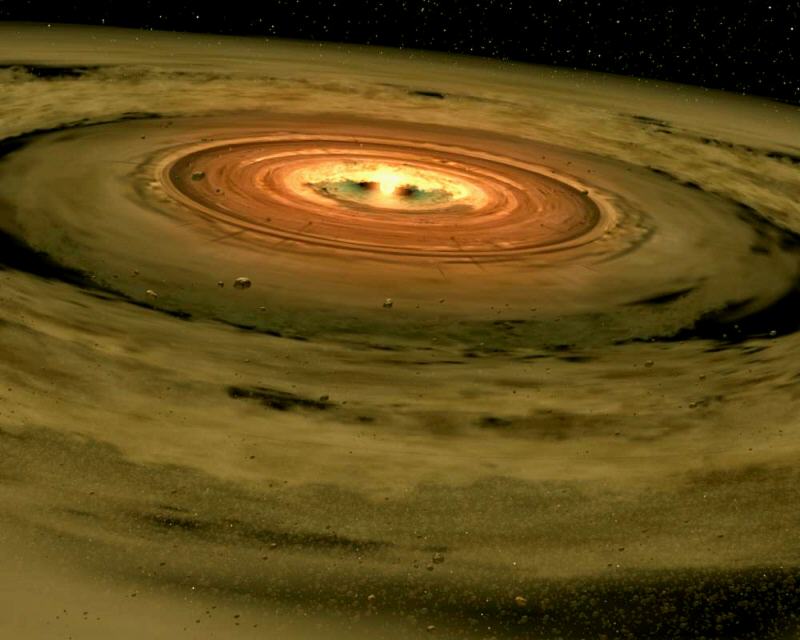
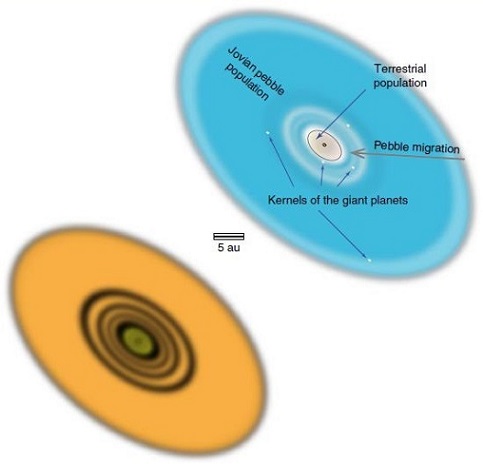
Accretion from dust to gas-giant planet occurred within 3 m.y. ('Pebble Accretion and the Diversity of Planetary Systems', J. E. Chambers, The Astrophysical Journal, vol. 825 (2016). In the beginning, µm-sized dust particles are embedded in a gaseous protoplanetary disk. By 0.02 m.y., mutual collisions between dust grains result in the formation of mm- to cm-sized pebbles. By 0.15 m.y., pebbles inside the ice line (~2.5–4.5 AU) have aggregated into planetesimals with diameters of 30–300 km. Just outside the ice line, aggregation of the larger ice-rich pebbles is more efficient, and larger planetesimals with diameters of ~1,500 km are formed during runaway growth. By 0.5 m.y., some of the larger planetesimals located within ~5 AU enter an oligarchic growth stage and become planetary embryos with diameters of 2,000 km. The largest embryos located just beyond the ice line begin to grow by "pebble accretion" due to the inward drift of pebbles, reaching sizes of a few Earth masses (M⊕). By 3 m.y., the largest of these embryos exceed a critical mass (3 × M⊕) and undergo runaway gas accretion to form gas-giant planets (Levison et al., 2015). It was argued by Desch et al. (2022 and references therein) that Jupiter's rapid growth attained a size of ≈ 20–30 M⊕ by about 0.4–0.9 m.y. after CAIs. A large protoplanetary disk (radius = ~100 AU) and a small turbulence strength (α = 0.0005) help promote the formation of these gas giants, which ultimately clear their orbits. Inside the ice line, the growth of terrestrial planets (0.02–1.4 M⊕) ceases due to pebble depletion in the disk.
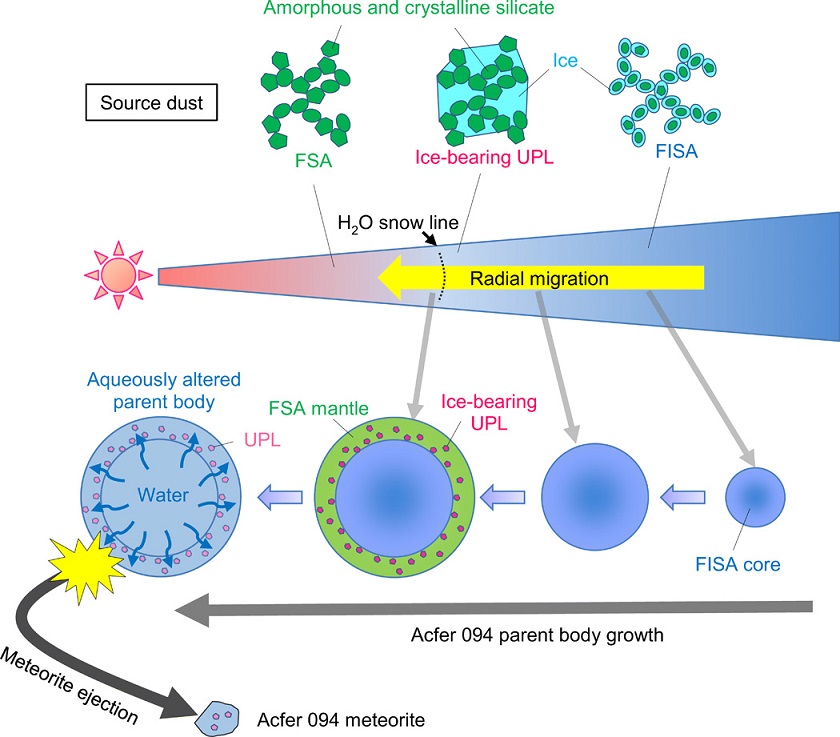
Matsumoto et al. (2019) employed advanced techniques including synchrotron radiation–based x-ray computed nanotomography in a study of the accretionary formation of the carbonaceous parent body of the Acfer 094 chondrite. They presented a formation scenario as follows (see also schematic illustration below):
During migration from the outer to the inner protoplanetary disk, the Acfer 094 parent body grew through the accretion of fluffy ice-silicate aggregates (FISA) and fluffy silicate aggregates (FSA), respectively, forming a stratified planetesimal
As the planetesimal passed through the H2O snow line, an additional ice-bearing ultraporous lithology (UPL), which was formed through sintering of fluffy icy dust aggregates, was incorporated into the growing mantle
Subsequent heating of the planetesimal caused melting of ice, especially that composing the core, which led to widespread aqueous alteration
The parent meteoroid of Acfer 094 was ultimately ejected from the mantle of the planetesimal in an impact event
Schematic illustration of the Acfer 094 Parent Body Formation Model
click on image for a magnified view
Schematic illustration credit: Matsumoto et al., Science Advances, vol. 5, #11 (2019, open accesslink)
'Discovery of fossil asteroidal ice in primitive meteorite Acfer 094'
(https://doi.org/10.1126/sciadv.aax5078)
II. Insights From Radiogenic Dating
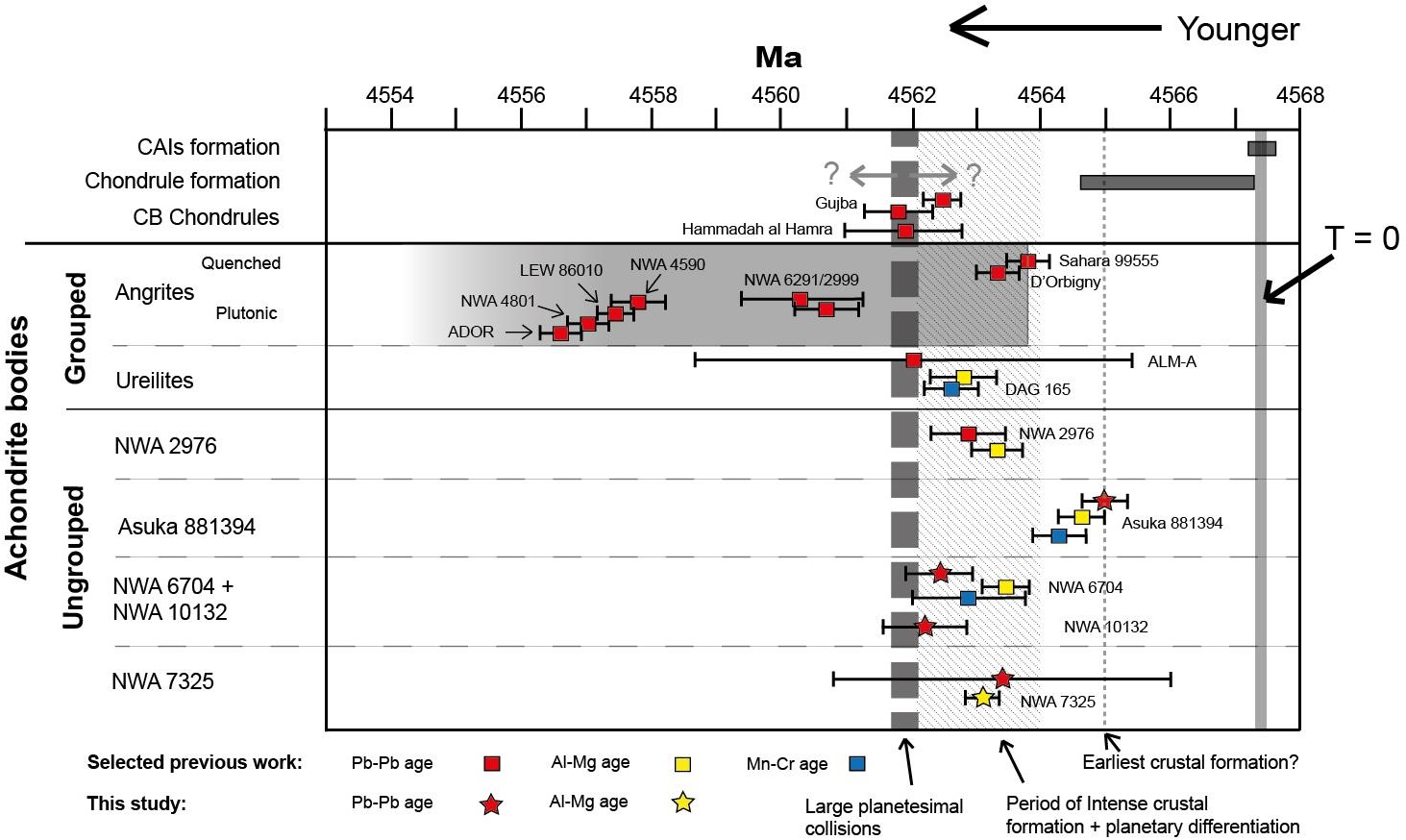
Improvements in the early chronology of the Solar System were presented by P. Koefoed (2017) based on more precise U–Pb data for the meteorites NWA 6704, NWA 10132, NWA 7325, and A-881394. The formation of crustal material of these planetesimals can be dated to as early as ~2 m.y. after CAIs, indicating that accretion of planetesimals was occurring contemporaneously with CAI formation.
Crystallization Ages for Early Solar System Meteorites
click on image for a magnified view
Diagram credit: Piers P. Koefoed, PhD thesis of The Australian National University (2017 open accesslink)
'Sequencing Planetary Accretion Using Chronology Of Ungrouped Achondrites'
III. Insights From Nucleosynthetic Isotope Anomalies
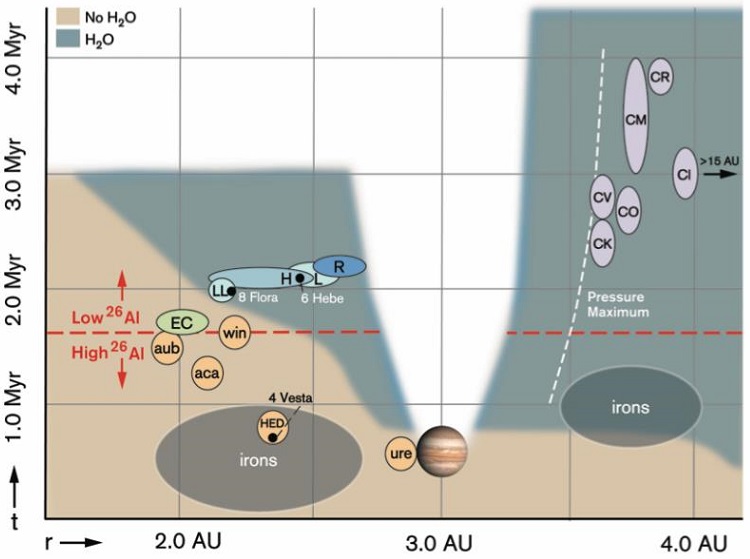
Initially, Trinquier et al. (2007) concluded that at least two distinct nebular reservoirs can be resolved based on 54Cr isotopic heterogeneity among the known parent bodies. Thereafter, based on O, Cr, Ti, and Ni stable-isotopic data, Warren (2011) recognized the existence of two distinct taxonomic superclans: those which accreted inside the orbit of Jupiter where thermal processing occurred under reducing conditions, termed 'non-carbonaceous' (NC), and those which accreted outside of its orbit where thermal processing occurred under oxidizing conditions, termed 'carbonaceous' (CC); the difference in redox conditions is attributed to differences in the ice, dust, and gas abundances (see also open access papers in EPSL by Budde et al. [2016], LPSC by Worsham et al. [2018 #2720], and Space Science Reviews by Kleine et al. [2020]). These two reservoirs were segregated by the rapid accretion of proto-Jupiter and reflect differences in the contribution (i.e., susceptibility to thermal processing) of proton (p-) process, rapid neutron capture (r-) process, and slow neutron capture (s-) process isotopes inherited as dust ejecta from explosive stellar nucleosynthesis—core-collapse supernovae, neutron star mergers, and low mass (1.5–4 M⊙) AGB stars, respectively (Poole et al., 2017; Bermingham et al., 2018; Ek et al., 2020). In a study of W, Mo, and Ru isotopes in iron meteorites, Kruijer et al. (2017) recognized that both of these reservoirs were coeval and remained spatially separated within the protoplanetary disk for a prolonged period (~ 3.6–4.8 m.y., inferred from timing of CR and CB parent body accretion, respectively) associated with the rapid growth of proto-Jupiter, attaining an ~30 M⊕ core at 2.9–3.2 AU within the first 0.6 m.y. (Desch et al., 2018).
Model Plot Predicting When and Where Meteorite Types Formed
click on diagram for a magnified view Data Key
Diagram credit: Desch et al., The Astrophysical Journal Supplement Series, vol. 238, #1, p. 23 (2018 open access versionlink)
'The Effect of Jupiter's Formation on the Distribution of Refractory Elements and Inclusions in Meteorites'
(https://doi.org/10.3847/1538-4365/aad95f)
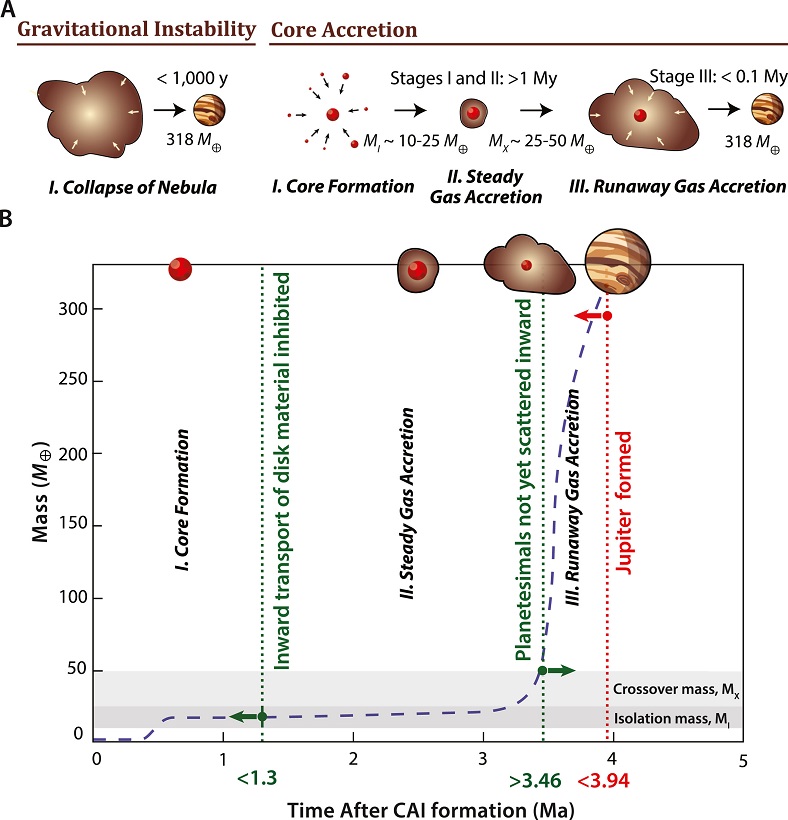
Additional constraints on the timing of the growth of Jupiter were provided by Weiss and Bottke (2021) based on isotopic and paleomagnetic data. They determined that the core accretion model rather than the gravitational instability model is most consistent with both their data and observations by the Atacama Large Millimeter/submillimeter Array (ALMA) (see diagram A below).
Two Models for the Formation of Jupiter
click on image for a magnified view
Diagram credit: Weiss and Bottke, AGU Advances, vol. 2, #2 (June 2021, open accesslink)
'What Can Meteorites Tell Us About the Formation of Jupiter?'
(https://doi.org/10.1029/2020AV000376)
Weiss and Bottke (2021) and Weiss et al. (2022) proposed a plausible scenario and timing sequence for the formation of Jupiter and evolution of the solar nebula as follows (see diagram B above):
Accretion of Jupiter begins with the formation of a metal-rich core, then reaching its isolation mass (MI) of ~10–25 M⊕ before 1.3 m.y. after CAIs
The growing planet created a gap (pressure bump) in the protoplanetary disk separating the NC and CC isotopic reservoirs.
Jupiter reached its crossover mass (MX) of ~20–50 M⊕ by 3.46 m.y. after CAIs.
Jupiter experienced runaway gas accretion at very rapid rates over a short period of <0.5 m.y., attaining its final mass of 318 M⊕.
The solar nebula in the non-carbonaceous reservoir dissipated between 1.22 and 3.94 m.y. after CAIs, the latter discerned from angrite paleomagnetic data.
The solar nebula in the carbonaceous reservoir dissipated between 2.51 and 4.89 m.y. after CAIs, the latter discerned from CV chondrite paleomagnetic data.
CO chondrite paleomagnetic data obtained by Borlina et al. (2022) suggest that the carbonaceous reservoir gas dissipated between 2.71 and 5.1 m.y. after CAIs, with a best resolved timing of ~4.2 m.y. after CAIs. They also determined that the nebula dissipation was most likely the result of magnetically driven winds and/or photoevaporation.
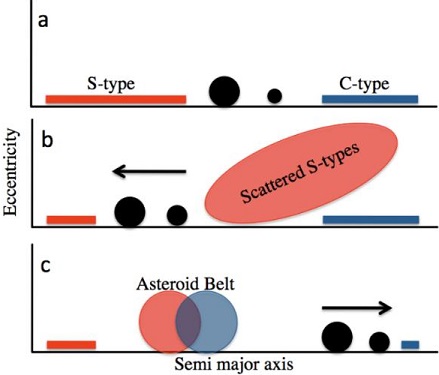
It has been posited that after Jupiter had grown to a massive size (>50 M⊕) by ~4 m.y. at an initial heliocentric distance of ~3 AU, it underwent a chaotic migration in a 2:1 (or 3:2) mean motion resonance with Saturn—first inward for ~100 t.y. to ~1.5–2.0 AU while clearing the inner disk of planetesimals, and then outward for 500 t.y. ultimately ending at its current location near 5.2 AU (and Saturn near 7.1 AU); this is known as the 'Grand Tack' scenario (Walsh et al. 2011, #2585, 2012; Johnson et al., 2016; Brasser et al., 2016). In accord with the 'Nice Model' (Gomes et al., 2005; Tsiganis et al., 2005; Morbidelli et al., 2005; named after the French city where proposed), an orbital instability caused the final outward migration of the four (or initially five to six before their ejection; Nesvorný and Morbidelli, 2012) gas planets, ultimately settling into their current orbits. The most plausible timing of this early instability is now considered to be ~30–100 m.y. after nebula dissipation, coeval with the Moon-forming impact (Clement et al., 2021 and references therein). This instability event led to the scattering of existing planetesimals from the carbonaceous reservoir into the inner Solar System where some of this material acquired orbital stability in the outer asteroid belt (Pierens et al., 2014). This event can also explain other characteristics of the current Solar System such as the relatively small mass of both Mars and the asteroid belt, as well as the dynamically cold orbits of the current terrestrial planets (Clement et al., 2018, Clement et al., 2019).
“The Grand Tack” Model of Jupiter and Saturn
Diagram credit: Walsh et al., MAPS, vol. 47, #12, p. 3 (2012 open accesslink)
'Populating the asteroid belt from two parent source regions due to the migration of
giant planets—“The Grand Tack”'
(10.1111/j.1945-5100.2012.01418.x)
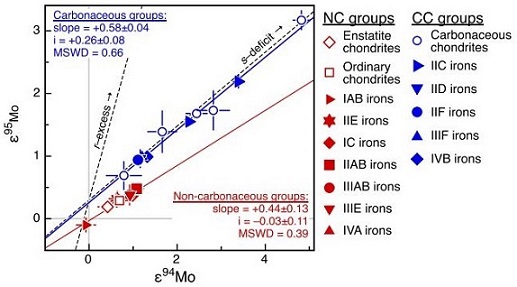
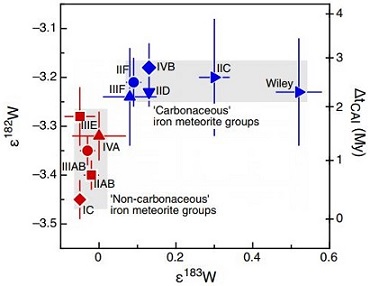
Kruijer et al. (2017) determined the ε182W values for representative iron meteorites, which reflect the timing of metal–silicate differentiation on their respective parent bodies. Based on coupled Mo- and W-isotopic diagrams (see below), they demonstrated that irons from groups IAB, IC, IIAB, IIE, IIG, IIIAB, IIIE, and IVA (and IIG; Wasson and Choe, 2009; A. Rubin, 2018) are associated with the non-carbonaceous reservoir (NC), in which iron parent bodies experienced earlier accretion (<0.4 m.y. after CAIs) and core formation (~ 0.3–1.8 m.y. after CAIs). By contrast, irons from groups IIC, IID, IIF, IIIF, and IVB are associated with the carbonaceous reservoir (CC), and their parent bodies experienced a later accretion (~1 m.y. after CAIs) and core formation (~ 2.2–2.8 m.y. after CAIs).
Rubin (2018 article, abstract) recognized that the CC irons are enriched in refractory siderophile elements and attributed this to the inheritance of refractory metal nuggets initially present in CAIs. The enrichment in Ni observed in CC irons compared to NC irons was considered to reflect in part the higher oxidizing conditions that existed in the outer Solar System where CC irons accreted. However, in an expanded sampling of ungrouped irons conducted by Spitzer et al. (2019, #2592), no significant difference in Ni content was found to exist between irons from the two reservoirs. It was also demonstrated by Rubin (2018) that CC irons generally have significantly higher CRE ages than NC irons, consistent with their location in the outer asteroid belt and thus greater distance traveled prior to intersection with the Earth. He also found that there are generally fewer members in the CC iron groups compared to the NC iron groups, which is likely a factor of (i) a smaller core volume for CC iron asteroids due to later accretion, less differentiation, and perhaps most importantly, a higher oxidation state resulting in less production of metal, and (ii) greater fragmentation experienced by CC iron meteoroids given their longer transit times in space. Furthermore, he posited that most ungrouped magmatic irons would derive from the CC reservoir, as are the two which had been adequately analyzed up to then, Mbosi and Grand Rapids. In their analysis of Mo, W, and Pt isotopes for ungrouped irons, Spitzer et al. (2019 #2592) found support for this latter hypothesis of Rubin (2018), as they determined that more of the ungrouped irons originated from the CC region compared to the NC region reflecting a ratio of 8:5. In addition, they recognized that those originating from the CC region generally have negative Δ17O values while those from the NC region have positive values.
Nucleosynthetic Mo and W Isotope Dichotomy
(ε notation denotes deviation from terrestrial standards in parts per ten thousand)
Diagrams credit: Kruijer et al., PNAS, vol. 114, #26, p. 6713 (2017 open accesslink)
'Age of Jupiter inferred from the distinct genetics and formation times of meteorites'
(http://dx.doi.org/10.1073/pnas.1704461114)
A subsequent Mo isotope study conducted by Budde et al. (2019) and utilizing a more comprehensive sampling of meteorite groups led to a refinement in the slopes and intercepts for the NC and CC groups (see revised coupled Mo isotope diagram below). The mixing lines of both groups have identical slopes with a value of 0.596, while the offset in the y-axis intercept between the CC and the NC groups reflects an excess of r- and possibly p-process Mo in the CC region of the protoplanetary disk. Further details about their study to constrain the origin of the Moon-forming impactor 'Theia' can be found on the NWA 032 page.
Nucleosynthetic Mo Isotope Dichotomy (Revised I)
(ε notation denotes deviation from terrestrial standards in parts per ten thousand)
Diagram credit: Budde et al., Nature Astronomy, vol. 3, pp. 736–741 (May 2019)
'Molybdenum isotopic evidence for the late accretion of outer Solar System material to Earth'
(https://doi.org/10.1038/s41550-019-0779-y)
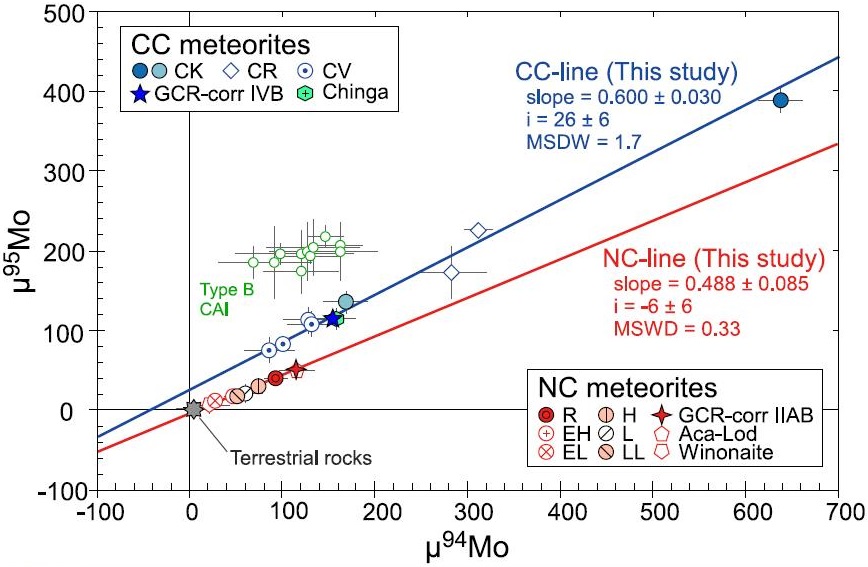
The Mo-isotopic dichotomy that exists between the CC and NC meteorites was also investigated by Yokoyama et al. (2019) employing an extremely precise measurement technique. Their study included ten irons (IIAB [4], IVB [4], IVB-like, IIE-like), two carbonaceous chondrites (CK4, CK5), five ordinary chondrites (H4, H5, LL5 [2], LL6), and two rumuruti chondrites (R3.9, R4). While the previous study by Budde et al. (2019) utilized a broader sampling of meteorite groups for their revision of the 95Mo–94Mo isotope diagram after Kruijer et al. (2017), the new study by Yokoyama et al. (2019) used improved values for irons that are corrected for neutron-capture modification due to galactic cosmic ray (GCR) exposure during prolonged transit times in space. Based on these more accurate values for iron meteorites, along with new values for other meteorite groups combined with recent literature data (e.g., Kruijer et al., 2017; Budde et al., 2019), they derived new slopes and intercepts for the coupled Mo isotope diagram as shown below.
Nucleosynthetic Mo Isotope Dichotomy (Revised II)
(µ notation denotes deviation from terrestrial standards in parts per million)
click on image for a magnified view
Diagram credit: Yokoyama et al., The Astrophysical Journal, vol. 883, #1, article 62 (2019)
'Origin and Evolution of Distinct Molybdenum Isotopic Variabilities within Carbonaceous and Noncarbonaceous Reservoirs'
(https://doi.org/10.3847/1538-4357/ab39e7)
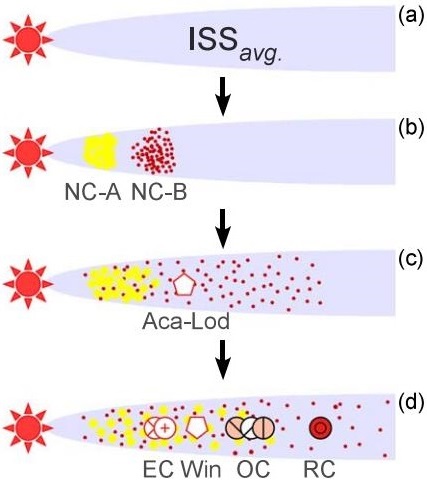
The new slope derived by Yokoyama et al. (2019) for the CC meteorites is consistent with that obtained in previous studies, with the Mo-isotopic variability among samples being attributed either to differences in the abundances of s-process-enriched presolar grains or to parent body processing (e.g., oxidation, thermal metamorphism). The new slope derived for the NC meteorites can be explained by the existence of two end-member components, NC-A and NC-B, which are resolved from each other by variations in s-process and r-process Mo isotope depletions. The NC-B component is represented most closely by the R chondrite and ACA–LOD groups, which exhibit the highest depletion in r-process Mo with no depletion in s-process Mo. Yokoyama et al. (2019) posit that the NC-B component could be a residual fine-grained phase that is isotopically complementary to the the type B CAI nebular reservoir, as established by a thermally-induced destruction of an r-process-rich carrier in the early protoplanetary disk (see schematic diagram by Yokoyama et al., 2019). Thereafter, the NC-A component was formed either by 1) another thermal processing event that destroyed an s-process-depleted carrier phase, or 2) the removal of a metal component from (thus increasing the ηs and ηr values), or the addition of a matrtix component to (thus decreasing the ηs and ηr values) an initial NC-B-like reservoir (see schematic illustration below).
Schematic Illustration of the Origin of the NC-A and NC-B Reservoirs
Diagram credit: Yokoyama et al., The Astrophysical Journal, vol. 883, #1, article 62 (2019)
'Origin and Evolution of Distinct Molybdenum Isotopic Variabilities within Carbonaceous and Noncarbonaceous Reservoirs'
(https://doi.org/10.3847/1538-4357/ab39e7)
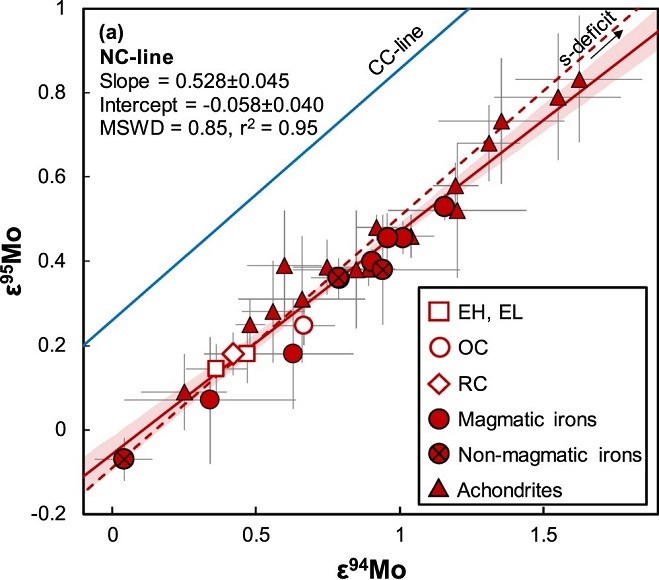
After accounting for cosmic-ray exposure effects on Mo isotopes, Spitzer et al. (2020) investigated the Mo isotope variations for a suite of iron meteorites from the NC region of the protoplanetary disk. In the diagram below, they derived a shallower s-process mixing line slope for NC meteorites compared to CC meteorties, which delineate a slope of 0.528 (±045) compared to 0.596, respectively. This difference in slope is attributed to an additional r-process contribution in the NC meteorties.
Nucleosynthetic Mo Isotope Dichotomy (Revised III)
(ε notation denotes deviation from terrestrial standards in parts per ten thousand)
click on image for a magnified view
Diagram credit: Spitzer et al., vol. 898. #1, (2020 open accesslink)
'Isotopic evolution of the inner Solar System inferred from molybdenum isotopes in meteorites'
(https://doi.org/10.3847/2041-8213/ab9e6a)
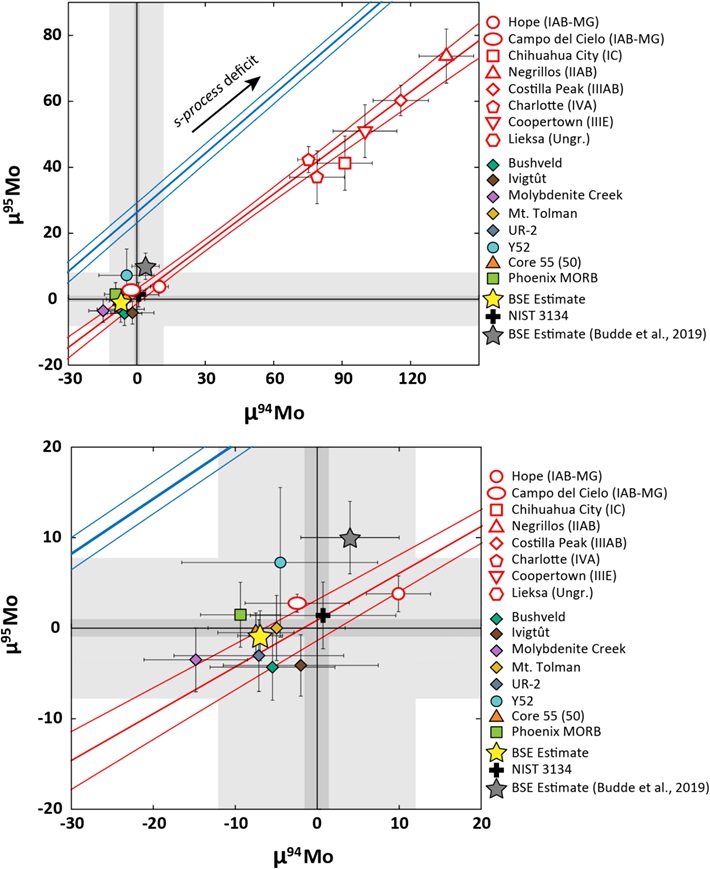
Improved slope and intercept values were obtained by Bermingham et al. (2025) in a Mo-isotopic study of multiple NC irons representing a variety of chemical groups, along with terrestrial rock samples of various ages from diverse locations (e.g., molybdenite from Isua, Greenland dated at 3.81 b.y.) using an advanced multi-dynamic negative thermal ionization mass spectrometry (N-TIMS) methodology. They found that the slope and intercept values calculated in earlier studies (see initial study and revisions I-III above) would overlap within error the newly acertained NC and CC µ94Mo vs. µ95Mo correlations (non-parallel) if certain aspects of the previous laboratory analytical procedures and/or sample components had been different (e.g., exclusion of leachates in the regression, exclusion of silicate meteorites potentially containing altered presolar components, attaining complete digestion of presolar components). The improved Mo isotopic values were utilized to estimate the proportions of NC and CC material accumulated by Earth (Bulk Silicate Earth [BSE]) during its late-stage accretion (i.e., the final 10 to 20 wt% of growth). The results of the study indicate the CC contribution at this time was minimal (<10%), and that the Moon-forming impactor 'Theia' was likely an NC-type body. A similar conclusion was presented by Kleine et al. (2024 #2537; see diagram), finding that only a minor CC-rich (volatile-enriched) component was delivered to Earth late in its accretionary phase but prior to the Moon-forming event.
Nucleosynthetic Mo Isotope Dichotomy (Revised IV)
slope = 0.517 (± 0.042); y-intercept = 1 (± 2)
(µ notation denotes deviation from terrestrial standards in parts per million)
click on image for a magnified view
Diagram credit: Bermingham et al., GCA, vol. 392, pp. 38–51 fig. 6a,b (2025 open accesslink)
'The non-carbonaceous nature of Earth's late-stage accretion'
(https://doi.org/10.1016/j.gca.2024.11.005)
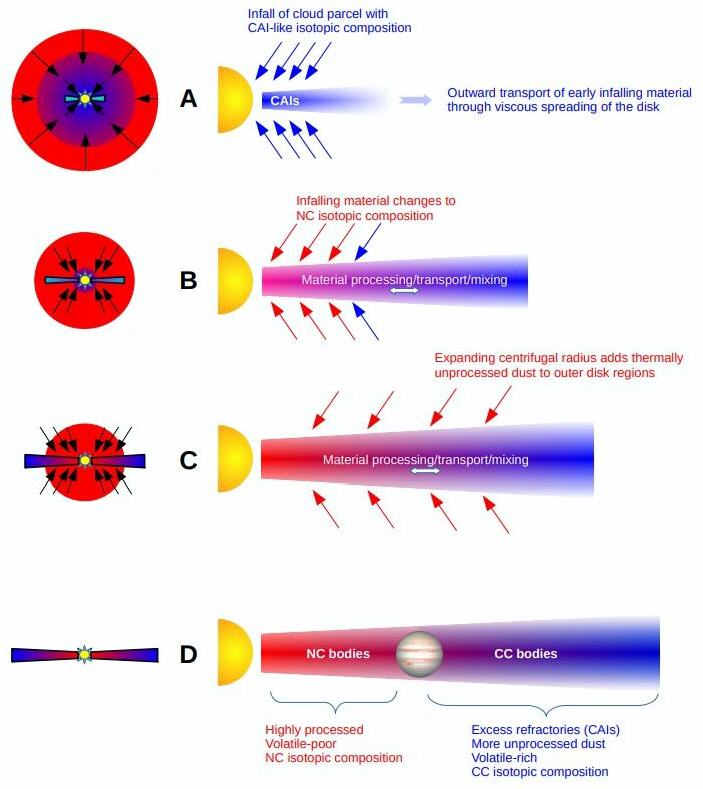
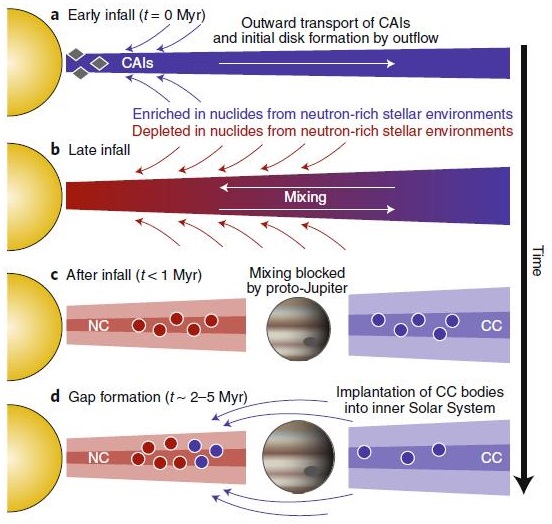
Nucleosynthetic isotope anomalies created during supernovae events were heterogeneously distributed within the molecular cloud, and this heterogeneity was imparted to the protoplanetary accretion disk throughout the early and late infall stages (Kruijer et al., 2019). Nucleosynthetic anomalies for many elements support the dichotomy between the NC and CC regions of the protoplanetary disk, including Cr, Ti, Mo, W, Hf, Sr, Nd, Ca, Ni, Sm, Ru, Ba, and Os (e.g., Burkhardt et al., 2019), Zr (e.g., Render et al., 2021), and Fe (e.g., Hopp et al., 2021). The isotopic offset between the CC and the NC groups demonstrated by most of these elements is attributed by Burkhardt et al. (2019) to primordial variability in the admixture of CAIs and CAI-like material on a molecular cloud scale. This isotopic heterogeneity was on the order of only ~0.1% (Kruijer et al., 2019). Burkhardt et al. (2019) suggest that during the cloud collapse phase the isotopic composition of the infalling dust evolved from CAI-like (termed 'IC' for Inclusion-like Chondritic component) to NC-like (more depleted in neutron-rich isotopes). Consequently, this led to an NC-like isotopic dilution of the inner nebular region, while at the same time, the outward expansion of the accretionary radius led to an enrichment of the outer nebular region in unprocessed, primitive, refractory- and volatile-rich material. The rapid formation of Jupiter to ~10–20 M⊕ within <0.5 m.y. created a barrier to further mixing between the NC and CC reservoirs (Kruijer et al., 2019). A possible inward-then-outward migration of Jupiter and Saturn ('Grand Tack') and/or the creation of an instability due to a mean motion resonance configuration between Jupiter and Saturn ('Nice Model') can explain many characteristics of the Solar System, including the distribution of NC and CC material in the asteroid belt, the volatile budget of Earth, and the small size of Mars. See two schematic illustrations of this scenario below.
1. Schematic Illustration of the Origin of the NC and CC Dichotomy
click on diagram for a magnified view
Diagram credit: Burkhardt et al., GCA, vol. 261, p. 165 (2019 open accesslink)
'Elemental and isotopic variability in solar system materials by mixing and processing of primordial disk reservoirs'
(https://doi.org/10.1016/j.gca.2019.07.003)
2. Schematic Illustration of the Origin of the NC and CC Dichotomy
Diagram credit: Kruijer et al., Nature Astronomy, vol. 4, p. 36 (2020)
'The great isotopic dichotomy of the early Solar System'
(https://doi.org/10.1038/s41550-019-0959-9)
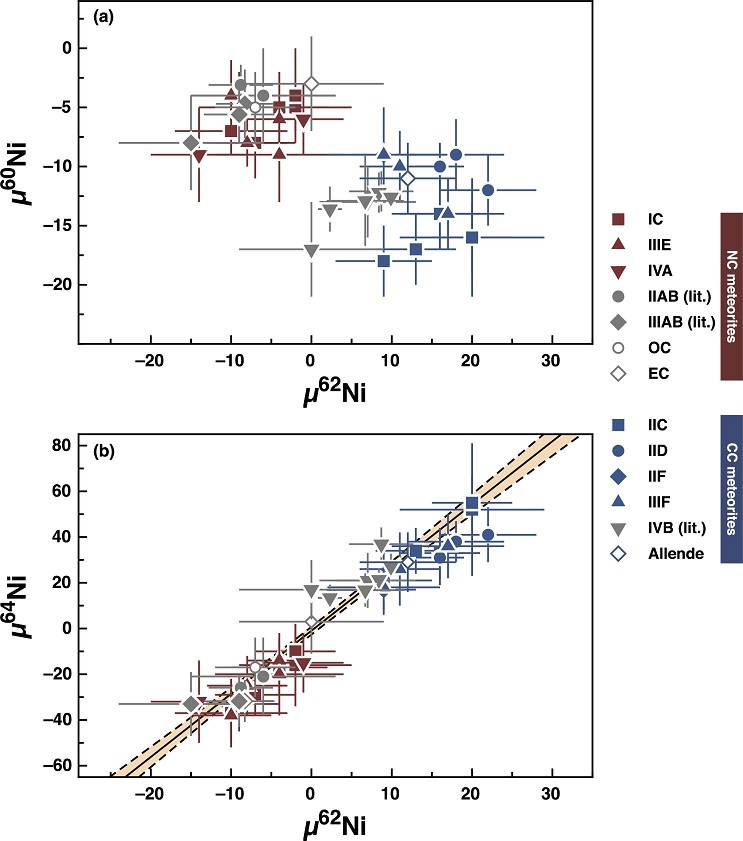
In a related study, Nanne et al. (2019) analyzed the Ni isotopes in irons from several CC-region chemical groups and found an ~60 ppm 58Ni excess for these irons compared to those from the NC-region chemical groups (see top diagrams below). They also assert that the NC–CC dichotomy reflects the late infall to the inner protoplanetary disk of material depleted in supernova-derived nuclides such as 54Cr, 50Ti, 58Ni, and r-process Mo at a time when the Jupiter gap prevented efficient exchange between the two isotopically-distinct disk regions. Thus, the present CC region in the outer protoplanetary disk preserves for the most part the initial disk isotopic composition that was established through an enrichment in supernova-derived nuclides, which were hosted by the earliest formed nebular solids—CAIs.
Ni Isotope Compositions for NC and CC Meteorites
(µ notation denotes deviation from terrestrial standards in parts per million)
click on diagram for a magnified view
Diagrams credit: Nanne et al., Earth and Planetary Science Letters, vol. 511, p. 47 (2019 open accesslink)
'Origin of the non-carbonaceous—carbonaceous meteorite dichotomy'
(https://doi.org/10.1016/j.epsl.2019.01.027)
Boss (2022 and previous articles) employed multidimensional hydrodynamics codes to further investigate the model illustrated above (e.g., Burkhardt et al., 2019; Kruijer et al., 2020) for the formation of the NC–CC dichotomy. A physical mechanism was posited to explain the isotopic change that occurred—from an enrichment in Type II supernova (SN II) isotopes before ~100,000 years which denotes the early infall phase, to a depletion in SN II isotopes thereafter which denotes the late infall phase ending ~1 m.y. years later. Their model demonstrated that a SN II shock wave triggered the gravitational collapse of the presolar molecular cloud core, injected short-lived radioisotopes (e.g., 60Fe, 26Al; the early infall phase), and accelerated this newly-formed protoplanetary disk to a velocity of ~3.2 km/s as it traversed the giant molecular cloud into a region lacking any supernova-derived nuclides (the late infall phase).
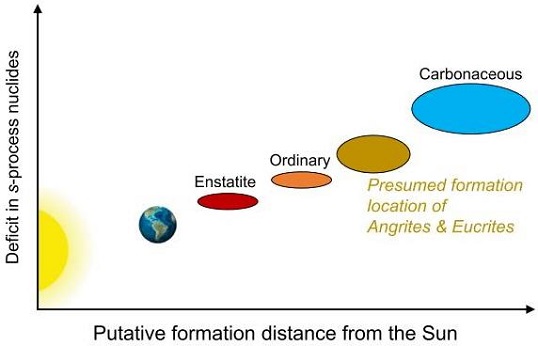
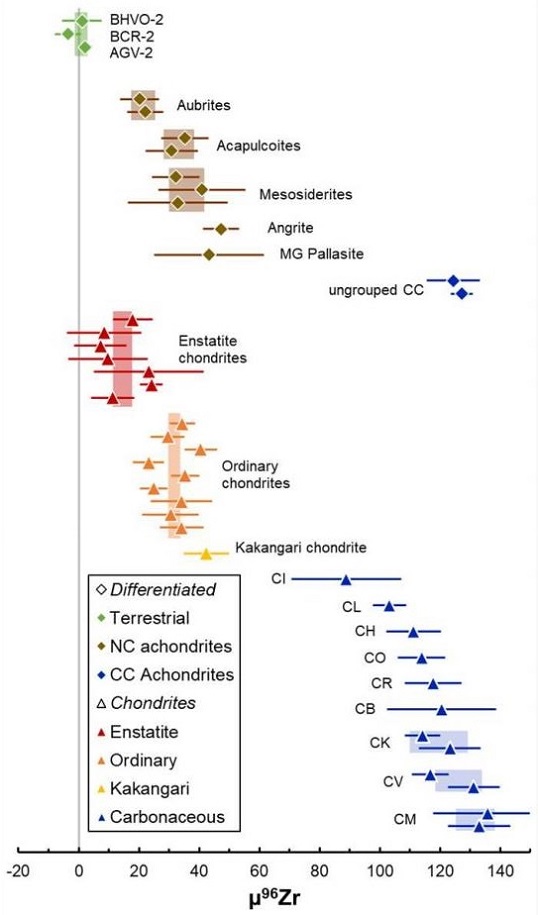
Render and Brennecka (2021) conducted a high-precision investigation of the nucleosynthetic isotope anomalies associated with the lithophile elements Nd and Zr in several angrites and eucrites. The rendered isotopic compositions for Nd and Zr, together with literature isotopic compositions for the moderately siderophile Mo and the highly siderophile Ru, demonstrate that a coherent trend exists in the distribution of s-process nuclides among different meteorite parent bodies, i.e., a progressive increase in s-deficits with increasing heliocentric distance. These nucleosynthetic signatures enabled them to model the heliocentric order of accretion of several major meteorite groups in the early protoplanetary disk (see top diagram below). Render et al. (2021) conducted a similar high-precision investigation of the nucleosynthetic isotope anomaly associated with the highly refractory, fluid-immobile, lithophile element zirconium (Zr) in most meteorite groups, which also demonstrates the NC–CC dichotomy (see bottom diagram below).
Cosmolocation From Nd, Zr, Mo, and Ru Nucleosynthetic Signatures
Diagram credit: Render and Brennecka, Earth and Planetary Science Letters, vol. 555, (2021)
'Isotopic signatures as tools to reconstruct the primordial architecture of the Solar System'
(https://doi.org/10.1016/j.epsl.2020.116705)
NC and CC Dichotomy Shown by Zr Nucleosynthetic Anomalies
Diagram credit: Render et al., 84th MetSoc, #6233 (2021)
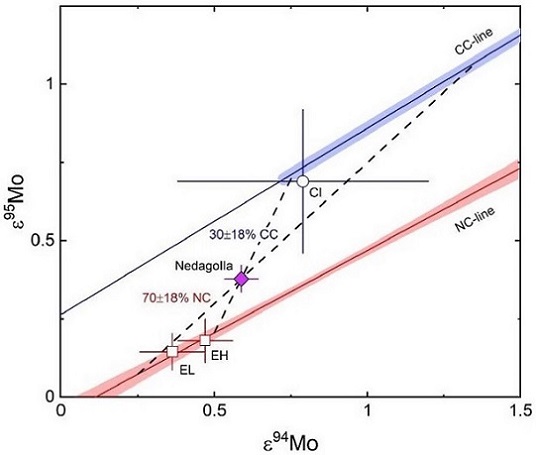
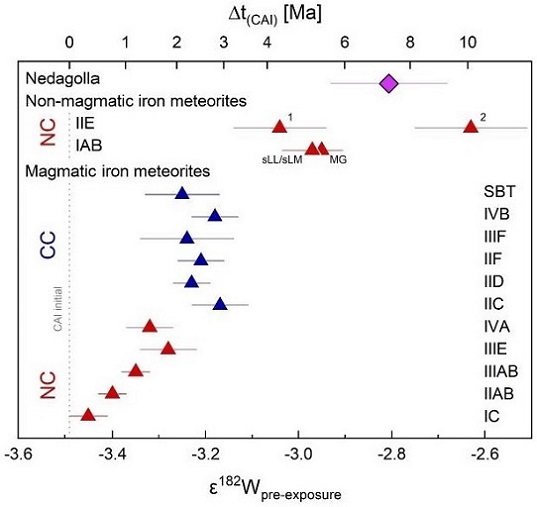
Using Mo, Ru, and Ni isotope systematics, Spitzer et al. (2020 #3040, 2021) identified the first meteorite that has a mixed NC–CC isotopic composition—the 4.6 kg ungrouped iron Nedagolla that fell in India in 1870. The formation of Nedagolla is best modeled by a hit-and-run collision between a small differentiated CI-like body and a larger, likely differentiated EH-like body that resulted in mixing of core material from both. This scenario is consistent with the plot of Nedagolla on a ε94Mo–ε95Mo isotope diagram located between the NC and CC lines (see diagram below). The chemical composition of Nedagolla reflects depletions in Mo and W indicative of more oxidizing conditions during core formation, in character with a CC origin. On the other hand, its composition reflects enrichments in Si and Cr indicative of more reducing conditions, in accord with an NC origin. The collision that produced the mixed melt parental to Nedagolla can be reasonably dated to later than ~7 m.y. after CAIs by Hf–W systematics, and the event may be associated with a dynamical instability related to the growth of Jupiter. A subsequent smaller impact could have ejected the Nedagolla fragment toward Earth orbit. Notably, a second ungrouped iron, the ~12.9 kg sulfide-rich Sirjan 001, has been determined by Tornabene et al. (2022 #6095) to also have a mixed NC–CC Mo-isotopic composition; further analyses are ongoing.
Mixing Lines Connecting Nedagolla and NC–CC Meteorite Groups
ε182W Values and Hf–W Ages for Iron Meteorite Groups
Diagrams credit: Spitzer et al., MAPS, vol. 57, #2 (2021 open accesslink)
'Collisional mixing between inner and outer solar system planetesimals inferred from the Nedagolla iron meteorite'
(https://doi.org/10.1111/maps.13744)
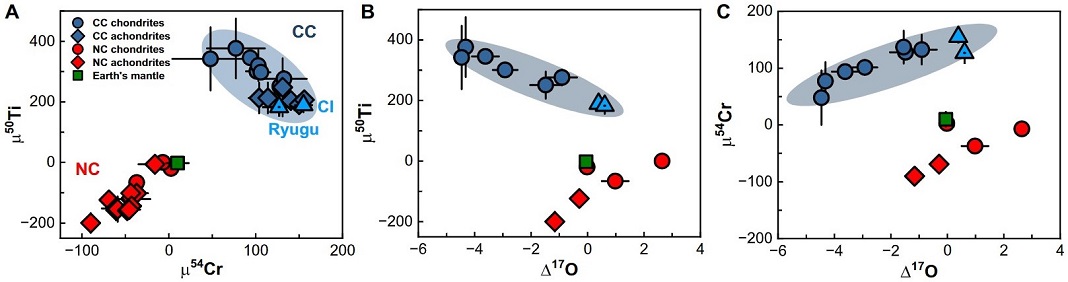
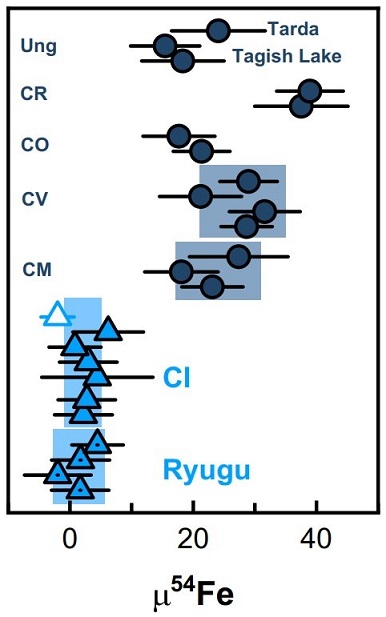
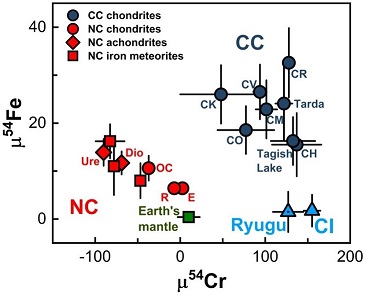
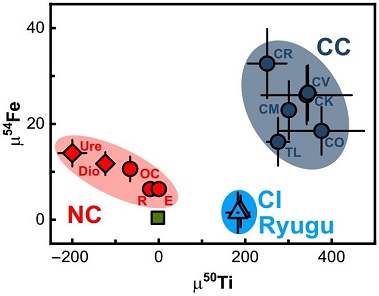
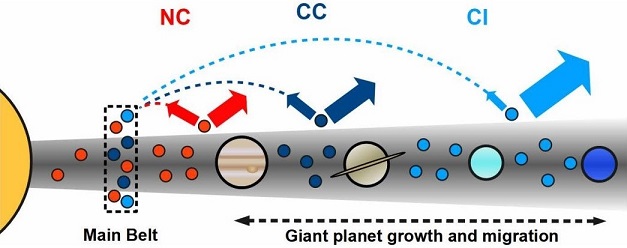
Hopp et al. (2022) investigated the comparative nucleosynthetic anomalous isotopes (O, Cr, Ti, Fe) of CI chondrites and samples of the Cb-type asteroid Ryugu returned by the JAXA Hayabusa2 mission. They found that the µ54Fe values of both CI chondrites and Ryugu samples are distinct from those of either NC or CC meteorites, indicating the existence of a third isotopic reservoir in the outer protoplanetary disk and thereby defining a trichotomy (see diagrams below). They suggest that CI chondrites and Ryugu originally formed in this distant reservoir and may even represent a common precursor body that experienced fragmentation after its implantation into the inner Main Belt. However, high-precision µ26Mg* data obtained by Bizzarro et al. (2023) indicate there were different parental sources for CI chondrites and Ryugu. Previously, computer modeling by Fernández and Ip (1981) demonstrated that close planetary encounters with Uranus and Neptune would have dispersed such cometesimals both outward into the cometary reservoir (Oort cloud) and inward into the inner Main Belt.
Nucleosynthetic Anomalous Isotope Plots for CI Chondrites and Asteroid Ryugu
(µ notation denotes deviation from terrestrial standards in parts per million)
click on diagrams for a magnified view
µ54Fe vs. µ54Cr and µ50Ti Isotopic Plots for CI Chondrites and Asteroid Ryugu Showing a Trichotomy
(µ notation denotes deviation from terrestrial standards in parts per million)
Schematic Illustration of Source Region and Dispersal of Cb-type Asteroids
(Cb-type asteroids = filled bright blue circles)
Diagrams credit: Hopp et al., Science Advances, vol. 8, art. eadd8141 (2022, open accesslink)
'Ryugu's nucleosynthetic heritage from the outskirts of the Solar System'
(https://doi.org/10.1126/sciadv.add8141)
Spitzer et al. (2024 abs, article) conducted a study similar to that of Hopp et al. (2022), in which they analyzed nucleosynthetic Ni isotopes in CI chondrites and Ryugu samples. Their results define a distinct compositional field for CI chondrites and Ryugu rather than an isotopic endmember (see their Fig. 1). Therefore, they argue that the segregation of the CI group/Ryugu from the other CC groups based on nucleosynthetic Ni isotopes can be attributed to a shared loss of some FeNi-metal content among the non-CI carbonaceous chondrites and/or a more efficient accretion of µm-scale FeNi-metal by the CI group/Ryugu subsequent to nebula dissipation, rather than to the existence of an isotopic trichotomy (see their Fig. 4). With respect to the predicted mean µ54Fe for both the CI group/Ryugu and the other CC groups, Yap and Tissot (2023 #1902) found that there is substantial overlap between them, which also supports a disk isotopic dichotomy rather than trichotomy. Spitzer et al. (2024) contend that all CC groups, including the CI group/Ryugu, are comprised of the same four initial components: refractory inclusions, chondrules, FeNi-metal, and fine-grained matrix. In addition, they demonstrated that the ~15% variation in Fe/Si ratios among carbonaceous chondrites can be attributed to the ~5 wt% variation in FeNi-metal abundances of their respective parent bodies.
Based on mineralogical analyses initially conducted by Ikeda (1992), and then by King et al. (2015) and others, a potential new group was proposed which was assigned the working name of 'CY chondrites'. However, it has now been demonstrated that the original six Yamato meteorites composing the 'CY' group actually originate from multiple source parent bodies (Ebihara et al., 2025; Schrader et al., 2025). Zhu et al. (2025) have verified through petrographic, geochemical, and isotopic data that the 'CY' members represent two distinct asteroids: 1) the CYi members are thermally metamorphosed CI lithologies produced in an impact shock event, during which both lithologies were ejected, and 2) the CYm members represent similar heating/dehydration processes on a parent body unique from that of CM chondrites. See the Dhofar 1988 page for current updates on the status of the CY group.
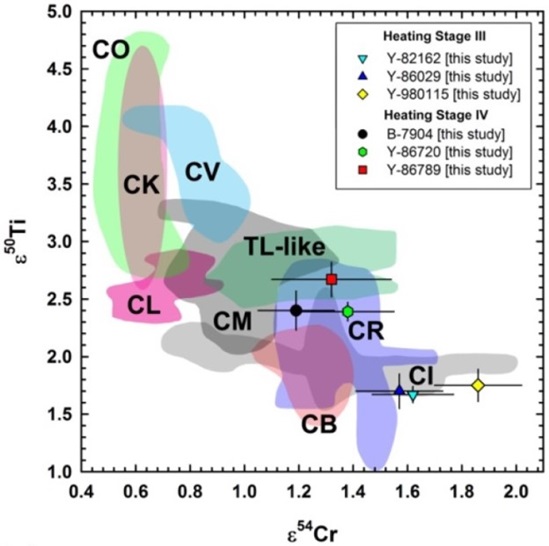
Furthermore, Schrader et al. (2025) have shown that the isotopic hiatus previously observed in the disk has now become a continuum with the inclusion of Cr and Ti isotopic data for these heated meteorites and other anomalous CC members, negating any evidence for the existence of a trichotomy (see diagram below).
ε54Cr vs. ε50Ti Isotopic Plots for CC Chondrite Groups Showing a Continuum
(ε notation denotes deviation from terrestrial standards in parts per ten thousand)
Diagram credit: Schrader et al., GCA, vol. 390, pp. 24–37 (2025)
'Reassessing the proposed "CY chondrites": Evidence for multiple meteorite types and parent bodies from Cr-Ti-H-C-N isotopes and bulk elemental compositions'
(https://doi.org/10.1016/j.gca.2024.12.021)
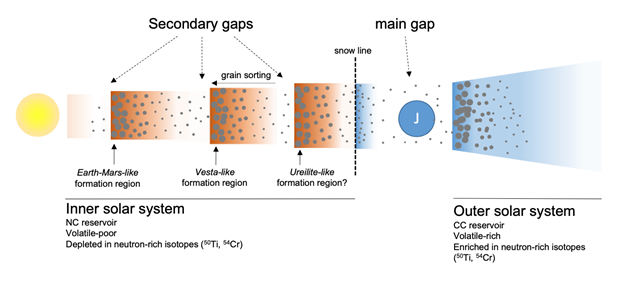
Genetic relationships among the meteorite parental source bodies were established at the time of their accretion within isotopically distinct disk reservoirs. A first-order taxonomic division was identified by Warren (2011), and the two subgroups were termed the 'non-carbonaceous' (NC) and the 'carbonaceous' (CC) superclans. This dichotomy is attributed by Rüfenacht et al. (2023) to a combination of snow line processes, thermal processing, and gravitationally-generated pressure bumps and gaps. They recognized that the isotopic compositional variability inherent among different meteorite groups could have been established through a number of possible mechanisms, including temporal isotopic heterogeneity of infalling material from the molecular cloud (e.g., Kruttasch, 2024 [#2096]), aerodynamic size- and density-sorting processes within the protoplanetary disk, and the selective thermal processing/destruction of interstellar medium dust and presolar grains. Utilizing high precision 50Ti, 54Cr, and 48Ca isotopic data for a wide variety of meteorite groups, Rüfenacht et al. (2023) distinguished two sub-reservoirs within the NC reservoir, each of which are comprised of isotopically distinct parent body clusters: 1) Vesta-like (ε50Ti = –1.23 [±0.14]), comprising HEDs, mesosiderites, angrites, brachinites, acapulcoites, lodranites, and MG pallasites, and 2) Mars-Earth-like (ε50Ti = –0.34 [±0.46]), comprising martian and terrestrial samples, aubrites, ECs, OCs, RCs, winonaites, and IAB silicates. In addition, a compelling case for the existence of a third sub-reservoir encompassing the ureilites has been presented by Kruttasch et al. (2025; see Figs. 4, 5). Rüfenacht et al. (2023) attribute these isotopically distinct clusters to secondary ring-like pressure maxima and gap substructures, thought to be generated and sustained by the spiral arms of a rapidly growing proto-Jupiter. The pressure maxima promote the aggregation of planetesimals through gravitational scenarios such as that involving the streaming instability (see diagrams below).
Disk Substructures Revealed by Nucleosynthetic Isotope Coupled Diagrams
click on image for a magnified view
Disk Substructures Revealed by Ti Nucleosynthetic Isotopes
Secondary Substructures in the Protoplanetary Disk
Diagrams credit: Rüfenacht et al., GCA, vol. 355, fig. 3 (2023 open accesslink)
'Genetic relationships of solar system bodies based on their nucleosynthetic Ti isotope compositions and sub-structures of the solar protoplanetary disk'
See also Schönbächler et al., Goldschmidt Conference 2023, paper #19035
'Nucleosynthetic Ti isotope compositions of planetary bodies indicate secondary sub-structures in the solar protoplanetary disk'
See also Schönbächler et al., Space Science Reviews, vol. 221, #97, fig. 14 (2025 open accesslink)
'Initial Conditions of Planet Formation: Time Constraints from Small Bodies and the Lifetime of Reservoirs in the Solar Protoplanetary Disk'
See also Sossi and Bower, Nature Astronomy, fig. S2 (2026 open accesslink)
'Homogeneous accretion of the Earth in the inner Solar System'
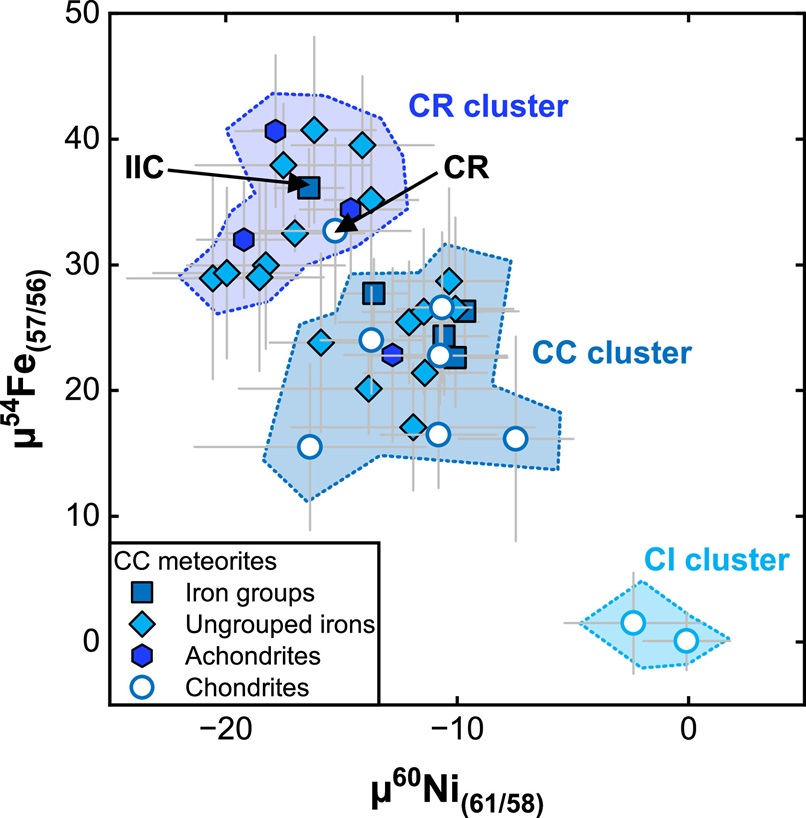
Spitzer et al. (2025) obtained Fe and Ni isotopic data for 27 ungrouped CC-type iron meteorites, 4 ungrouped CC-type achondrites, and 5 established iron groups (IIC, IIF, IIIE, IIIF, and IVB). Using both µ54Fe vs. µ64Ni and µ60Ni vs. µ64Ni coupled diagrams, they demonstrated that Ryugu and CI chondrites plot in a unique space compared to all other CC- and NC-type meteorites. They also found that no CI chondrites experienced a differentiation process, which they attribute to late formation after dissipation of the nebular gas. In addition, they demonstrated that CR-related meteorites constitute a genetic cluster distinct from Ryugu/CI chondrites and other CC-type meteorites based on Fe–Ni isotopic compositions, thus establishing three statistically significant CC-type clusters (see diagram below). Notably, all CR-related meteorites (e.g., chondrites, achondrites, and irons) derive from an early, isolated and sustained reservoir, and represent those CC planetesimals which are the most dissimilar to CI chondrites.
Ni–Fe Isotopic Data Reveal Secondary Disk Substructures
(µ notation denotes deviation from terrestrial standards in parts per million)
click on image for a magnified view
Diagram credit: Spitzer et al., EPSL, vol. 667, art. 119530, fig. 3 (2025 open accesslink)
'The evolution of planetesimal reservoirs revealed by Fe-Ni isotope anomalies in differentiated meteorites'
(https://doi.org/10.1016/j.epsl.2025.119530)
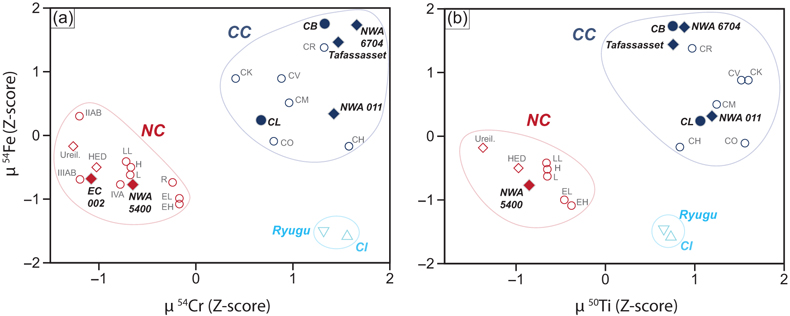
Further statistical analysis was conducted by Rego et al (2025) to investigate the dichotomy vs. trichotomy debate regarding the structure of the protoplanetary disk. Utilizing the 54Fe, 54Cr, and 50Ti isotopic anomalies, they applied hierarchical cluster analysis using the Ward's method (agglomerative algorithm) and the Elbow method (experience-based strategy), along with Monte Carlo simulations, to identify the optimal number of clusters within the dataset. Results of their analysis indicate there are three statistically coherent clusters, corresponding to NC meteorites, CC meteorites, and CI/Ryugu (see their Figure 2 below).
Hierarchical Cluster Analysis of Meteorite Groups
click on diagram for a magnified view
Diagram credit: Rego et al., Geochemical Perspectives Letters, vol. 37, p. 9, fig. 2 (2025, open accesslink)
'Consolidating the isotopic trichotomy of planetary materials with new evidence'
(https://doi.org/10.7185/geochemlet.2538)
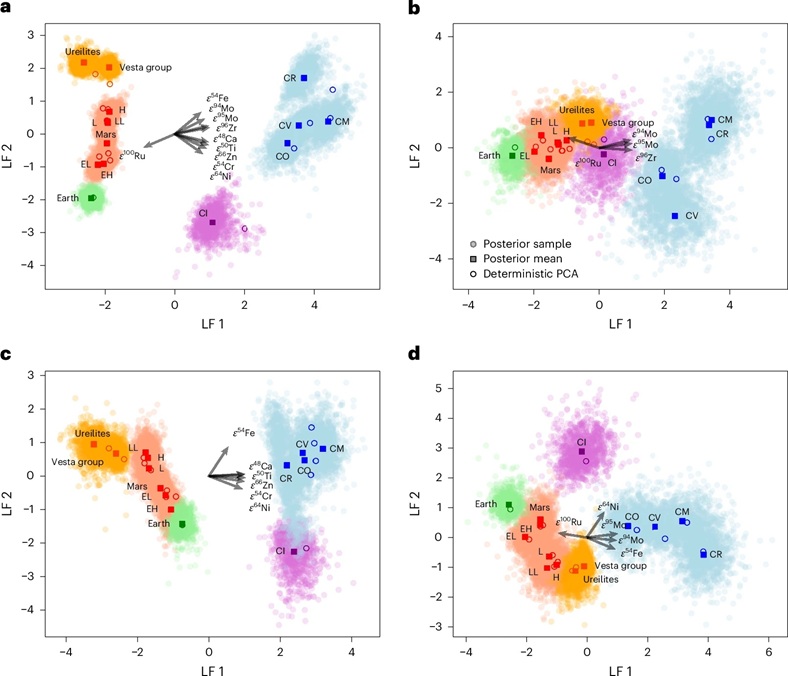
A third primary Solar System reservoir has been verified through ongoing research, including that published by Shollenberger et al. (2025), who employed Principle Component Analysis to the Ca, Ti, Cr, Fe, Ni, and Zn isotopic data obtained for the "Ryugu A0208" particle. Additional evidence supporting a third reservoir was published by Sossi and Bower (2026; see their Fig. 1 below), who applied both Bayesian latent factor analysis and deterministic Principle Component Analysis to the Ca, Ti, Cr, and Zn isotopic data obtained for individual NC parent bodies. Importantly, Sossi and Bower (2026) concluded that the Earth accreted nearly all of its isotopic composition from material that originated in the NC reservoir. This is consistent with results published by other researchers (e.g., Dauphas et al., 2024; Nimmo et al., 2024 [open access arXiv version]), whose models generally align with a scenario in which the Earth accreted 95% EC (NC) material during the first 75% of accretion, 80% EC material between 75% and 99.5% of accretion, and 95% EC material during the final 0.5% of accretion (late veneer). See the NWA 4801 page for further timeline details.
NC and CC Reservoirs with Subgroup Divisions
a: all elements; b: heavy elements; c: iron-peak elements; d: siderophile elements
(see Fig. 1 in the article for a complete description)
click on diagram for a magnified view
Diagram credit: Sossi and Bower, Nature Astronomy (2026 open accesslink)
'Homogeneous accretion of the Earth in the inner Solar System'
(https://doi.org/10.1038/s41550-026-02824-7)
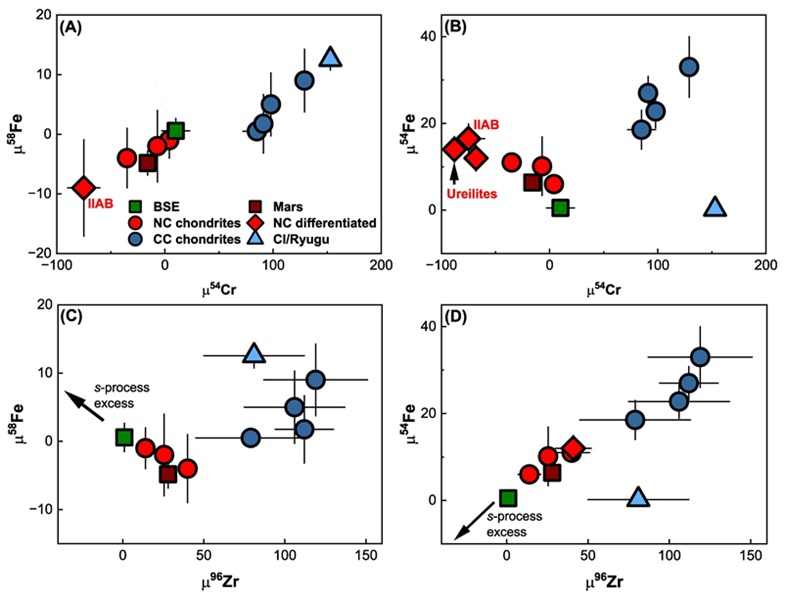
Hopp et al. (2026) used 54Fe–58Fe nucleosynthetic isotope data to further rule out a significant contribution of either CC or CI material to the late-stage accretion of Earth. The diagram below demonstrates the existence of three statistically significant clusters (a trichotomy) in the Solar System based on nucleosynthetic Fe, Cr, Zr, and Ti isotopes, and indicates that the bulk silicate Earth (BSE) accreted predominantly through oligarchic growth from an unsampled, s-process–enriched (i.e., negative ε94Mo and ε96Zr) NC component which was likely derived from a location sunward of proto-Earth. Their conclusion aligns well with that of many other researchers, including a multielement isotope study by Burkhardt et al. (2021), in which they calculated a peak contribution of CC material to both bulk Earth and bulk Mars of 4 mass% (see their Fig. 5). In addition, Burkhardt et al. (2021) reasoned that the similar contribution of CC material to both Earth and Mars argues against a CC origin for Theia in the Moon-forming imapct.
Contribution of Fe, Cr, and Zr Isotopic Anomalies to the Accretion of Earth
click on diagram for a magnified view
Diagrams credit: Hopp et al., Icarus, vol. 453, art. 117057, fig. 3 (2026 open accesslink)
'Iron isotope anomalies and the origin of the Earth'
(https://doi.org/10.1016/j.icarus.2026.117057)
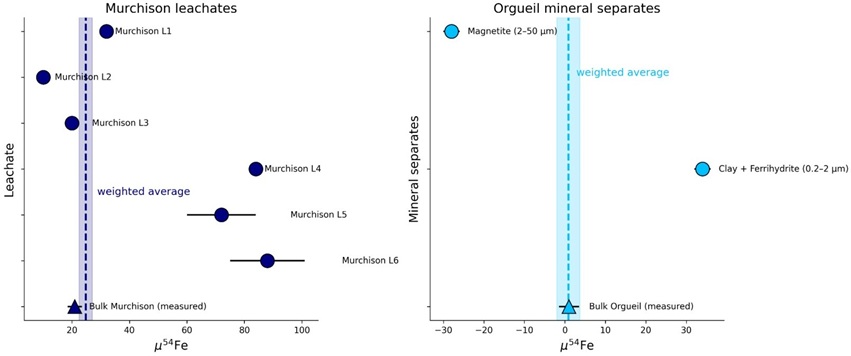
Hopp et al. (2022) established that the carrier phase of nucleosynthetic 54Fe and 58Ni isotopic anomalies in CC meteorites (showing excesses in both 54Fe and 58Ni) is primarily presolar material produced in the inner Si/S shell of core-collapse supernovae (≤25 M⊙), with a possible limited contribution from type Ia supernovae. Following this publication, an investigation to determine the carrier of presolar nucleosynthetic 54Fe isotope anomalies in CI chondrites was conducted by Mukherjee et al. (2026 #1801). Results of their comparative Fe-isotopic analysis of both Orgueil (CI) and Murchison (CM) agrees with the conclusions of Hopp et al. (2022), finding that the µ54Fe anomalies in CI chondrites were produced in the Si/S zone of core-collapse supernovae, and are now likely contained in the magnetite fraction of the 2–50 µm-sized mineral separates (see diagram below).
µ54Fe in Murchison (CM) and Orgueil (CI)
click on diagram for a magnified view
Diagram credit: Mukherjee et al., 57th LPSC, #1801 (2026)
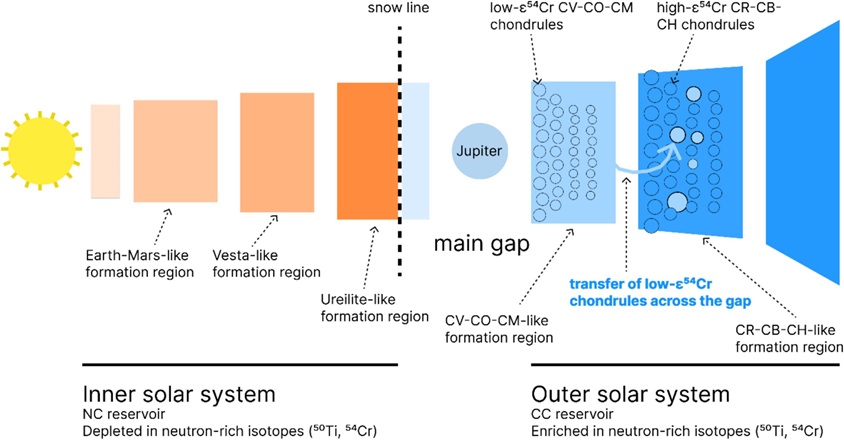
Anand and Mezger (2025) conducted Cr isotopic analyses on 9 chondrules from the CR2 chondrite Shişr 033. In agreement with Δ17O values obtained in a previous study by Marrocchi et al. (2022), ε54Cr values for the Shişr 033 chondrules exhibit a statistically-confirmed bimodal distribution (see the Renazzo page). Anand and Mezger (2025) propose that secondary disk substructures are likely responsible for the existance of two isotopically distinct CR chondrule populations, as previously suggested by Rüfenacht et al. (2023). Anand and Mezger (2025) inferred that a relatively small abundance of low-ε54Cr CV–CO–CM-like chondrules drifted outwards across a disk gap and into the high-ε54Cr CR sub-reservoir prior to parent body accretion (see diagram below).
Secondary Disk Substructures and CR Chondrule Isotopic Bimodality
click on diagram for a magnified view
Diagram credit: Anand and Mezger, Icarus, vol. 441, art. 116714, fig. 3 (2025, open accesslink)
'Chromium isotopes in CR chondrites reveal two distinct chondrule reservoirs'
(https://doi.org/10.1016/j.icarus.2025.116714)
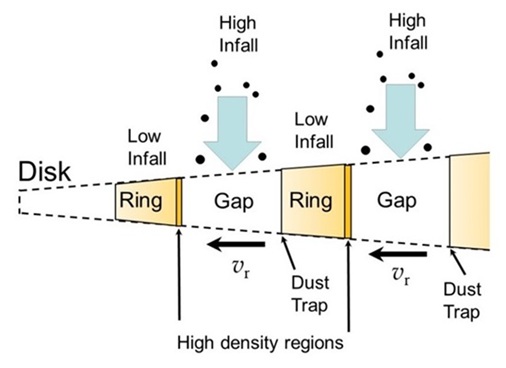
The formation of the primary substructure of protostellar disks, namely gaps and rings, was described by astrophysicist A. Prof. Kurt Liffman (2024 #1048). As micron-sized dust particles are ejected from the proto-Sun in bipolar jet flows and/or disk winds, they fall back onto the outer regions of the protostellar disk. These infalling inner-disk particles carry less angular momentum than does the outer-disk material, which results in a reduction of angular momentum in the outer-disk region and a corresponding radial flow inwards toward the protostar (at a speed of ~30 km per year). Because the mass of the infall material is temporally correlated with its radial disk speed, an inhomogeneous infall mass will produce gaps (higher infall mass) and rings (lower infall mass) over time. As this process continues, the radial flow of material in the gaps will ultimately reach the outer edge of the rings, thus increasing the local density and promoting the growth of planetesimals (see schematic diagrams below).
Diagrams credit: K. Liffman, 55th LPSC, #1048 (2024)
Full article in Publications of the Astronomical Society of Australia, vol. 40, art. e058 pp. 1–11 (2023)
'Inviscid protostellar disc ring formation and high-density ring edges due to the ejection and subsequent infall of material onto a protostellar disc'
(https://doi.org/10.1017/pasa.2023.55)
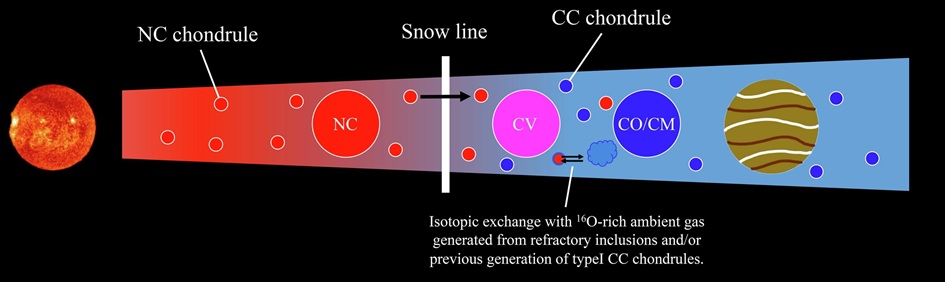
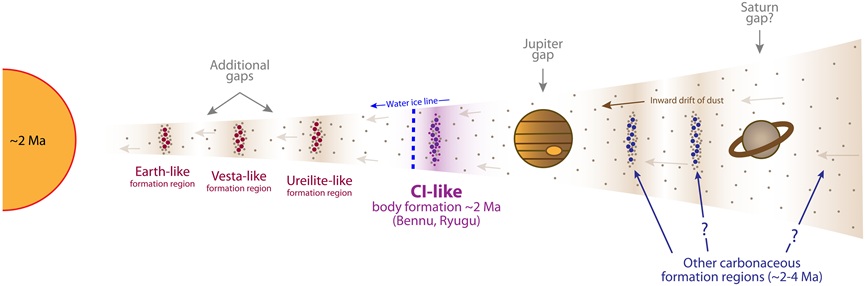
Sumitani et al. (2026) presented an alternate scenario for the formation location of the CV (and possibly CK, CM, and CO) parent body, one very different from most of the scenarios proposed previously (e.g., Anand and Mezger, 2025; see synopsis above). Based on the oxygen isotopic compositions of a set of rare chondrule types (~5% of the total) identified in the NWA 6991 CV3ox meteorite, they posit that the precursors to these type I chondrules were initially formed in the NC reservoir before being transported outward into the CC reservoir. Thereafter, this isotopically and chemically NC-like (16O-poor, relatively Mg-poor {=local oxidizing conditions due to high dust:gas ratio}) precursor dust was thermally processed (i.e., partial melting, mixing, isotopic exchange, recrystallization) in the presence of nebular gases having a CC-like (16O-rich, Mg-rich {=local reducing conditions due to low dust:gas ratio}) isotopic and chemical composition. In consideration of all available isotopic and petrographic data, as well as the size of the NC precursor dust particles, they contend that the CV parent body, and probably the CK parent body (and possibly the CM–CO clan), incorporated a minor abundance of these chondrule types as accretion proceeded near the water snowline just inside the orbit of proto-Jupiter (see schematic diagram below). Notably, while analagous schematic diagrams have shown this same disk zone to be empty space, the scenario proposed by Sumitani et al. (2026) fills it with multiple CC-type bodies.
Schematic Illustration of the CV Chondrule and Parent Body Formation Location
click on schematic diagram for a magnified view
Diagrams credit: Sumitani et al., Geochimica et Cosmochimica Acta, vol. 424, pp. 30–46, fig. 11 (2026 open accesslink)
'Oxygen isotope systematics of petrographically and chemically rare chondrules from the NWA 6991 (CV3) chondrite: Implications for chondrule precursors and radial transport in the protoplanetary disk'
(https://doi.org/10.1016/j.gca.2026.04.046)
Prior to the publication by Sumitani et al. (2026) above, Fukuda et al. (2024) studied the NC-like Cr–Ti–O isotope signatures of the cores of large chondrules from the least metamorphosed CV and CK chondrites. They proposed that some of the mm-scale chondrules and fragments, or their precursors, were initially formed in the inner disk and then transported outward to the CV formation region during the very early phase of disk evolution. However, based on newly obtained data including Fe, Si, and Cr isotope systematics (see their Fig. 5), van Kooten et al. (2026) contend that only a unique population of large reduced chondrules were transported outward (coeval with CAIs) where they were incorporated into CV chondrites, while the typical population of small-sized CV chondrules were formed locally in the outer disk. Dating of such transported chondrules (now CV chondrule cores) would help establish the viability of this scenario.
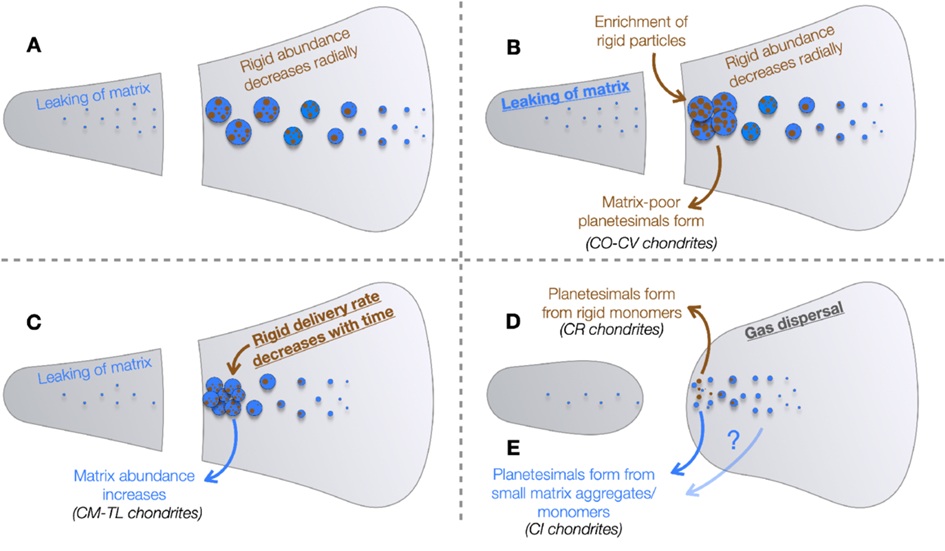
Contrary to the formation model advanced by Sumitani et al. (2026) above, Gurrutxaga et al. (2026) presented an archetypal model wherein all of the carbonaceous chondrites formed in a common long-lived pressure bump (dust trap). This particular pressure maximum is thought to have been located just beyond the water–ice sublimation line and to be temporally associated with the formation of proto-Jupiter (e.g., Yap et al., 2025 and references therein). The variability in the composition (e.g., matrix mass fraction) and in the formation times of each CC planetesimal was explained by a scenario in which the protoplanetary disk was comprised of both rigid particles (refractory inclusions and chondrules) and fragile particles (CI chondrite-like matrix), the relative proportions of which having evolved over time. Results of their simulations (see schematic diagram below) indicate that pebbles composed of cohesive aggregates of both rigid and fragile particles decoupled from the gas and were trapped in the pressure bump, promoting the formation of a relatively early population of planetesimals (e.g., CO, CV, CM) at the outer edge of the disk gap. As the protoplanetary disk evolved and the gas began to dissipate through photoevaporation and/or other processes (e.g., Bryson et al., 2026), the outer disk was increasingly depleted in the larger rigid particles due to their faster radial drift, thus becoming more enriched in the fragile fine-grained matrix particles. Eventually the rigid particles became the dominant material trapped in the pressure bump, and aggregation of the late-stage CR chondrite-like planetesimals occurred. As the gas density decreased further, the fine-grained matrix material decoupled and aggregated in the pressure bump and likely beyond as well, forming the late-stage CI chondrite-like planetesimals (see their Fig. 6). Moreover, the sequential formation model of Gurrutxaga et al. (2026) allows for the very early accretion and differentiation of the NC and CC iron parent bodies (~0.95 m.y. after CAIs; e.g., Bryson et al., 2026) under a similar disk substructure scenario.
Schematic Diagram of the Location and Timing of CC Body Formation
click on schematic diagram for a magnified view
Diagram credit: Gurrutxaga et al., The Astrophysical Journal, vol. 1003, #2, fig. 1 (2026 open accesslink)
'Carbonaceous Chondrites Provide Evidence for Late-stage Planetesimal Formation in a Pressure Bump'
(https://doi.org/10.3847/1538-4357/ae6104)
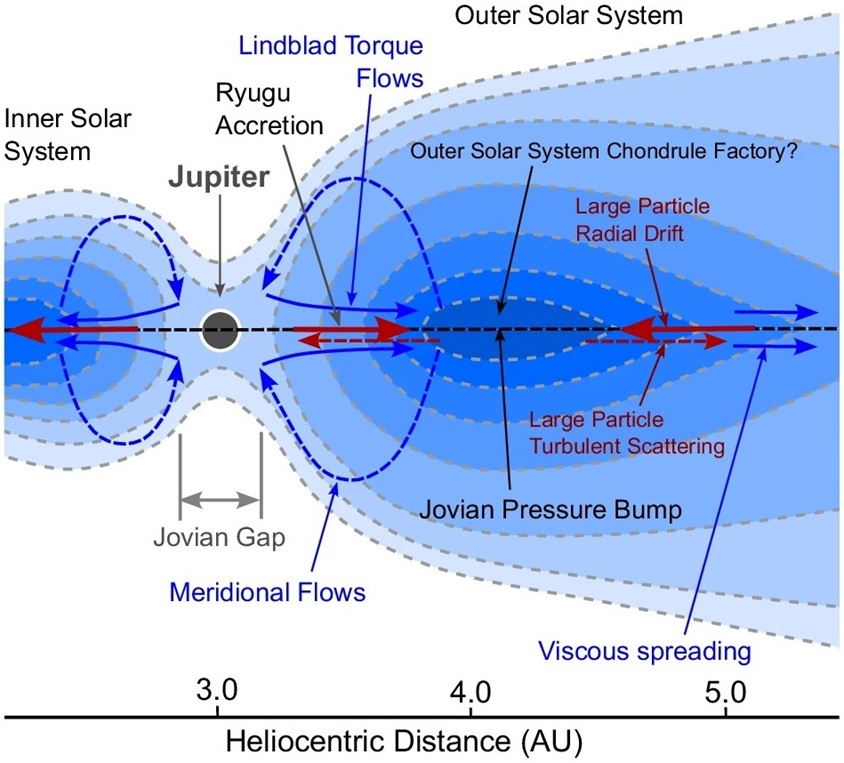
A high abundance of sub-spherical objects (SSOs) were observed by Genge et al. (2025) in a highly altered sample (A0180) of asteroid Ryugu. These SSOs, which were analyzed primarily through Nano X-ray Computed Tomography, have a mean diameter of ~7 µm (5.4–30.2 µm) in size and occur at a modal volume >350 ppm. The SSOs likely represent microchondrules in which the core silicates have been completely altered to phyllosilicates, and the original FeNi-metal rims have been transformed to iron sulfide crystals by an S-rich fluid. They contend that these microchondrules have been aerodynamically size-sorted and concentrated through intense turbulence within small, high-vorticity eddies near the sunward inner edge of the pressure bump of proto-Jupiter, where such conditions may have generated the streaming instability and initiated planetesimal accretion. This fine-grained, unprocessed material would have been conveyed to this unique location in part through an inwards meridional flow, and would have remained chemically and isotopically (e.g., 16O- and 15N-enriched) primitive (see schematic diagram below).
Suggested Accretion Region of Ryugu and CI Chondrites Near Jupiter
click on diagram for a magnified view
Diagram credit: Genge et al., Nature Communications, vol. 16, art. 6466, fig. 5 (2025, open accesslink)
'Abundant microchondrules in a sample of asteroid 162173 Ryugu suggest a turbulent origin for primitive asteroids'
(https://doi.org/10.1038/s41467-025-61357-1)
Results of lab analyses of samples returned from both the Cb-type asteroid Ryugu and the B-type asteroid Bennu indicate a CI chondrite affinity, but with clasts that have evaded aqueous homogenization and retained their unique isotopic composition (e.g., Bizzarro et al., 2026 [see their Fig. 4]. Ongoing research has been galvanized to better understand the formation location of this unique Solar System material. Already it has been determined that the reason bulk elemental abundances of CI chondrites match the Sun's photosphere is a consequence of the fine-grained (nm–µm-scale) nature of these meteorites. Their composition reflects a relatively homogenous mixture representing material from many different reservoirs and nebula components, including an abundance of nucleosynthetic anomalous isotopes which provide a means to determine the CI formation location.
Several novel models have previously been presented to explain the unusual petrographic and isotopic characteristics of CI chondrites and CI-like asteroids: e.g., Spitzer et al. (2024), Genge et al. (2025), Sumitani et al. (2026), and van Kooten et al. (2026 [see their Fig. 6]). A distinguished team of theoretical meteoriticists, Schönbächler et al. (2026), have presented a compelling scenario that is consistent with the available petrographic and isotopic evidence. The petrographic evidence includes the unique characteristics of CI chondrites, such as their very fine-grained textures, relict anhydrous silicate grains, abundance of water, and lack of visible chondrules and CAIs. The isotopic evidence includes the presence of nucleosynthetic anomalous isotopes, some of which are consistent with derivation from the NC region of the protoplanetary disk (e.g., ε54Fe, ε96Zr, ε100Ru, µ148Nd; see their Figs. 3 and 4). The model of Schönbächler et al. (2026) successfully ties the CI chondrites to the NC inner region of the Solar System through the influence of a rapidly growing proto-Jupiter with its accompanying gap and pressure bumps. These structures act as a filter limiting the radial inflow to only dust-sized particles. In this scenario, only the finest-sized dust remains coupled to the gas and is allowed to reach the water-ice sublimation line inward of proto-Jupiter, while the streaming instability initiates accretion of the larger particles ultimately leading to the formation of planetesimals (see their Fig. 5 schematic illustration below).
Schematic Diagram Showing the Proposed Location of CI Formation
click on schematic diagram for a magnified view
Diagram credit: Schönbächler et al., Science Advances, vol. 12, #39, fig. 5 (2026 open accesslink)
'Nucleosynthetic constraints on the origin of Bennu and CI-like asteroids'
(https://doi.org/10.1126/sciadv.aei910)
IV. Insights From Nearby Protoplanetary Disks
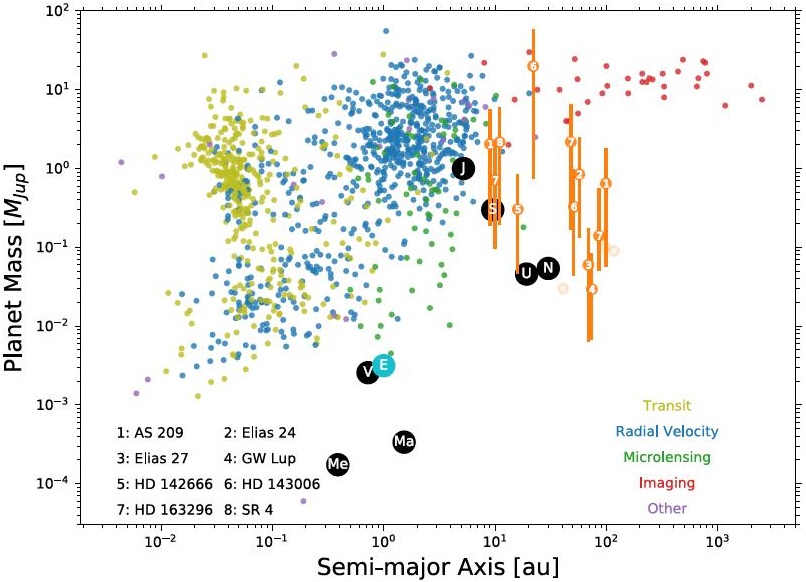
Insights into the earliest stages of planetary accretion can also be made through studies of nearby protoplanetary disks. The Disk Substructures at High Angular Resolution Project (DSHARP) survey was instituted to characterize the substructures of a select group of 20 protoplanetary disks associated with young stars (Andrews et al., 2018). These stars have median ages of ~1 m.y., with some as young as a few hundred thousand years, and they have masses of ~0.2–2 M⊕. Utilizing the very high resolution data (spatial resolution of ~5 AU) from the Atacama Large Millimeter/submillimeter Array (ALMA) radio telescope, the team investigated small-scale disk features, including concentric bright rings, dark gaps, spiral patterns, and asymmetries (e.g., crescent/arc structures [vortex scenario of Pérez et al., 2018]; Isella et al., 2018), which are associated with the earliest stages of planet formation. The rings are likely formed through dust trapping at the outer edge of a pressure bump produced by one or more embedded planets (Dullemond et al., 2018; Guzmán et al., 2018; Bodénan et al., 2021 #1954). In-depth analyses of the disk features enabled the identification of potential planets with Neptune- to Jupiter-scale masses (Zhang et al., 2018; see diagram below).
click on image for a magnified view
Diagram credit: Zhang et al., The Astrophysical Journal Letters, vol. 869, #2, article L47, p. 26 (2018 open accesslink)
'The Disk Substructures at High Angular Resolution Project (DSHARP): VII. The Planet-Disk Interactions Interpretation'
(https://doi.org/10.3847/2041-8213/aaf744)
Images credit: ALMA (ESO/NAOJ/NRAO), S. Andrews et al.; NRAO/AUI/NSF, S. Dagnello
High-resolution images of 20 protoplanetary disks obtained with the Atacama Large Millimeter/submillimeter Array (ALMA)
that are included in the Disk Substructures at High Angular Resolution Project (DSHARP) survey
The compositional dichotomy between the NC and CC regions of the protoplanetary disk has been attributed to the rapid growth of Jupiter to a size of ~20 M⊕ in ~1 m.y., at which point it became a sustained barrier to the inward streaming of dust and pebbles due to gas drag. An alternative model for the creation of this barrier was proposed by Brasser and Mojzsis (2020). Based on data from their dynamical simulations, they contend that the accretion of Jupiter to the minimum size necessary to establish an effective barrier would have taken a longer time, and therefore would not have prevented proto-Mars from growing into a much more massive body than it did. They posit instead that the protoplanetary disk had a ringed structure with coherent pressure maxima and minima (bright and dark annuli, respectively) which enabled the accretion of Jupiter and other gas giants and which provided an effective barrier near 5 AU separating the NC and CC regions.
Protoplanetary Disk Structure of the Early Solar System
Schematic illustration credit: Brasser and Mojzsis, Nature Astronomy, vol. 4 pp. 492–499 (2020)
'The partitioning of the inner and outer Solar System by a structured protoplanetary disk'
(https://doi.org/10.1038/s41550-019-0978-6)