Found November 2, 2020
30° 8' 25" N., 4° 5' 36" E.
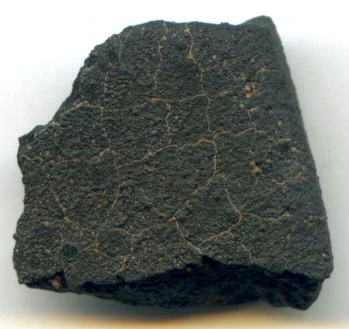
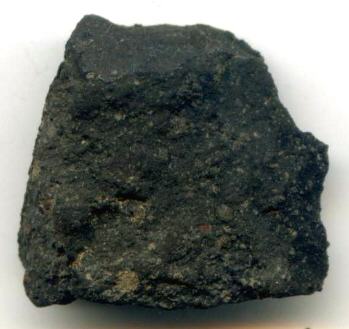
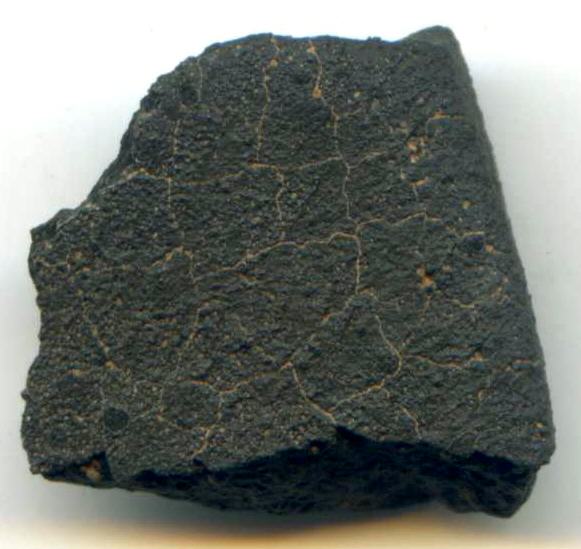
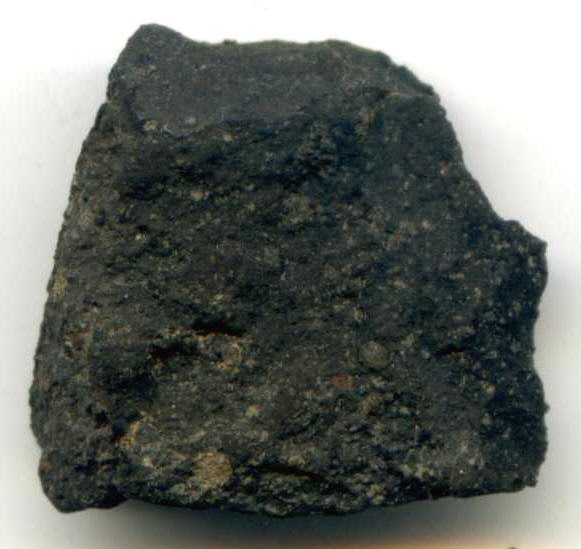
Several relatively fresh stones with a combined weight of 127.4 g were found in the Sahara Desert in the Hassi Messaoud region of Algeria (Google Earth image). A sample was sent for analysis and classification to the Institute for Planetology in Münster, Germany (K. Klemm and A. Bischoff) and the Geosciences Museum of the Georg-August University in Göttingen, Germany (oxygen isotope analysis; A. Pack). The meteorite, designated Qued Mya 002, was initially classified as a CM2 chondrite, the main mass of which is curated at the Decker Meteorite Shop and Museum.
The classification analysis of Qued Mya 002 revealed a brecciated chondrite consisting of dark fine-grained matrix with small chondrules (~250 µm), silicates (olivine (bimodal composition, Fa0.8–43.7) and low Ca-pyroxene), and an aqueous alteration phase identified as tochilinite–cronstedtite intergrowths (TCI). Accessory metal and sulfides are present, while only rare CAIs were detected. It should be noted that the analyses of paired stone Qued Mya 003 revealed no evidence of aqueous alteration (e.g., TCI, phyllosilicates), and further studies of Qued Mya 002 should be untaken to verify its subtype.
Multiple analytical techniques were applied by Irving et al. (2022 #2046) and Garvie and Irving (2022 #2217; XRD data) to a number of previously classified carbonaceous chondrites. High-precision oxygen isotope data obtained by Irving et al. (2022) for a broad sampling of carbonaceous chondrites enabled them to define two new CC region trend lines that are nearly aligned with those previously known (see top diagram below). The data points delineate a new carbonaceous group of at least 16 meteorites that was termed 'CT chondrites', a toponym for the type 3 group member Telakoast 001. The CT group was previously comprised of only petrologic type 2 and type 3 members, but it has been proposed by Irving et al. (2024 #6221) that the petrography, geochemistry, and O-isotopic composition of ungrouped achondrite NWA 16493 is consistent with it becoming the first equilibrated member of the group. With further analyses, including nucleosynthetic anomalous 54Cr values, it may soon be determined that other variously classified stones (e.g., NWA 13167 [C2-ung], NWA 13249 [C2-ung], NWA 13456 [C2], NWA 13455 [CO3-an], and NWA 13479 [C2-ung]) with petrographic, chemical, mineralogical, magnetic susceptibility, and isotopic similarities to those in the initial study actually belong in the CT group.
Oxygen Isotope Plot for Carbonaceous Chondrite Groups
(note: Qued Mya 002 has a nearly identical plot as NWA 11699)
click on image for a magnified view
Diagram credit: Irving et al., 53rd LPSC, #2046 (2022)
'CT Chondrites: A Newly Recognized Carbonaceous Chondrite Group With Multiple Members, Including Telakoast 001, Chwichiya 002 And Cimarron'
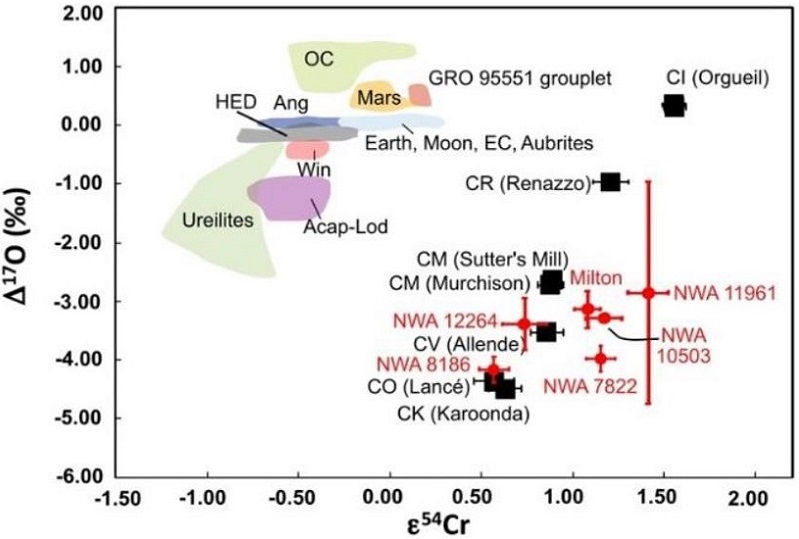
The other new trend line demonstrated by Irving et al. (2022) delineates a potential carbonaceous grouplet of 4 that was termed 'CZ chondrites' (see diagram above). In addition, a trend line previously proposed by Irving et al. (2019 #2542) that they termed 'CX' initially comprised four meteorites from the CC region representing different textural types—Milton (pallasite), NWA 10503 (metachondrite), NWA 12264 (dunitic breccia), and NWA 11961 (unequilibrated chondrite). More recently, Cuppone et al. (2025) conducted in-depth analyses of NWA 13489, the results of which led them to conclude that a genetic relationship may exist between four meteorites—NWA 13489, NWA 11961, NWA 10503/10859, and Milton (see the NWA 13489 page for further details).
O–Cr Diagram to Distinguish 'CX' Trend Meteorites
click on photo for a magnified view
Diagram credit: Irving et al., 50th LPSC, #2542 (2019)
'Evidence For A Unique Carbonaceous Chondrite Parent Body ('CX') And Another One With A Dunitic Mantle'
Information about other members of the CT group can be found on the following pages: Chwichiy 002 (CT3.00; CM2.8–CM2.9), NWA 8781 (CT3), NWA 12416 (CT3), and tentative members NWA 13167 (CT2) and NWA 16493 (CT7). The specimen of Qued Mya 002 shown above is a partially crusted 1.25 g fragment.