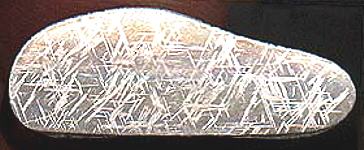
Iron, ungrouped
Plessitic octahedrite
Found 2000
no coordinates recorded
Many individual masses from this rare shower-producing meteorite have been recovered in Taza, Morocco, having a total weight of 75.3 kg. This meteorite was assigned number 859 within the Northwest Africa dense collection area series. Many of the Taza masses have well-oriented shapes.
Taza is chemically anomalous and unrelated to any established iron chemical group. However, Taza has an elemental composition very similar to the ungrouped, plessitic iron, Butler, and the two can be clearly grouped together (see table below). They have an extremely high Ge concentration of 2000–2300 ppm (Wasson, 2011), four times higher than any other iron meteorite. Similarly, their Au and As contents are high. A high Ni content of ~16% promotes kamacite to form discontinuous, pointed spindles, rimmed by taenite, with widths measuring ~0.15 mm. Tetrataenite (~50% Ni) forms a narrow border on some kamacite spindles. In the dense, fine-grained plessite matrix, this spindle pattern is repeated on a scale ten times finer to form a µm-sized Thomson (Widmanstätten) structure. This uncommon plessitic microstructure is transitional between the octahedrites and the ataxites.
Comparison of Volatile Element Abundances for Taza and Butler
Co(%)
Ni(%)
Cu(ppm)
Ga(ppm)
Ge(ppm)
As(ppm)
W(ppm)
Ir(ppm)
Pt(ppm)
Au(ppm)
Taza
1.29
16.34
291
87.2
2290
54
6.7
2.42
38
6.48
Butler
1.21
15.67
151
87.1
1970
48
5.1
1.8
34.9
6.77
Close compositional and textural similarities between Taza and thousands of iron meteorites weighing over 800 kg found over a period of many years in the Eastern Highlands of Morocco, including the ungrouped plessitic irons NWA 11010 (832.4 g) and Oglat Sidi Ali (240 g comprising 30 pieces), led to the conclusion that all of these meteorites are likely paired (Nachit et al., 2022). In addition, the ungrouped plessitic iron Butler likely originated from the same parent body. It was tentatively declared by Wasson (2011) that Taza and Butler are probably nonmagmatic irons.
A recent Mo isotopic analysis of 25 ungrouped irons, published by Spitzer et al. (2025), enabled the assignment of Taza and Butler to the non-carbonaceous (NC) taxonomic superclan. In addition, the team utilized Hf–W isotopic data to determine the timing of silicate–metal differentiation for each of these ungrouped irons, and the late core formations ages of Taza and Butler of ~7 m.y. after CAIs is consistent with a non-magmatic origin. The specimen of Taza shown above is a 13.42 g etched partial slice that displays kamacite spindles in a Thomson (Widmanstätten) pattern.