Achondrite, ungrouped
(Ureilite-like)
Found 2020
18° 16' 49" N., 2° 5' 42" E.
A single oriented stone weighing ~4.3 kg was found in Mali and subsequently sold by dealers to Dr. J. Piatek in 2021. A type sample was sent for analysis and classification to the University of New Mexico (C. Agee, M. Spilde, and K. Ziegler), and Tin-Essako 001 was determined to be a metal-rich ungrouped achondrite with affinities to ureilites.
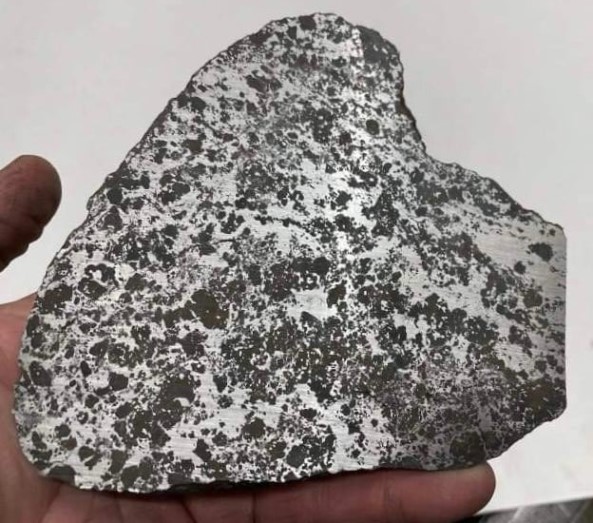
Descriptions of Tin-Essako 001 were published by the primary classification team at UNM and in an abstract by Goodrich et al. (2022 #6141). The meteorite consists of a heterogeneous mixture of nearly equal proportions of metal and silicates, the latter comprising mostly olivine with lesser melt-textured areas of plagioclase + Si-rich glass. Minor sub-mm-sized chromite grains occur as inclusions in both metal and silicates, and carbon is present both as a fibrous-textured phase at olivine–metal grain boundaries and as inclusions in metal.
Although the high FeNi-metal content and certain mineralogical aspects (e.g., lack of both pyroxene and sulfide) of Tin-Essako 001 are unique compared to the known ureilites, both the overall geochemistry and the oxygen isotopic composition are consistent with the more ferroan members of that group. The abstract by Goodrich et al. (2022 #6141) provides two plausible scenarios for the formation of this meteorite on the ureilite parent body, both possibly involving impact heating/mixing. They also pose the question of whether the metal is indigenous or not. Interestingly, subsequent analyses of ureilite metal compositions conducted by Patzer et al. (2024 #2482) found that the Ni content (wt%) and the Ni/Co ratios in the studied ureilites are generally the same as the values published in the MetBull for Tin-Essako 001. Future research should provide further insights into the petrogenesis of this unique meteorite.
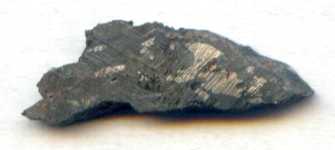
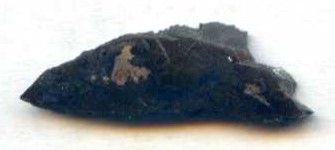
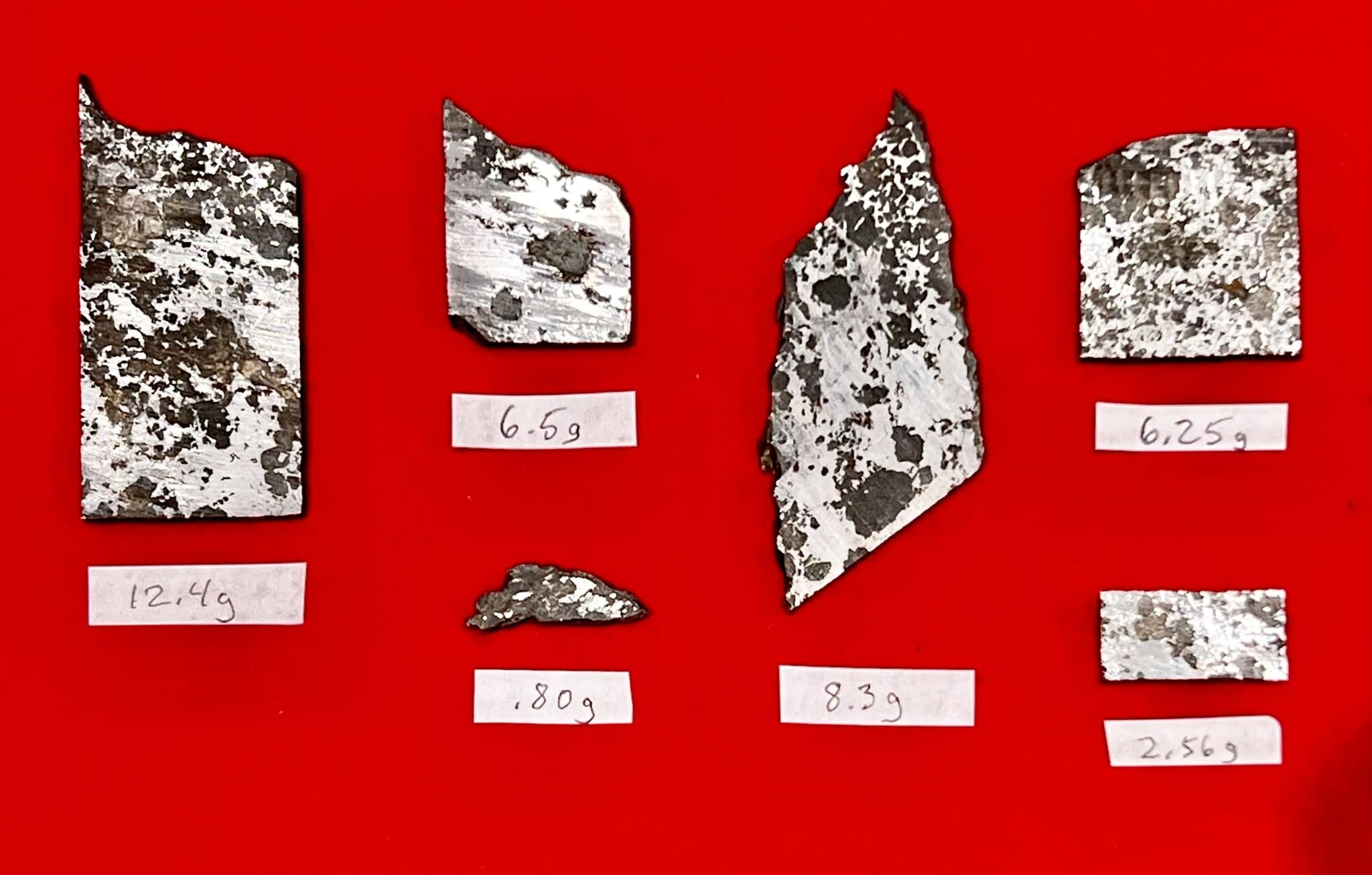
Tin-Essako 001 has undergone moderate terrestrial weathering and is only weakly shocked. A synopsis of current models for ureilite formation is presented on the Kenna and the Almahata Sitta pages. The specimen of Tin-Essako 001 shown above is a 0.80 g cut fragment. The top photo below shows an assortment of slices, courtesy of J. Collins, and below that is a public domain photo of a large slice presented by Dr. Carl Agee.