APPENDIX

PART V

CHEMICAL, ISOTOPIC, & STRUCTURAL TRENDS FOR CLASSIFICATION

CONTINUE TO
[PART I] Chondrites
[PART II] Achondrites
[PART III] Irons
[PART IV] Stony-Irons
[APPENDECTOMY]

  1. Oxygen Content:
  2. Carbonaceous chondrites are oxygen-rich with most of the iron combined as silicates, magnetite, or water. Ordinary chondrites have about half their iron in the oxide form with the rest in troilite or metal. Enstatite chondrites are oxygen-poor with all the iron in metal or sulfide form. R chondrites have a high degree of Fe oxidation.
  3. CI-normalized refractory-lithophile abundance ratio:
  4. Carbonaceous chondrites have a ratio of 1.00–1.35 (CV = 1.33, CK = 1.11–1.33, CO,CM = 1.11, CR = 1.00), R chondrites 0.85, ordinary chondrites 0.77–0.82, and enstatite chondrites ~0.6.
  5. Fine-grained matrix/chondrule modal abundance ratio:
  6. Carbonaceous chondrites have a ratio of 0.5–7.0, ordinary chondrites ~0.3, enstatite chondrites essentially none, and R chondrites 1.6 (±0.9).
  7. Abundance of isotopically heterogeneous refractory inclusions:
  8. Carbonaceous chondrites have a ratio of ~0.5–5.0 vol%, ordinary chondrites have a negligible amount, enstatite chondrites a negligible amount, and R chondrites essentially none.
  9. Whole rock O-isotope composition:
  10. Carbonaceous chondrites are much below the terrestrial fractionation line (TFL), ordinary chondrites are above the TFL, enstatite chondrites are on the TFL, and R chondrites are much above the TFL. The CO and CK groups share a common O-isotopic composition.
  11. CI-normalized Se/Sb concentration ratios:
  12. Carbonaceous chondrites have a ratio of 0.6–0.9, ordinary chondrites 0.9–1.1, enstatite chondrites 1.0–1.2, and R chondrites 1.5 (±0.2).
  13. Molar An of plagioclase:
  14. Carbonaceous chondrites have a high molar, ordinary chondrites have a low molar, enstatite chondrites have a very low molar, and R chondrites have a low molar.
  15. Abundance of opaque mineral-rich porphyritic chondrules:
  16. Carbonaceous chondrites have a large abundance, ordinary chondrites have few, enstatite chondrites have a low to moderate abundance, and R chondrites have few.
  17. Ratio of Iron to Silicon:
  18. Subdivides ordinary chondrites into subgroups H, L, and LL, and the enstatite chondrites into subgroups EH and EL.
  19. Ratio of Magnesium to Silicon:
  20. Separates the carbonaceous, ordinary, and enstatite chondrites. Carbonaceous chondrites have average ratios of 1.05. Ordinary chondrites have ratios of 0.97, 0.92, and 0.92 for H, L, and LL groups, respectively. Enstatite chondrites have ratios of 0.73 and 0.88 for EH and EL groups, respectively.
  21. Ratio of Calcium to Silicon:
  22. Subdivides carbonaceous chondrites into subgroups CI, CM, CR, CO, CK, CV, and CH.
  23. CV oxidized Bali-like and Allende-like, and reduced subgroups are separated by FeNi-metal, sulfide, and magnetite abundances (after Bland et al., 2000):
  24. Ratio of low-temperature metals (e.g., Pd and Au) to Ir:
  25. Ratios are higher in EL than in EH chondrites.
  26. Chondrule Size (Brearley and Jones, 1998):
  27. Average diameter (mm) decreases in the order CV>LL>CR=CK=L>EL=K>R>CM=H>EH>CO>CH

    ORDINARY CHONDRITE CHONDRULE SIZES (µm)
    after K. Metzler (2018)
      Mean
    2D (3D)
    Median
    2D (3D)
    Min
    2D (3D)
    Max
    2D (3D)
    H4 (NWA 2465) 450 (490) 370 (420) 95 (90) 5400 (2360)
    L4 (Saratov) 500 (610) 450 (530) 130 (180) 2160 (2520)
    LL4 (NWA 7545) 690 (830) 580 (730) 190 (245) 3810 (2880)
    after D. W. Hughes (1978)
    L/LL4 (Bjurböle) — (750) — (688) 200 (250) — (—)
  28. Petrologic Type:
  29. Type 3 represents unaltered material, while lower numbers represent progressive alteration by aqueous conditions and higher numbers represent progressive alteration by thermal metamorphism. As metamorphic alteration increases to type 7, a number of chemical and physical changes occur (reference not recorded):

CO3 Petrographic Types
after Sears et al., 1991
  TL sens. (120°C)
3.0 <0.017
3.1   0.017–0.030
3.2   0.030–0.054
3.3   0.054–0.100
3.4   0.100–0.170
3.5   0.170–0.300
3.6   0.300–0.540
3.7   0.540–1.000
3.8   1.000–1.700
3.9 >1.700

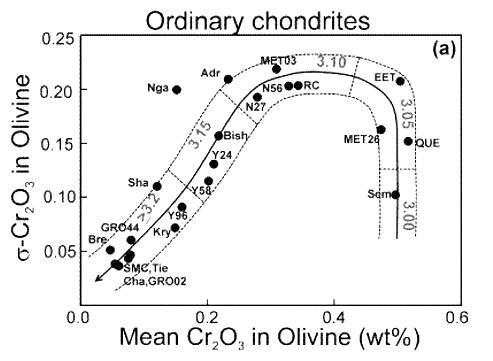
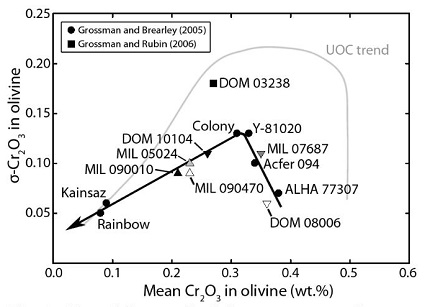
It is considered that the TL sensitivity technique is not applicable below subtype 3.2 because feldspar could have been dissolved during the aqueous alteration process. This classification method has now been superseded by more sensitive techniques that are able to measure the peak metamorphic temperatures, and thus enable the direct comparison of petrologic types among chemical classes. To discriminate among subtypes below type 3.2, it has been shown that the Cr content of ferroan olivine is an excellent indicator of metamorphism. Chromite exsolves from olivine in the incipient stages of metamorphism, initially producing heterogeneous Cr2O3 contents, and eventually low-Cr olivine. In a study by Chizmadia and Bendersky (2006), they determined that this sequence progresses from type 3.0, corresponding to high Cr2O3 contents of 0.3–0.4 wt%, to type 3.2, in which Cr2O3 constitutes less than 0.1 wt%. The gap between these subtypes represents type 3.1. A detailed petrographic study of CO3 chondrites was conducted by Davidson et al. in 2014 in order to better define a metamorphic trend for this group (see following diagram).


Diagram credit: J. N. Grossman & A. J. Brearley, MAPS, vol. 40, p. 87 (2005)
'The onset of metamorphism in ordinary and carbonaceous chondrites'
(http://dx.doi.org/10.1111/j.1945-5100.2005.tb00366.x)

CO3 Chondrites


Image courtesy of Davidson et al., 45th LPSC, #1384 (2014)

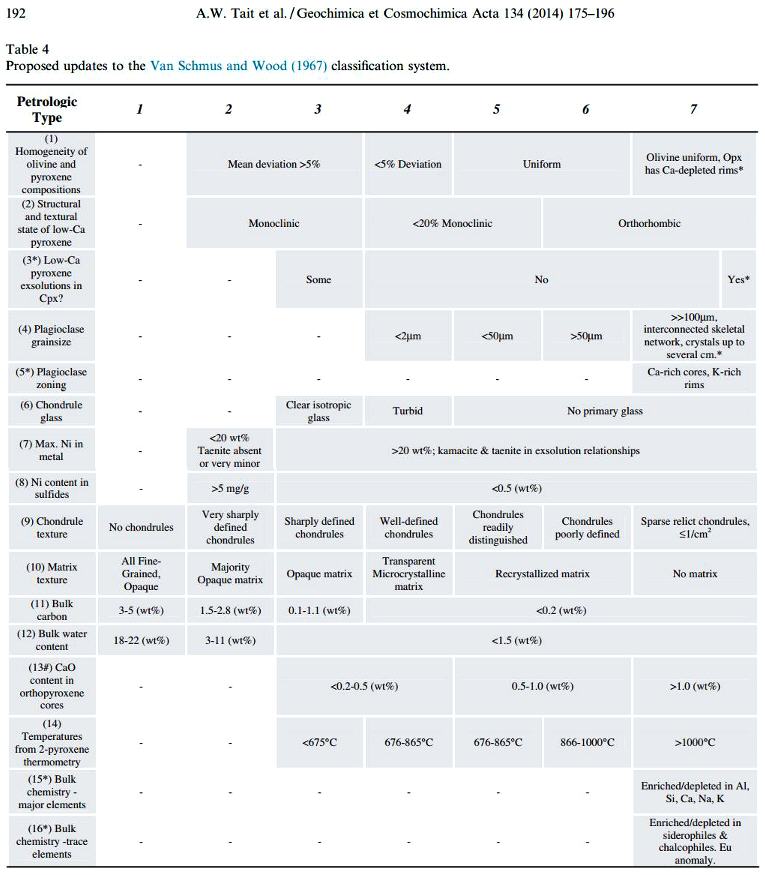
A Chemical-Petrologic Classification for the Chondritic Meteorites (Van Schmus and Wood, 1967)
Revised by Tait et al. (2015) to include criteria for petrologic type 7, incorporating updates from Sears and Dodd (1998), Brearley and Jones (1998), #Dodd (1981), and *Tait et al. (2014)


Diagram credit: A.W. Tait et al., GCA, vol. 134, p. 192 (2014)
'Investigation of the H7 ordinary chondrite, Watson 012: Implications for recognition and classification of Type 7 meteorites' (http://dx.doi.org/10.1016/j.gca.2014.02.039)

In a manner similar to that employed for the chondrite groups, the eucrites have been petrologically divided into a metamorphic sequence comprising seven types (after Takeda and Graham, 1991; Yamaguchi et al., 1996):
  1. Type 1—Most rapidly cooled within the sequence; mesostasis-rich with a glass phase and original chemistry preserved; exhibits pronounced Mg–Fe zoning in pyroxenes; represents the least altered basalt studied; e.g., clasts in Y-75011, Y-75015, and Y-74450

  2. Type 2—Metastable Fe-rich pyroxenes are absent; mesostasis glass is no longer clear; e.g., Pasamonte

  3. Type 3—Zoning from core to rim is less defined with an increase in Ca towards the rim; pyroxenes becoming cloudy; coarsening of pyroxenes resulting from augite exsolution lamellae; e.g., clast in Y-790266

  4. Type 4—Only remnants of zoning still visible; cloudy pyroxenes present; mesostasis glass is recrystallized or absent; augite exsolution lamellae becoming resolvable in microprobe; e.g., Stannern, Nuevo Laredo

  5. Type 5—Homogenous host composition with readily resolvable exsolved pigeonite lamellae; pigeonites extensively clouded by reheating; mesostasis glass recrystallized or absent; e.g., Juvinas, Sioux Co., Lakangaon

  6. Type 6—Most slowly cooled eucrites in the sequence; the clinopyroxene pigeonite is partly inverted to orthopyroxene through slow cooling processes; pyroxenes contain Mg-rich cores and coarse augite exsolution lamellae; original mesostasis is absent; Ca is enriched in the rims; often have a brecciated texture; e.g., Millbillillie, Y-791186

  7. Type 7—Recognized as the most metamorphosed in the sequence (Yamaguchi et al., 1996); e.g., Palo Blanco Creek, Jonzac, Haraiya, A-87272, NWA 3152

Weathering Grade (Cassidy, 1980; Otto, 1992)
(based on surficial rust and evaporites, used for Antarctic meteorites)

Weathering Grade (Wlotzka, 1993)∗
(based on oxidation of FeNi-metal and FeS; primarily used for ordinary chondrites)

Revised by Zurfluh et al. (2016)
(based on improved weathering parameters applied to a greater number of meteorite samples)

When metal and troilite each are oxidized >95 vol%, the sample is classified as W4.0, while a sample with 100 vol% metal alteration and 90 vol% troilite alteration is still a W3.6.

Weathering Index (Rubin and Huber, 2005)
(based on the amount of staining in silicates, used for oxidized CK and R chondrites)

Fracturing Scale

Age-Dependent Fragmentation and Dispersion in Hot Deserts (A. Al-Kathiri et al., 2005)

Fragmentation is considered to result from daily thermal fluctuations, volume increase, and penetration of sand and water into cracks. Dispersal occurs through natural means, i.e., wind and water, as well as by animals.

Fragmentation Index (FI):
the mass of the largest fragment ÷ total mass of all fragments
Fragment Dispersion (FD):
the maximum distance between different fragments of a single fall

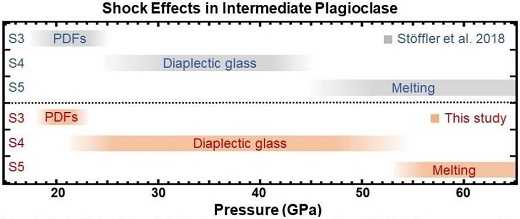
Shock Stage* (olivine-bearing meteorites) (Stöffler et al., 1991; revised by Schmitt et al., 1994, Schmitt and Stöffler, 1995, and Rubin, 2004)

*Shock stage is determined by the highest indicated stage by at least 25% of the indicator grains. In actuality, shock stage is determined by factors in addition to equilibrium shock pressure, including shock duration, pre-shock porosity, and stress-strain history (Xie et al., 2006).

Shock Stage (orthopyroxene-bearing meteorites) (Rubin et al., 1997), in conjunction with olivine and plagioclase data characterized by Stöffler et al., 1991; Schmitt et al., 1994; Schmitt and Stöffler, 1995; and Izawa et al., 2011)

Shock Pressure Calibration (Schmitt, 2000)

A. SILICATES
B. TROILITE
C. LOCALIZED SHOCK-INDUCED MELTING
When utilizing shock-melt veins, pressure calibrations for stage S6 of Stöffler et al. (1991) may be too high by a factor of at least two (Xie et al., 2006).


Diagram credit: Xie et al., 85th MetSoc (2022
#6487)
'Is Diaplectic Glass A Glass?'

Chromite as a Shock Indicator (Rubin, 2003)

Rubin (2004) proposed that all equilibrated (type 4–6) ordinary chondrites were impact shocked to stage S3–S6, with subsequent annealing to an apparent shock stage of S1; some OCs experienced further shock events to acquire their present shock stage of S2–S6.

Shock Indicators in IVA Irons (Yang et al., 2011)

Yang et al. (2011) proposed that IVA irons experienced three impacts: 1) a glancing impact 4.5 b.y. ago that ejected the silicate mantle and produced a 300 km-diameter molten metallic body; 2) a head-on collision occurred upon cooling to 200°C, likely producing a rubble-pile >30 km in diameter which resulted in shock reheating; 3) a final severe impact 400 m.y. ago producing a swarm of m-sized fragments and their delivery to Earth.

Shock Stages in Eucrites (Kanemaru et al., 2019)

A systematic method to determine shock stages for eucrites was proposed by Kanemaru et al. (2019 #2321, #6347) based on petrographic and mineralogical features and through the use of X-ray diffraction (XRD) analysis.


See also the treatise on shock systematics by Stöffler et al. (2018) titled 'Shock metamorphism of planetary silicate rocks and sediments: Proposal for an updated classification system', published in Meteoritics & Planetary Science.

Meteorite Pairing (P. Benoit et al., 2000)

PAIRING CRITERIA:
Parent body history
Bulk elemental and isotopic concentrations
Mineral abundance and compositions
Petrography (shock, metamorphic, and igneous textures)
Stable isotope abundance and formation ages
Meteoroid space history
Cosmogenic noble gas ratios (cosmic-ray exposure age, shielding, solar gases, thermal history)
Natural TL (reheating)
Meteorite terrestrial history
Geographic proximity
Shape and size
Number of specimens
Terrestrial age
Weathering grade
Natural TL levels
Applying data from these criteria to the formula below, a pairing score and its associated pairing likelihood is obtained.

Prel = Prel* × Pss × Pbrec × Pcre × Psolar × P3He × Ptage × Pweath × PNatTL

where...
Prel* = relative abundance by classification
Pss = relative abundance by shock stage
Pbrec = relative abundance by brecciation
Pcre = relative abundance by cosmic-ray exposure age
Psolar = relative abundance by solar-gas-bearing meteorites
P3He = relative abundance by light noble gas depleted meteorites
Ptage = relative abundance by terrestrial age
Pweath = relative abundance by weathering factor
PNatTL = relative abundance by natural TL levels

Pairing score (%) / Pairing likelihood

>90_______Likely
80–90_____Probable
70–80_____Possible
50–70_____Potential
<50_______Candidate or Unlikely

Compositional Relationships Among Bodies
(Lindstrom et al., 1994; Mayne et al., 2008)

MINERAL COMPOSITIONS
  *Fe/Mn (pyx) plag. Fe-metal sulfide secondary alter.
HED 20––40 An90 Y Troilite none
Angrites 60&––90 An99 N Troilite none
Moon 70 An92 Y Troilite none
Earth 60 An50 N Pyrrh. hydrous phases
Mars 35 An50 N Pyrrh. hydrous phases
Venus 55 N Pyrrh. anhydrous phases

*Differences in Fe/Mn ratios are attributed to initial accretional abundances. The primordial value of the Fe/Mn ratio in pyroxenes remains constant regardless of differentiation processes, and is considered to be diagnostic for the origin of each planetary body.

BULK CHEMICAL COMPOSITIONS
  Fe/Mn K/U K/La (×CI) Rb/La (×CI)
HED 30 (±2) 2,000 0.03 0.002–0.02
Ibitira 34–36
Angrites 80–95 150 0.002–0.03 0.001
Moon 62 (±18); 67 (±9) 1,700 0.03 0.016
Earth 40 (±11) 12,500 0.15 0.09
Mars 35–50 15,000 0.2 0.3
Venus 55 (±30) 12,500 0.1–0.2 0.1

*O-ISOTOPIC COMPOSITIONS
  Δ17O (‰)
CR chondrites –0.96 to –2.42
Lodranites –0.85 to –1.49
Acapulcoites –0.85 to –1.22
Winonaites ~ –0.4 to –0.80
HED –0.24
Brachinites –0.13 to –0.30
Angrites –0.125
Moon 0.00
Earth 0.00
Mars +0.3
Venus +0.0 to +0.3
H (4–6) +0.73
L (4–6) +1.07
LL (4–6) +1.26

17O is a convenient measure of the vertical displacement of a data point from the terrestrial fractionation line:
Δ17O = δ17O – (0.52 × δ18O)
where δ17O = 17O/16O, and δ18O = 18O/16O, expressed as parts per thousand (per mil [‰]) and measured in terms of deviations from a standard (Standard Mean Ocean Water [SMOW])

e.g., δ18O = [(18Osample ÷ 16Osample) ÷ (18OSMOW ÷ 16OSMOW)] – 1
See an oxygen 3-isotope plot

A report by E. Young (2007) concludes that optically thin photoactive regions in the outer disk were the site of CO photochemical conversion to 16O-poor, high Δ17O water ice. This 16O-poor water was transferred to the inner Solar System during the infall phase, or within a wavefront, on a timescale of 100 t.y. to 1 m.y., exchanging with the silicates and other chondrite constituents which formed subsequently in the inner Solar System; the igneous, refractory-rich CAI material that condensed prior to this water transfer remains 16O-rich.

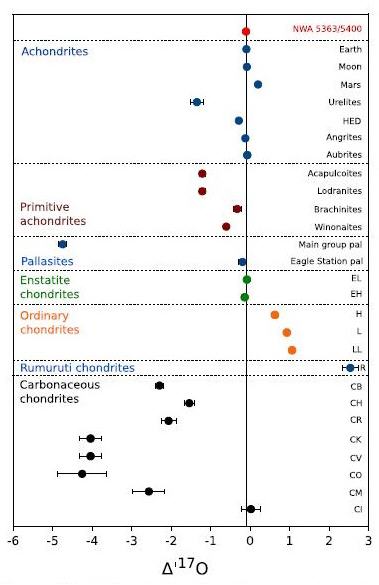
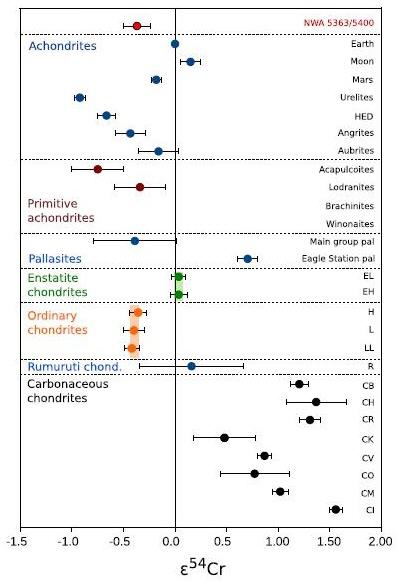
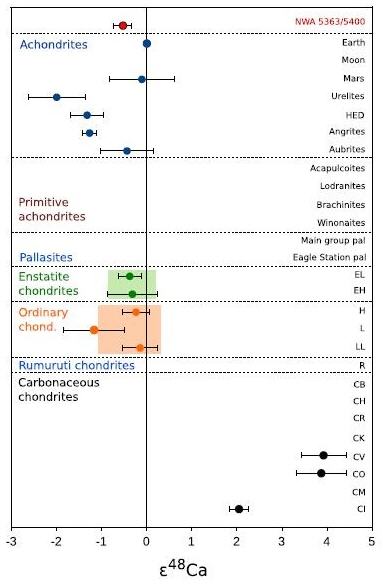
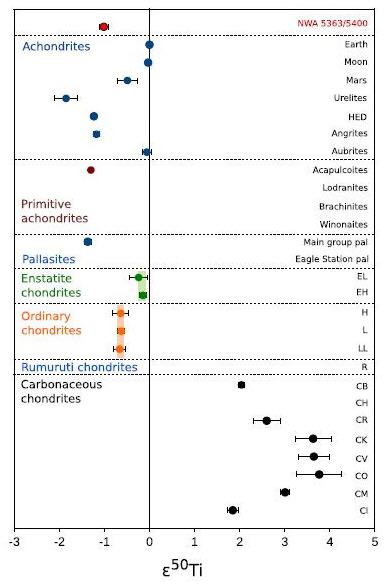
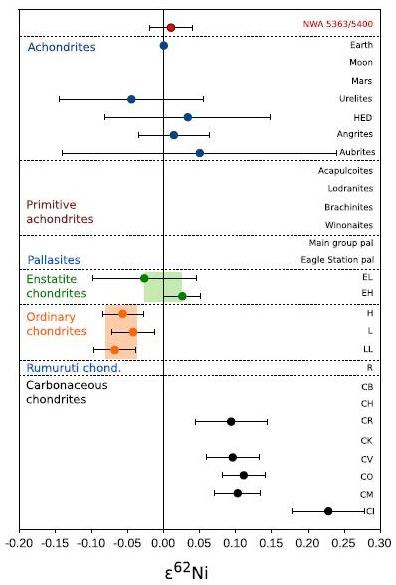
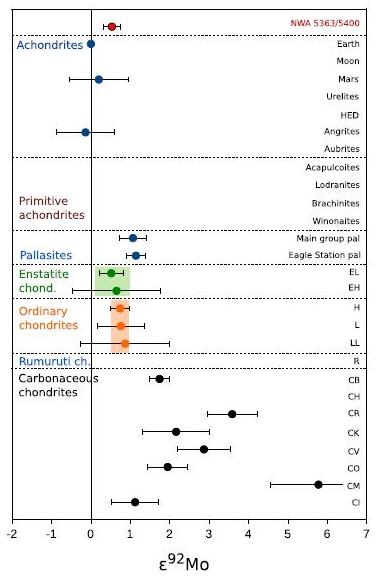
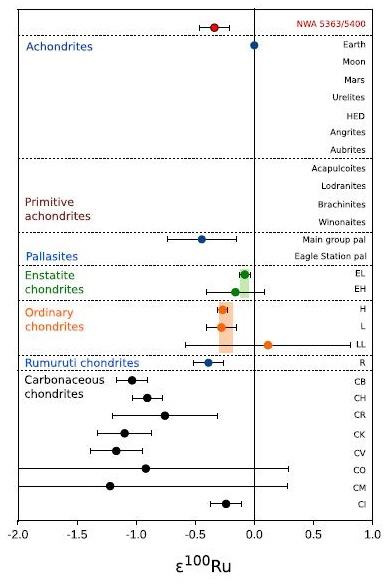
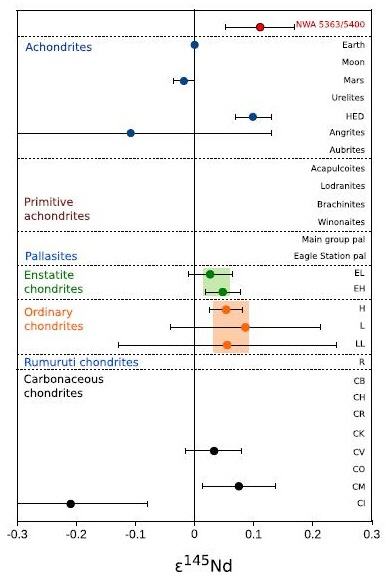
Nucleosynthetic Anomalies Among Parent Bodies For O, Cr, Ca, Ti, Ni, Mo, Ru, and Nd
Burkhardt et al. (2017)


Diagrams credit: Burkhardt et al., MAPS, vol. 52, #5, pp. 815-817 (2017)
'In search of the Earth-forming reservoir: Mineralogical, chemical, and isotopic characterizations of the
ungrouped achondrite NWA 5363/NWA 5400 and selected chondrites' (http://dx.doi.org/10.1111/maps.12834)

Formational Relationships Among Ureilites (Cohen et al., 2004)

TOPICAL, CHEMICAL, AND ISOTOPIC PARAMETERS
Surface Depth
low formation pressure (~10–25 bars) high formation pressure (> ~100–125 bars)
highly reduced (smelting) little reduced (smelting suppressed)
low δ18O & Δ17O high δ18O & Δ17O
low C content high C content
magnesian (high Mg#; ~75–95) ferroan (low Mg#; ~60–90)
albitic melt clasts (<An25) labradoritic melt clasts (An3958)
ol–aug melt clasts (An3954)
ol–pig ureilite residues ol–aug ureilite residues

Accretion Process

Accretion from dust to gas-giant planet occurred within 3 m.y. ('Pebble Accretion and the Diversity of Planetary Systems', J. E. Chambers, The Astrophysical Journal, vol. 825, 2016):

In the beginning, µm-sized dust particles are embedded in a gaseous protoplanetary disk. By 0.02 m.y., mutual collisions between dust grains result in the formation of mm- to cm-sized pebbles. By 0.15 m.y., pebbles inside the ice line (~2.5–4.5 AU) have aggregated into planetesimals with diameters of 30–300 km. Just outside the ice line, aggregation of the larger ice-rich pebbles is more efficient, and larger planetesimals with diameters of ~1,500 km are formed during runaway growth. By 0.5 m.y., some of the larger planetesimals located within ~5 AU enter an oligarchic growth stage and become planetary embryos with diameters of 2,000 km. The largest embryos located just beyond the ice line begin to grow by "pebble accretion" due to the inward drift of pebbles, reaching sizes of a few Earth masses (M). By 3 m.y., the largest of these embryos exceed a critical mass (3 × M) and undergo runaway gas accretion to form gas-giant planets. A large protoplanetary disk (radius = ~100 AU) and a small turbulence strength (α = 0.0005) help promote the formation of these gas giants, which ultimately clear their orbits. Inside the ice line, the growth of terrestrial planets (0.02–1.4 × M) ceases due to pebble depletion in the disk.

Accretion ages, in m.y. after CAIs (Sugiura and Fijiya, 2011, 2012; Budde et al., 2018):

magmatic irons=0.0 (±0.9)
pallasites=0.0 (±0.9)
mesosiderites=0.0 (±0.9)
angrites=0.5 (±0.4)
HED=0.8 (±0.3)
aubrites=<1.5
NWA 011=<1.5
ureilites=~1.0
acapulcoites=~1.2
Tafassasset=~2.0
chondrites: E=1.8; O=2.1; R=2.4; CK=2.6; CO=2.8; CV=3.0; CH/CB=3.3; CM=~3.5; CI=~3.5; CR=~3.6

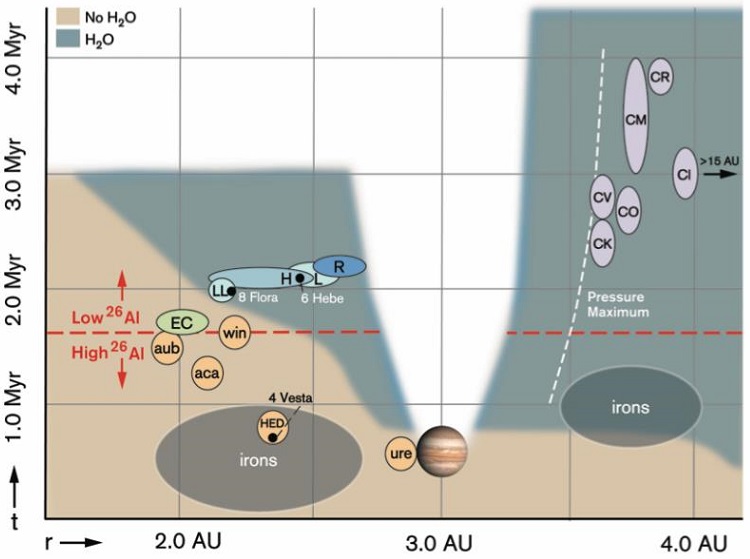
Model Plot Predicting When and Where Meteorite Types Formed
standby for carbonaceous vs. non-carbonaceous reservoirs diagram
click on photo for a magnified view
Data Key

Diagram credit: Desch et al., The Astrophysical Journal Supplement Series, vol. 238, #1, p. 23 (2018 open access version link)
'The Effect of Jupiter's Formation on the Distribution of Refractory Elements and Inclusions in Meteorites'
(https://doi.org/10.3847/1538-4365/aad95f)

Melting/Differentiation Process

As stated by Sanders and Scott (2007), any body that accreted to a diameter >60 km (i.e., large enough to minimize heat loss from the surface through conduction) within ~2 m.y. after CAI formation (the oldest known objects dating to 4.567 b.y. ago) as the angrites did, must contain enough 26Al to produce global melting and differentiation. In contrast, Senshu and Matsui (2007) determined that accretion to a diameter of only ~14 km occurring within 2 m.y. after CAI formation was all that was required for global differentiation to occur, while accretion to a diameter of 40–160 km within 1.5 m.y. after CAI formation was cited by Hevey and Sanders (2006) and Sanders and Taylor (2005) as the minimums for differentiation. Sanders and Scott (2011) later revised that to suggest radiogenic melting proceeded in bodies >20 km in diameter that accreted within 1.5 m.y. after CAI formation, while bodies accreting later than 1.5 m.y. after CAIs were heated but not melted. Furthermore, they found that bodies which accreted later than 2.2 m.y. would not have melted at all. In addition, at large heliocentric distances (>~2.8 AU) accretion would proceed too slowly for sufficient 26Al to accumulate and initiate global melting prior to a body growing too large (~200 km diameter) for melting to be possible (Nyquist and Bogard, 2003).

Be that as it may, Wasson (2016) presented evidence showing that the slow heating generated entirely by the decay of 26Al is insufficient to melt asteroids, and that an additional heat source would have been required; e.g., the rapid heating incurred from major impact events. He determined that the canonical 26Al/27Al ratio of 0.000052 is much too low to cause any significant melting, and that a minimum ratio of 0.00001 would be required to produce a 20% melt fraction on a well-insulated body having a significant concentration of 26Al. For example, the initial ratio of 0.0000004–0.0000005 calculated for the angrites Sah 99555 and D'Orbigny based on their 26Al–26Mg isochrons is too low to have generated any significant melting, and therefore impacts provided a major source of heat in early solar system history.

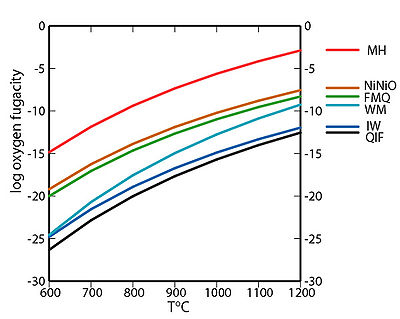
Oxygen Buffer Systems

Fugacity-temperature diagram

Log oxygen fugacity vs. temperature at 1 bar pressure for common buffer assemblages, plotted from algorithms compiled by B. R. Frost in
Mineralogical Society of America 'Reviews in Mineralogy', vol. 25, "Oxide Minerals: Petrologic and Magnetic Significance" (D. H. Lindsley, ed., 1991).
MH: magnetite-hematite; NiNiO: Nickel-nickel oxide; FMQ: fayalite-magnetite-quartz; WM: wüstite-magnetite; IW: iron–wüstite; QIF: quartz-iron-fayalite

Cosmochronology

SOME SHORT- AND LONG-LIVED CHRONOMETERS
Norris et al., 1983; Hibiya et al., 2014; Pravdivtseva et al., 2016;
Villa et al., 2020, Desch et al., 2022 [I, II] and ref. therein
Parent → Daughter Half-life Minerals dated
41Ca → 41K 0.0994 (±0.0015) m.y.
36Cl → 36Ar, 36S 0.301 (±0.002) m.y.
26Al → 26Mg 0.717 m.y. (weighted mean) or
0.708 (±0.017) m.y. (Nishiizumi, 2004) or
0.705 m.y. (AMS standard)
Plag – Olv,Pyx
10Be → 10B 1.387 (±0.012) m.y. CAIs, (FUN) CAIs, PLACs
135Cs → 135B 2.3 (±0.3) m.y.
60Fe → 60Ni 2.62 (±0.04) m.y. Chr – metal
53Mn → 53Cr 3.98 (±0.11) m.y. Olv – Chr
107Pd → 107Ag 6.5 (±0.3) m.y. metal – metal
182Hf → 182W 8.896 (±0.089) m.y. Pyx – metal
247Cm → 235U 15.6 (±0.5) m.y.
129I → 129Xe 16.14 (±0.12) m.y. Pyx – Pyx
205Pb → 205Tl 17.3 (±0.7) m.y.
92Nb → 92Zr 34.7 (±0.7) m.y. Pyx – Chr
146Sm → 142Nd *68 (±7) m.y. or
**103 (±5) m.y.
Chr,Pyx – Plag
244Pu → 236U, 232Th 80.0 (±0.9) m.y.
235U → 207Pb 703.81 (±0.96) m.y. Zircon – Zircon
176Lu → 176Hf 3.54 b.y. Pyx – Chr
238U → 206Pb 4.4683 (±0.0048) b.y. Zircon – Zircon
87Rb → 87Sr 49.61 (±0.16) b.y. metal – Plag
147Sm → 143Nd *106.25 (±0.38) b.y. Chr,Pyx – Plag
*IUPAC-IUGS recommendation
**most consistent, best Sm–Nd age anchor (see Fang et al., 2022 #6465 and references therein)

Visit Jim Hurley's informative webpage on the subject of Radiometric Dating.


CONTINUE TO
[PART I] Chondrites
[PART II] Achondrites
[PART III] Irons
[PART IV] Stony-Irons
[APPENDECTOMY]

© 1997–2025 by David Weir