Achondrite, ungrouped
(L chondrite-related)
mouseover for alternate view
Purchased December 2019
no coordinates recorded
A single brown stone lacking fusion crust and weighing 1,603 g was found in Mauritania. It was subsequently purchased by R. and J. Chaoui in December 2019 from a dealer in Zouerat, Mauritania. A sample was sent for analysis and classification to the University of Washington in Seattle (A. Irving) and Washington University in St. Louis (P. Carpenter), and NWA 13272 was classified as an ungrouped achondrite with mineralogical and geochemical affinities to the L chondrite group. The 4,870 g (in 31 pieces) NWA 13351 is paired with NWA 13272, and an additional 730 g paired stone was reported by D. Baidari. In addition, an update by A. Irving in MetBull 113 reports that NWA 12738, NWA 13351, NWA 14843, NWA 14849, NWA 14963, and NWA 14970 are likely pairings as well.
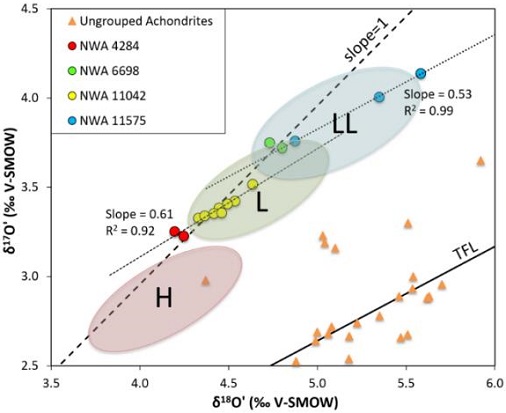
Northwest Africa 13272 is a fine-grained achondrite consisting of poikilitic grains of pyroxene (assemblages composed of orthopyroxene, pigeonite and augite) enclosing small chadacrysts of olivine (Fa24.0–29.5) with interstitial devitrified silicic glass. Accessory minerals include troilite, chromite, and very rare kamacite, as well as the secondary weathering products calcite, anhydrite, and Fe hydroxides. An oxygen isotope analysis was conducted at the University of New Mexico (K. Ziegler), and the values plot near the L/LL chondrite field (see the oxygen three-isotope plot).
An in-depth examination of the meteorite by Wang et al. (2023 #1021) identified three different lithologies: Type-4 chondrite, Type-7 chondrite, and Type-7 chondrite–impact melt breccia, with parts of the latter having been shock-darkened by opaque phases. Based on geochemistry and oxygen isotopes, they concluded that NWA 13272 has a stronger affinity to the L chondrite group, and therefore comprises L4 and L7 clasts along with recrystallized melt which was produced by either high-temperature impact heating or parent body magmatism.
Vaci et al. (2018) identified several ungrouped igneous achondrites with oxygen isotopic affinities to L and LL chondrites which they designated "supra-TFL achondrites" (see diagram below). The MetBull shows that Northwest Africa 13272 has an O-isotopic signature similar to several ungrouped achondrites including NWA 11575 and NWA 12628, as well as to the ungrouped metal-rich chondrite NWA 12379. Some of these meteorites could represent previously unidentified parent bodies distinct from the OC parent bodies (H, L, and LL) that formed within a common isotopic reservoir in the inner Solar System.
Note: The plot for NWA 6698 was revised in Vaci et al. (2021 #2378). This meteorite is a ureilite-related dioritic cumulus phase.
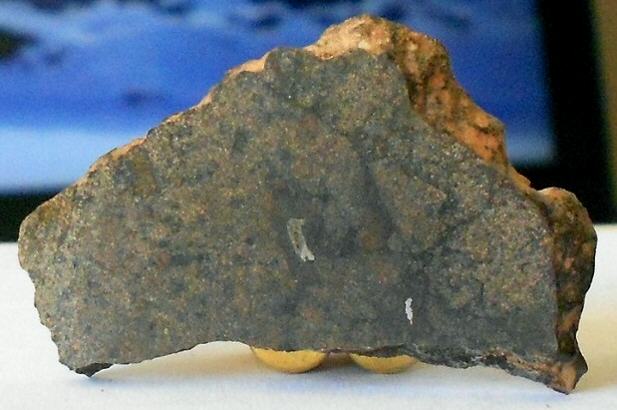
Northwest Africa 13272 shows evidence of low shock and a low to moderate degree of terrestrial weathering. The specimen of NWA 13272 shown above is a 3.7 g partial slice, with excellent photos courtesy of Sergey Vasiliev—SV-meteorites.