Achondrite, ungrouped
Clinopyroxenite
(alt., enstatite–chondrite-related impact-melt rock; A. Rubin [2025])
Purchased February 2023
no coordinates recorded
One large stone (1,359 g) and three smaller stones (808 g, 650 g, and 26 g) were reportedly found in the Aougrout District, Timimoun Province of Algeria. The stones were relatively fresh and still partially covered with black fusion crust. All four stones were initially purchased by J. Chaoui in late 2022, and they were subsequently sold in early 2023 to J. Piatek (half main mass, 645 g), B. Hoefnagels (half main mass, 650 g), and M. Lyon (three smaller stones). A type sample was submitted for analyses and classification to the University of Washington in Seattle (A. Irving) and to Brown University in Providence, RI (J. Boesenberg, D. Ibarra [oxygen isotopes]), and NWA 15915 was determined to be an ungrouped achondrite, specifically, a highly reduced, Mg-rich clinopyroxenite.
Northwest Africa 15915 consists primarily of coarse-grained augite (~ 77–90 vol%) with a lesser presence of enstatite grains (~ 10–20 vol%) as well as sparse fine enstatite lamellae in the augite (Irving et al., 2024 #6209; Mitchell et al., 2025 #2035). Low-Ni kamacite (1.8 vol%), K-rich plagioclase (1.1 vol%), and secondary Fe oxide occur as accessory phases. The very low abundance of plagioclase and the lack of olivine suggests a cumulate origin for the meteorite (A. Tomkins, pers. comm.).
A notable phase present in the meteorite consists of submicron to >1 mm-sized, spherical sulfide assemblages consisting of daubréelite (0.2 vol%), Cr-troilite (0.1 vol%), and ferroan alabandite (<0.1 vol%), which are ubiquitously present interstitially and within the pyroxene crystals (Mitchell et al., 2025 #2035). Analyses of the sulfide spherules were conducted by Dickens and Bell (2024 #6440), and they concluded that the sulfide inclusions were trapped as an immiscible liquid during a rapid cooling phase on the parent body. They also identified both oldhamite and caswellsilverite hosted in some alabandite grains. Exceptional high-resolution photos of these sulfide inclusions can be seen in the Encyclopedia of Meteorites, courtesy of Robert Smart.
The oxygen isotopic composition of NWA 15915 has values that plot with those of the aubrites and several other mineralogically similar meteorites with which NWA 15915 is probably launch-paired, including Ksar Ghilane 022, NWA 13304, NWA 13307 (see abs), and NWA 16555, as well as NWA 8173, Itqiy, and Zakłodzie (Irving et al., 2024 #6209; see diagram below).
Oxygen Isotopes for Aubrites and Augite-rich Pyroxenites
click on photo for a magnified view
Diagram credit: Irving et al., 86th MetSoc (2024 #6209)
'Reduced Ultramagnesian Augite-Rich Achondrites With Affinities To Aubrites'
Magnetic properties of NWA 15915 were analyzed by Mitchell et al., 2025 #2035), and their results suggest that the Fe-metal and daubréelite may have acquired a primary thermal remanence during parent body petrogenesis, indicative of a differentiated asteroid. On the other hand, both the lack of shock features and the lack of separation of dense sulfides from the silicates is consistent with a low gravity environment on a relatively small asteroid (A. Tomkins, pers. comm.).
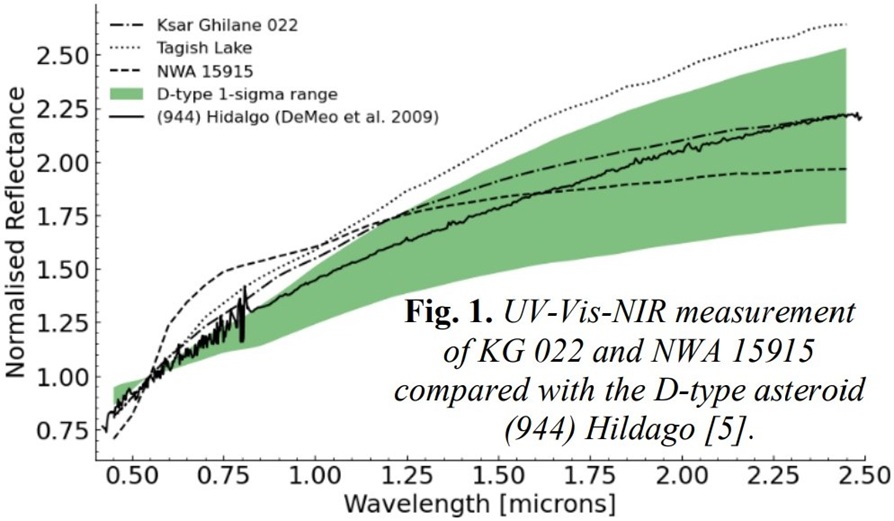
Various techniques were used by Rider-Stokes et al. (2025 #5056) to analyze NWA 19515 and its probable launch-pair Ksar Ghilane 022. Using the Bus–DeMeo taxonomy, they placed NWA 19515 and Ksar Ghilane 022 with the D-type asteroids based on its very red spectral slope and absense of spectral features (see diagram below). However, they note that the significant difference in visual albedos between aubrite-like meteorites, which contain low-iron silicates that produce relatively high albedos (Yang and Jewitt, 2011 and references therein), and D-type asteroids having average to low albedos, makes such a match unlikely (see also Wargnier et al., 2025).
NWA 15915 and KG 022 Comparison to D-type Asteroids
click on photo for a magnified view
Diagram credit: Rider-Stokes et al., 87th MetSoc (2025 #5056)
'Insights Into Unique Pyroxene Dominated Surfaces and Implications for Ongoing Space Missions'
See also the Icarusarticle (2025)
In addition to the reflectance spectra data, Rider-Stokes et al. (2025 #5056) used combined isotopic data for both meteorites to derive a Pb–Pb isochron age for NWA 15915 and Ksar Ghilane 022 of 4.528 (±0.010) b.y. They recognize that this age is significntly older than the present surface of Mercury, and thus rule out such a potential origin as well. In a recent study of enstatite chondrites conducted by A. Rubin (2025), it was recognized that most E chondrites having high degrees of shock also have ancient ages of 4.520–4.563 b.y., as determined by various dating techniques (Ar–Ar, Rb–Sr, and I–Xe); this age range is consistent with the age calculated for NWA 15915. With its age considered together with other accumulated research data, A. Rubin (2025) suggests that ungrouped achondrite NWA 15915 (and Ksar Ghilane 022) may otherwise be characterized as an enstatite–chondrite-related impact-melt rock. The timing of the shock events that affected the E chondrite planetesimals coincides with the proposed early instabilities leading to migration of the gas giant planets, known as the "Grand Tack" scenario of Walsh et al. (2012), and the "Nice Model" of Tsigani et al. (2005) (see the Protoplanetary Disk page for further details).
According to a large study by Burbine et al. (2024) utilizing the RELAB spectral database, the red-sloped spectra of both D-type and X-type asteroids are most often matched with CM chondrites (~50%) and iron meteorites (~33%). However, the authors assert that iron meteorites would likely have high visual geometric albedos, while D-type asteroids usually have very low visual geometric albedos. Despite the high visual geometric albedos among the aubrites, ~15% of them are placed with the relatively featureless B-type asteroids; this match might only be possible given an extremely space-weathered asteroid surface. Burbine et al. (2024) contend that the Bus–DeMeo taxonomic system does poorly for spectra that have weak to absent absorption features, without which the mineralogy of an asteroid cannot be accurately determined.
Aubrites have a median cosmic ray exposure age of 50 Myr and are likely delivered to Earth via Mars-crossing orbits (Ćuk et al., 2014). It is considered that aubrites, composed of iron-poor enstatite, likely derive from high-albedo, spectrally featureless asteroids of the Hungaria collisional family. A study was conducted by Cartier et al. (2024) using the experimentally-determined correlations of Ni and Co metal–silicate partition coefficients with pressure and oxygen fugacity (ƒO2), seeking to estimate the size of the parent bodies of various achondrite meteorites. Their model results indicate values for the aubrite parent body of 29 GPa and IW–5.0, which are consistent with a planet-sized object 10,840 km in diameter (8,740–14,210 km diameter considering error bars). They propose that the large aubrite parent body could now comprise the Hungaria family asteroids, which represent the silicate impact debris from the collisional disruption of proto-Mercury.
Estimated Parent Body Sizes of Select Achondrites
click on photo for a magnified view
Diagram credit: Cartier et al., GCA, vol. 367, pp. 142–164 (2024 open accesslink)
'Partitioning of nickel and cobalt between metal and silicate melts: expanding the oxy-barometer to reducing conditions'
(https://doi.org/10.1016/j.gca.2023.12.020)
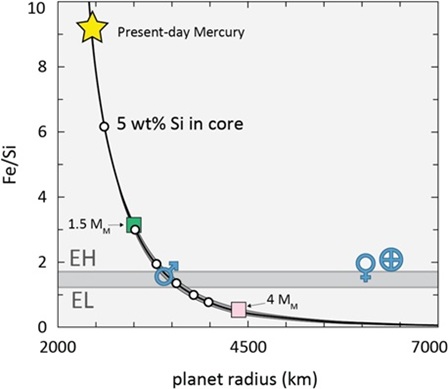
Under the assumption that the bulk silicate composition of Mercury is similar to enstatite chondrites, Fischer and Parman (2025) calculated the net Si abundance lost from the mantle and added to the core which is needed to match the Mercury fractionation line (MFL), as was determined by surface compositional analysis. To achieve the best agreement with each of the model parameters and with the MFL, they found that removal of ~32% Si from the mantle at an oxygen fugacity of IW–4.5 (±1.0) would lead to a final core Si concentration of ~3.4 wt%. A better agreement with other relevant factors is realized by using a larger initial mass for Mercury of ~1.5–4 times its current mass. Fischer and Parman (2025) posit that increasing the mass of Mercury (i.e., the mantle thickness) by 2× would increase the Si content of the core to ~15 wt%, thereby establishing a bulk Fe/Si ratio of ~1.9; this value is consistent with that of the other terrestrial planets and the EH chondrites. Such an increase in mass for Mercury would correspond to a larger radius of ~3,500 km (see diagram below).
Mercury Initial Parent Body Size
Venus (♀), Earth (⊕), and Mars (♂)
Diagram credit: Fischer and Parman, Icarus, vol. 439, art. 116664 (2025 open accesslink)
'The bulk composition and initial size of Mercury'
(https://doi.org/10.1016/j.icarus.2025.116664)
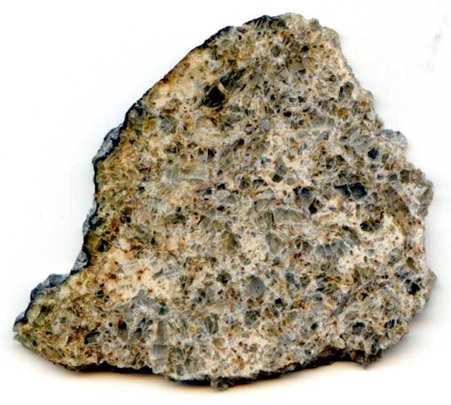
The specimen of NWA 15915 shown above is a 9.17 g partial slice. The photo shown below is a 4.2 g partial slice of the ungrouped achondrite Ksar Ghilane 022, considered to be a likely launch-pair of NWA 15915.
Ksar Ghilane 022
Clinopyroxenite
Found in Tunisia in 2023
32° 33' 32" N., 9° 30' 29" E.
See two excellent hi-res photos of a slice of Ksar Ghilane 022, published in MB 113 by Robert Smart: 12
Read the Micro Visions article for November 2025 about NWA 15915 in Meteorite Times Magazine, written by John Kashuba and including his always excellent thin section photomicrographs.