Ténéréite (evolved)* or Tafassite Clan
(Achondrite, ungrouped in MetBull 99)
Found 2010 in Algeria
no coordinates recorded
At least forty-two conjoint stone meteorite fragments, mostly devoid of fusion crust, were found in Algeria in 2010. They were subsequently purchased by G. Hupé in February 2011 during the Tucson Gem and Mineral Show—read his interesting account which was published in the Meteorite Times Magazine for June 2011 issue. Associated fragments were tracked down and acquired from various Moroccan dealers by G. Hupé over the succeeding four months. The total combined weight of these paired fragments was 8,387 g. An additional 5,100 g of fragments, designated NWA 6693, were acquired in March 2011 by E. Thompson and are considered likely paired with NWA 6704. One other group of paired stones previously obtained by G. Fujihara in January 2011 received a separate designation as NWA 6926. A portion of both NWA 6704 and NWA 6926 were submitted for analysis and classification to the University of Washington in Seattle (A. Irving and S. Kuehner), while a portion of NWA 6693 was submitted to the University of California in Los Angeles (P. Warren).
*Previously, Floss (2000) and Patzer et al. (2003 #1352, 2004) proposed that the acapulcoite/lodranite meteorites should be divided based on metamorphic stage:
primitive acapulcoites: near-chondritic (Se >12–13 ppm [degree of sulfide extraction])
typical acapulcoites: Fe–Ni–FeS melting and some loss of sulfide (Se ~5–12 ppm)
transitional acapulcoites: sulfide depletion and some loss of plagioclase (Se <5 ppm)
lodranites: sulfide, metal, and plagioclase depletion (K <200 ppm [degree of plagioclase extraction])
enriched acapulcoites (addition of feldspar-rich melt component)
A similar distinction could be made among the winonaites in our collections, as well as among members of the newly proposed group ténéréites (Agee et al., 2020). One of the most "primitive" members identified in this new group is NWA 7317, which contains relict chondrules comparable to a petrologic type 6 chondrite. However, most ténéréites have experienced more extensive thermal metamorphism involving incipient melting and now exhibit highly recrystallized textures, characteristics analogous to the "typical" acapulcoites. Metamorphic progression in other ténéréites involved higher degrees of partial melting and even separation of a basaltic fraction (e.g., NWA 011 pairing group). Samples representing such an advanced metamorphic stage are known as lodranites in the acapulcoite/lodranite metamorphic sequence, while the term "evolved" could be used to represent a similar metamorphic stage in the ténéréite group.
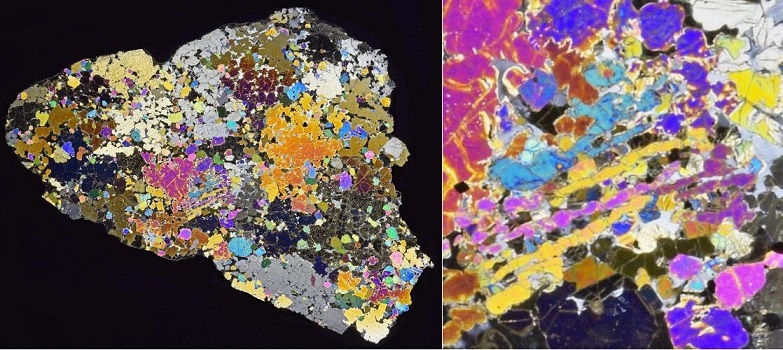
The meteorite was originally described as an igneous cumulate that originated on a large partially differentiated parent body distinct from all others known to date. In the December 2019 GCA article by Day et al., 'Ferrous oxide-rich asteroid achondrites', they concluded based on several factors (textures, rare earth element chemistry, highly siderophile element abundances, and oxygen and stable [Ti, Cr] isotope compositions) that NWA 6704 has characteristics which "conform to a cumulate or melt origin". Notably, a possible relict barred chondrule found in one NWA 6704 thin section by Peter Marmet would be indicative of a low-degree partial melt or possibly a melt re-fertilization process, rather than an origin as a cumulate or restite (see photo below).
Possible Relict Barred Chondrule in NWA 6704
Photos courtesy of Peter Marmet
Northwest Africa 6704 is composed primarily of orthopyroxene (~70 vol%), yellowish-green in color, occurring as both mm-sized grains and larger cm-sized megacrysts that enclose other smaller grains such as olivine and plagioclase (Irving et al., 2011; Warren et al., 2013; Hibiya et al., 2018). The Fe-rich olivine grains (~14 vol%) are likely xenocrysts similar to those present in some quenched angrites (Hibiya et al., 2014). These olivine grains contain relatively high NiO (ave. 0.9 wt%). Other components include highly sodic plagioclase (~10 vol%, as albite), pigeonite (~7 vol%, as rims on orthopyroxene megacrysts), FeNi-metal (~0.3 vol%, as awaruite), and chromite (~0.15 vol%), along with trace amounts of merrillite and sulfides (heazlewoodite and pentlandite). Plagioclase forms a continuous 3-D framework within the orthopyroxene megacrysts, and is inferred to have crystallized in situ from an undercooled melt. The plagioclase contains tiny grains of the Ni-rich (~80 wt%) metal awaruite. Curvilinear trains of micro-inclusions (mostly oxides) along with empty, smooth-walled bubbles are present in the orthopyroxene megacrysts, reflecting shock mobilization/injection (Irving et al., 2011; Warren et al., 2013; high-res image from Hibiya et al., 2018). Local compositional and textural variation, including an olivine-rich enclave, was observed in the NWA 6693 meteorite.
This meteorite is unique because of its great abundance of highly-ferroan mafic silicates (low-Ca pyroxene: Mg# = 57–60; olivine: Fa50–53), its highly sodic plagioclase (Ab91–93), and its Ni-rich phases (olivine: ave. 0.9 wt% NiO; metal: ave. 81 wt% NiO; and sulfide: ~0.002 wt% NiO). These Ni-rich phases are indicative of formation in a highly oxidizing environment (FMQ –2.6). Consistent with oxidation conditions is the fact that the bulk rock and siderophile element compositions are nearly chondritic, although the meteorite does show depletions of S and highly volatile elements. Elemental ratios (Mg/Si = 0.48 by wt.) indicate that very little fractionation has occurred in the parent melt, and the compositional trends exclude this rock from being a refractory residue (restite) of a partial melt (Warren et al., 2011; 2013). The FeO/MnO ratios for low-Ca pyroxene in this meteorite (81–106; Irving et al., 2011) are distinctly higher than those of both HED and martian meteorites, and it was concluded that the parental source material for the NWA 6704 pairing group was extremely oxidized (FeO-rich).
Iizuka et al. (2013) report high abundances of highly siderophile elements (HSE) for this meteorite similar to those of some brachinite-like achondrites such as GRA 06128/9 and Zag (b). In their study of HSE abundances and Os-isotopic systematics in brachinites and other FeO-rich brachinite-like achondrites, Day and Warren (2015) found that NWA 6693[6704] has a high Pt/Os ratio indicative of a cumulate derived from a low-degree partial melt infused with a residual metal melt component. In addition, they reasoned that the variability observed in the Pd/Os ratios of NWA 6693[6704] and other brachinite-like achondrites reflects variable degrees of fractionation of such a metal melt prior to its incorporation. The high abundance of HSEs was attributed by Warren et al. (2013) to the highly oxidizing formation conditions which inhibited sequestration and removal of HSEs by FeNi-metal during differentiation. In a study of NWA 6704 conducted by Archer et al. (2016), it was determined that the bulk HSE abundances are nearly chondritic and exhibit only a low degree of fractionation, consistent with a scenario in which only minor, localized silicate partial melting occurred with some loss of sulfides. Their results indicate that core formation had not proceeded to any great extent on the parent body by the time the meteorite was formed. It was further argued that the NWA 6704 chondritic precursor lithology was instantaneously melted during an impact event, and then rapidly cooled at ~1–100°C/hr under super-saturation conditions which promoted coarse dendritic growth of orthopyroxene (Hibiya et al., 2018). As temperatures fell below ~1100°C cooling proceeded much more slowly, consistent with burial ~100 m deep under an ejecta blanket (Hibiya et al., 2017, 2018).
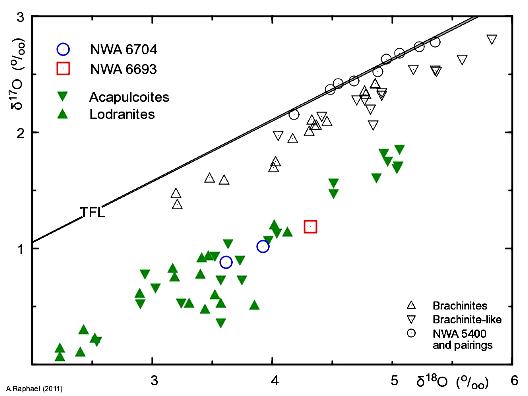
Separate O-isotopic analyses were conducted for NWA 6704 and NWA 6693 initially at Okayama University in Japan, and at Seoul National University in the Republic of Korea, respectively. It was ascertained by both institutions that this ungrouped achondrite plots within the field of the acapulcoite–lodranite clan (see oxygen three-isotope plot). However, mafic silicates in these paired meteorites are significantly more ferroan and the feldspar significantly more sodic than members of the acapulcoite–lodranite clan. While this diagnostic method suggests a connection might exist with the acapulcoite–lodranite clan, its O-isotopic composition also plots within the CR/CB/CH field, presenting yet another possibility for a connection (see oxygen three-isotope plot). The O-isotopic composition of NWA 6704 also plots close to the ungrouped LEW 88763, and although their mineralogy is completely different it is notable that they have complementary HSE patterns (Day and Warren, 2015). Notably, new analyses of LEW 88763 by Day et al. (2015) led them to propose its reclassification as an anomalous achondrite, possibly related to NWA 6704 and pairings. A diagram depicting the O-isotopic plot for NWA 6704 and NWA 6693, the acapulcoite–lodranite clan, and brachinites is shown below courtesy of Achim Raphael.
Northwest Africa 6704 — Oxygen isotopes (R. Tanaka, OkaU): replicate
analyses by laser-fluorination produced δ17O =
1.015‰, 0.880‰; δ18O = 3.922‰, 3.613‰; Δ17O = -1.048‰, -1.020‰;
Northwest Africa 6693 — Oxygen isotopes (B-G. Choi and I. Ahn, Seoul-NU): replicate analyses by laser-fluorination produced δ17O = 1.19‰; δ18O = 4.32‰; Δ17O = -1.08‰
Additional constraints on the origin of this meteorite were established through studies of the Cr-isotopic systematics (Sanborn et al., 2013). The resulting ε54Cr value of +1.69 (±0.07) resolves NWA 6704 from the acapulcoite–lodranite clan (ε54Cr = –0.75; Göpel and Birck, 2010); discrimination between these groups had not been attained through the use of O-isotopic values alone. Continued efforts to better resolve the relationship that exists among the numerous anomalous meteorites has been ongoing (e.g., Bunch et al., 2005, [#2308]; Floss et al., 2005, [MAPS vol. 40, #3]; Irving et al., 2014 [#2465]; Sanborn et al., 2014 [#2032]). As provided in the Sanborn et al. (2014) abstract, a coupled Δ17O vs. ε54Cr diagram is one of the best diagnostic tools for determining genetic relationships among meteorites. The diagrams below include the paired stones NWA 6704 and 6693, and it is apparent that they plot within the CR chondrite field.
Diagram credit: Sanborn et al., 45th LPSC, #2032 (2014)
Δ17O, ε54Cr, and ε50Ti Relationships for CR-like Achondrites
click on image for a magnified view
Diagrams credit: Sanborn et al., GCA, vol. 245, pp. 577–596 (2019)
'Carbonaceous Achondrites Northwest Africa 6704/6693: Milestones for Early Solar System Chronology and Genealogy' (https://doi.org/10.1016/j.gca.2018.10.004)
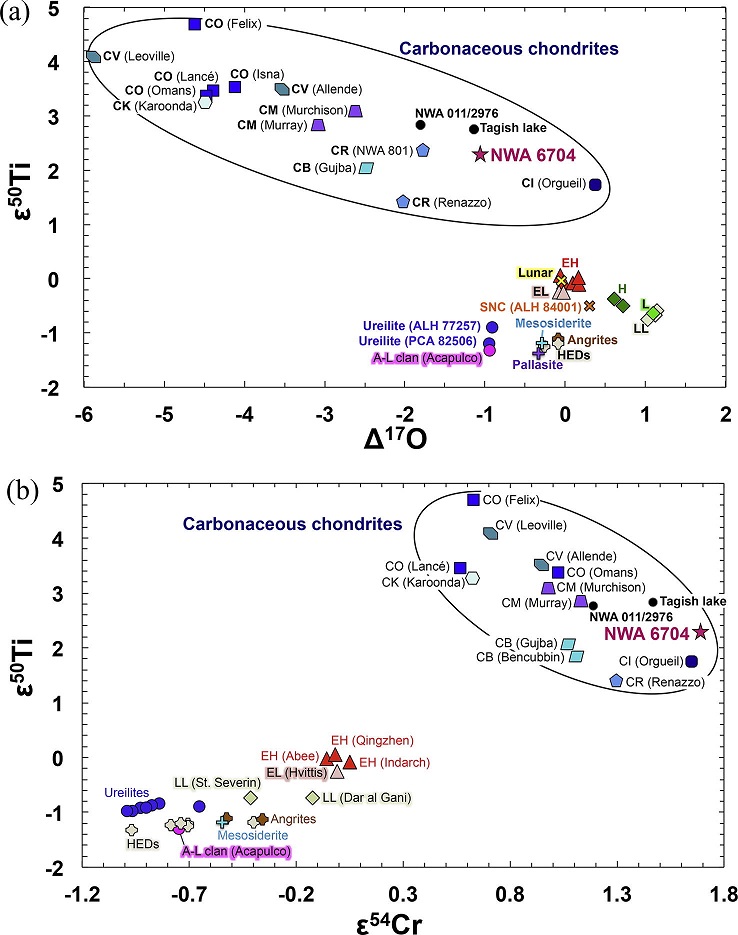
However, a plot of Δ17O vs. olivine Mg# (Mg/[Mg+Fe]) resolves the NWA 6704 pairing group from other meteorite groups as well as ungrouped meteorites with similar O-isotopic compositions, as it displays a significantly more ferroan composition (Warren et al., 2013). Further resolution of the parental source group for NWA 6704 was obtained by Hibiya et al. (2017, 2018) through a titanium isotope analysis. It is demonstrated on both Δ17O vs. ε50Ti and ε54Cr vs. ε50Ti coupled diagrams that the meteorite plots within the field for carbonaceous chondrites (see diagrams below). Based on the results of their petrologic, geochemical, and isotopic analyses of NWA 6704, Hibiya et al. (2017, 2018) concluded that an undifferentiated asteroid experienced an impact-generated melting event followed by rapid cooling. Presumably, subsequent burial beneath an ejecta blanket ushered an extended period of slow cooling.
Δ17O, ε54Cr, and ε50Ti Relationships for NWA 6704
click on image for a magnified view
Diagram credit: Hibiya et al., GCA, vol. 245, pp. 597–627 (2019)
'The origin of the unique achondrite Northwest Africa 6704: Constraints from petrology, chemistry and Re–Os, O and Ti isotope systematics'
(https://doi.org/10.1016/j.gca.2018.04.031)
An Ar–Ar and noble gas study was conducted by Fernandes et al. (2013) to constrain the petrologic history and to determine the CRE age of this meteorite. The oldest possible crystallization age was determined to be 4.56 (±0.29) b.y., or 4–5 m.y. after CAIs. This is in agreement with the U–Pb age of 4.56280 (±0.00046) b.y. determined by Iizuka et al. (2013), and the most precise and accurate age of 4.56238 (±0.00049) b.y. determined by P. Koefoed (2017). A refined Pb–Pb isochron age of 4.56278 (±0.00018) b.y. was calculated by combining data obtained from both the Australian National University and UC Davis (Huyskens et al. (2017). In a subsequent investigation, Amelin et al. (2019) employed the 238U/235U value directly measured for NWA 6704 of 137.7784 to calculate the most precise and accurate Pb–Pb isochron age of 4.56276 (+0.00022/-0.00030) b.y. In a similar manner, the best age estimate for NWA 6693 was determined to be 4.56263 (+0.00029/-0.00021) b.y. Other isotopic chronometers (e.g., Al–Mg, Mn–Cr [Sanborn et al., 2019], Rb–Sr, Re–Os) give ages that are consistent with the Pb–Pb age and attest to rapid cooling, crystallization, and isotopic closure. Based on initial Sr chronometry data, Amelin et al. (2019) determined that accretion of the NWA 6693/6704 parent body occurred within 3.6 m.y. of the formation of CAIs.
The occurrence of an impact-resetting event prior to complete cooling of the planetesimal is indicated by the loss of fluid from micro-inclusion bubble trains present in orthopyroxene crystals. This event may be related to a resetting event that occurred 4.199 (±0.032) b.y. ago as revealed by Amelin et al. (2018) through Ar–Ar chronometry. In addition, they provided further evidence of another thermal event that occurred ≤2.12 b.y. ago. The CRE age was calculated based on Ne and Ar systematics to be 30 (±3) m.y. (Fernandes et al., 2013). Furthermore, the pre-atmospheric size of the meteoroid was calculated to have been at least 100 cm in diameter.
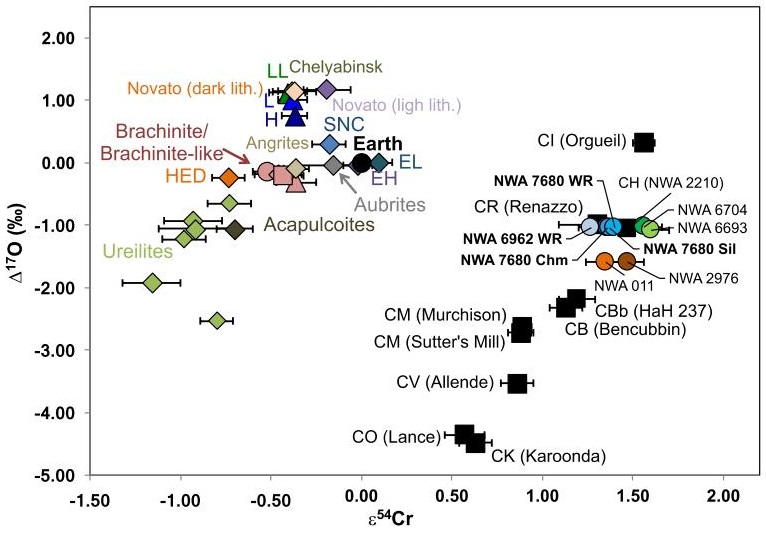
Further studies have been conducted by Sanborn et al. (2018) of new anomalous ungrouped meteorites recovered in Northwest Africa. Utilizing a coupled Δ17O vs. ε54Cr diagram, they demonstrated that NWA 6704 and pairings, NWA 011 and pairings, and NWA 6962/7680 all plot within the CR/CH carbonaceous chondrite field represented by CR2 Renazzo and CH3 NWA 2210, which suggests a possible genetic linkage among them (see diagram below).
ε54Cr vs. Δ17O Diagram for NWA 6704 Pairing Group
click on image for a magnified view
Diagram credit: Sanborn et al., 49th LPSC, #2296 (2018)
The reflectance spectra of NWA 6704 was acquired and compared to that of known asteroid groups (Le Corre et al., 2014). The analysis of a large-sized sample was comparable to spectra from the S(VI) asteroid group, which is thought to represent formation as a partial melt residue (e.g., winonaites). The spectra of a smaller, grain-sized sample plotted between the S(V) and S(VI) asteroid fields, the former thought to represent formation as a metamorphosed H chondrite or a primitive achondrite (e.g., acapulcoites/lodranites). However, direct spectral comparisons of NWA 6704 to known asteroids only produced a relatively close match to V-type asteroids (e.g., Vesta). Moreover, direct spectral comparisons of NWA 6704 to HED suite meteorites demonstrated a close similarity to the basaltic and cumulate eucrites as well.
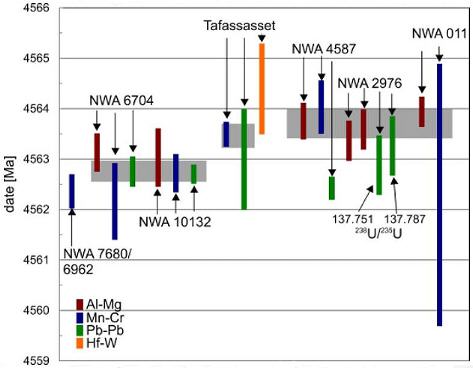
A separate 940 g stone designated NWA 10132 was found at a location different from the NWA 6704 pairing group, but it has a similar mineralogy, an almost identical O-isotopic composition, and a matching U–Pb age (Irving et al., 2015; Koefoed et al., 2015). Based on these facts, NWA 10132 is thought to be a possible genetic relative, likely comagmatic and/or launch paired. Consistent with this hypothesis, Y. Amelin (2017) determined that the Rb–Sr data for NWA 10132, NWA 6693, and NWA 6704 are similar and establish an isochron age of 4.543 (±0.035) b.y. In addition, the ε54Cr value for NWA 10132 determined by Sanborn et al. (2018) matches that of the NWA 6704 pairing group, and they calculated an age for NWA 10132 based on Mn–Cr systematics anchored to D'Orbigny of 4.56276 (±0.00041) b.y., as well as an age based on U–Pb systematics of 4.56271 (±0.00019) b.y.; both of these ages are concordant with the ages previously calculated for the NWA 6704 pairing group. Employing the 238U/235U ratio value of 137.7784 (Huyskens et al.), a similar Pb–Pb isochron age of 4.56212 (±0.00067) b.y. was calculated for NWA 10132 by P. Koefoed (2017). A fourth chronometric age for NWA 10132 was calculated by Huyskens et al. (2019) based on Al–Mg systematics. They derived an absolute age anchored to D'Orbigny of 4.56304 (±0.00059) b.y. Their compiled diagram incorporating multiple chronometric system ages for four potentially different achondrite parent bodies that accreted in the CR reservoir is shown below.
Diagram credit: Huyskens et al., 50th LPSC, #2736 (2019)
It was asserted by Agee et al. (2020) that the similarity in O, Cr, and Ti values among the CR2 carbonaceous chondrites and these ungrouped equilibrated meteorites is coincidental, and that significant geochemical differences (e.g., olivine Fa content and Fe/Mn) and other discrepancies (e.g., petrologic type discontinuity) exist that make a common parent body untenable. They contend that the thermally metamorphosed CC meteorites represent a unique group for which they propose the name 'ténéréites' (see list and diagrams below).
Diagram credit: Agee et al., 51st LPSC, #2292 (2020)
'Northwest Africa 12869: Primitive Achondrite From the CR2 Parent Body or Member of a New Meteorite Group?'
Diagram credit: Dr. Carl Agee, IOM Seminar Sept 1, 2020
'Dr. Carl Agee: Some New Meteorites from the Sahara Desert'
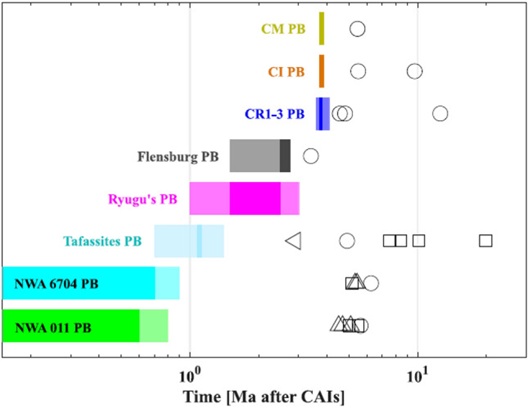
Ma et al. (2021, 2022) and Neumann et al. (2021) investigated the suite of ténéréites, for which they proposed the name 'tafassites'. They employed numerical modeling to constrain the formation and thermal history of the parent body, which they found was most consistent with an accretion age of 0.9 (±0.1) m.y. after CAIs—significantly earlier than that of the CR chondrite parent body at 3–4 m.y. after CAIs. In addition, they determined the diameter of the tafassite parent body to be 200–400 km. Moreover, based on stable isotope systematics and the distinct accretion ages obtained for the NWA 011 and NWA 6704 grouplets of 1.5 and 1.7 m.y. after CAIs, respectively, they argued that these meteorites derive from one or more additional parent bodies associated with a common reservoir (see top diagrams below). At the other end of the lumping–splitting spectrum, Jiang et al. (2021) contend that the CR parent body once comprised all of the meteorites that are isotopically and geochemically similar, composing a now disaggregated, at least partially differentiated body with a metallic core, achondritic mantle, and chondritic crust (see schematic illustration below).
ε54Cr vs. Δ17O for Tafassites and the NWA 011 and NWA 6704 grouplets
click on image for a magnified view
Diagrams credit: Ma et al., Geochemical Perspectives Letters, vol. 23, pp. 33–37, fig. S-13 (2022 open accesslink)
'Early formation of primitive achondrites in an outer region of the protoplanetary disc'
(https://doi.org/10.7185/geochemlet.2234)
Accretion Times for CC Reservoir Parent Bodies
Diagram credit: Neumann et al., Nature Scientific Reports, vol. 14, art. 14017, fig. 3 (2024 open accesslink)
'Recurrent planetesimal formation in an outer part of the early solar system'
(https://doi.org/10.1038/s41598-024-63768-4)
Schematic Diagram of a Partially Differentiated CR Parent Body
Schematic illustration credit: Jiang et al., 84th MetSoc, #6062 (2021)
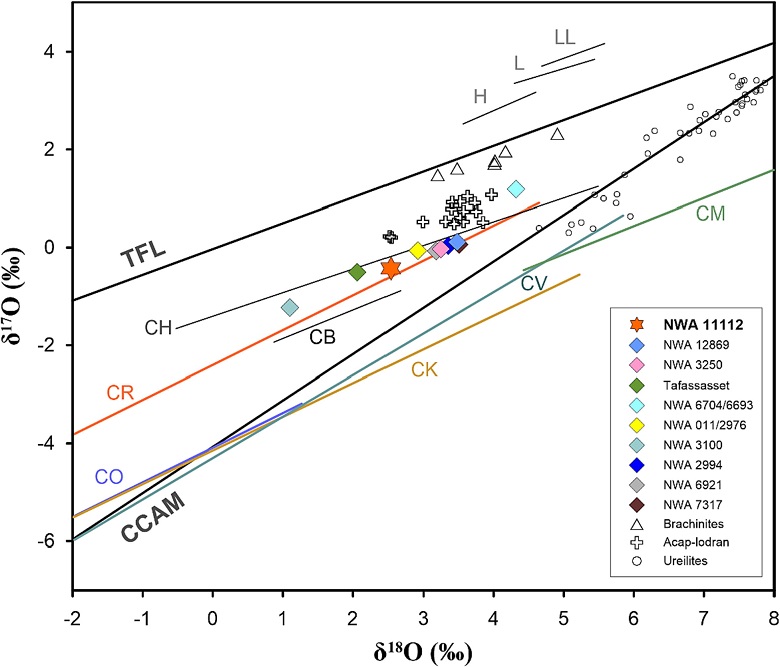
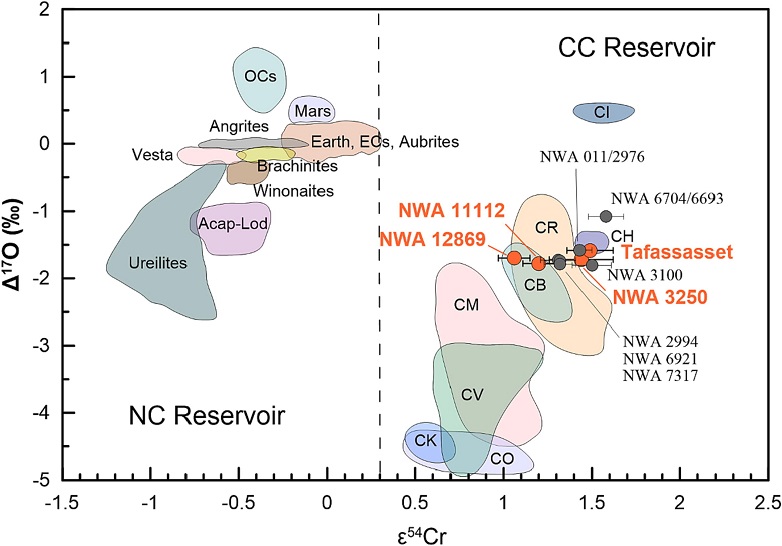
A more comprehensive investigation of the suite of four ungrouped primitive achondrites (NWA 3250, NWA 11112, NWA 12869, and Tafassasset) was undertaken by Jiang et al (2023) with an expanded team having relevant expertise in Cr and O isotope systematics, Mn–Cr chronometry, nucleosynthetic anomalous isotopes, and geothermometry. Employing advanced petrographic and mineralogical techniques, including high resolution X-ray tomographic microscopy, their analyses led to the conclusion that NWA 3250, NWA 11112, and NWA 12869 compose a grouplet of primitive achondrites that derive from a small parent body (tens of km in diameter) which accreted very early (<1 m.y. after CAIs) from a nebular reservoir that would later produce the CR chondrite parent body. Importantly, they determined that Tafassasset should be removed from inclusion in this grouplet due to significant mineralogical differences in comparison with the other three members (see diagrams below). Therefore, a potential 'tafassite clan' comprised of up to 4 parent bodies, each of which formed early in the CR reservoir, may be represented in our collections as (1) Tafassasset grouplet, (2) Jiang et al. grouplet, (3) NWA 011 basalt grouplet, and (4) NWA 6704 orthopyroxene grouplet.
Triple Oxygen Isotopes for CR-like Primitive Achondrites
click on image for a magnified view
ε54Cr vs. Δ17O for CR-like Primitive Achondrites
click on image for a magnified view
Diagrams credit: Jiang et al., GCA, vol. 345, pp. 1–15 (2023)
'Tracking and dating incipient melting of a new grouplet of primitive achondrites'
(https://doi.org/10.1016/j.gca.2023.01.022)
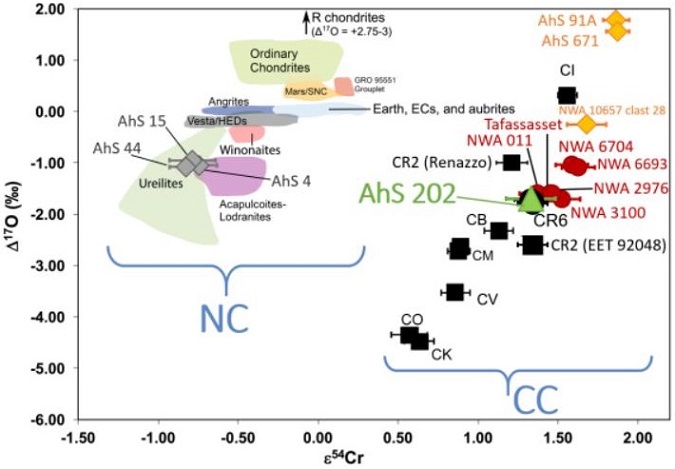
Miller et al. (2021) utilized a coupled ε54Cr vs. Δ17O diagram (see diagram below) to determine the genetic provenance of the ungrouped carbonaceous chondrite AhS 202, which was found as a xenolithic clast in the Almahata Sitta polymict ureilite. Based on its plot, AhS 202 could represent the unmelted chondritic lid surrounding a Ceres-sized (~640–1,800 km-diameter as indicated by evident prograde metamorphism involving the amphibole tremolite [Hamilton et al., 2020; Hamilton et al., 2021; Dodds et al., 2022 {#2158}]) differentiated asteroid, possibly associated with the early-formed (i.e., prior to CR chondrule formation at ~3.8 m.y. after CAIs) ténéréite group (Agee et al., 2020). Alternatively, AhS 202 may derive from an asteroid that formed in the CR reservoir and was previously unrepresented in our collections. Interestingly, the tremolite-bearing C1-ung chondrite MIL 090292 may be a second sample from the same parent body (Hamilton and Goodrich, 2023 #6137).
ε54Cr vs. Δ17O Diagram for AhS 202
click on image for a magnified view
Diagram credit: Miller et al., 52nd LPSC, #2360 (2021)
'Stalking a Large Carbonaceous Chondrite Asteroid Using ε54Cr–Δ17O Isotope Systematics of the Unique Xenolith Almahata Sitta 202'
Hibiya et al. (2019) used Nb–Zr chronometry in combination with precise U–Pb age data for NWA 6704 to investigate the origin of the short-lived radionuclide 92Nb and resolve any potential differences in its initial abundance and distribution between the inner NC and outer CC protoplanetary disk regions at the time of Solar System formation. In comparison to the initial 92Nb/93Nb ratio of (1.7 ± 0.6) × 10–5 obtained in a prior study of three NC achondrites (Agoult, Ibitira, and NWA 4590; Iizuka et al., 2016), which attests to a homogeneous distribution within this region, Hibiya (2019 #6370) calculated a significantly higher initial 92Nb/93Nb ratio of (3.0 ± 0.3) × 10–5 for NWA 6704 representing the CC region. This demonstrates that 92Nb was heterogeneously distributed between the two protoplanetary disk regions. In addition, they determined that the nucleosynthesis of 92Nb could not have occurred through the γ- or p-process (photodisintegration reactions) in Type Ia supernovae, but instead is more consistent with the v-process (neutrino-induced reactions) in core collapse Type II supernovae (Hayakawa et al., 2013). In this scenario a nearby Type II supernova exploded within 100 m.y. prior to the collapse of the protosolar cloud, ultimately infusing only the CC accretion region with ejected 92Nb radionuclides (free decay interval of ~10 m.y.; Yin et al., 2000).
The meteorites composing this unique pairing group were found to have features consistent with a low weathering grade described as generally unshocked (S1) after significant annealing (Warren et al., 2013). The specimen of NWA 6704 framed above is a 1.56 g fragment.