NORTHWEST AFRICA 6926

Ténéréite (evolved)*
or Tafassite Clan
(Achondrite, ungrouped in MetBull 100)
standby for nwa 6926 photo
click on photo for a magnified view

Purchased in 2011
no coordinates recorded

Numerous small fragments mostly devoid of fusion crust, having a combined weight of 220 g, were found in Algeria and subsequently purchased by G. Fujihara in January 2011 from a Moroccan dealer in Zagora. These fragments are likely part of the same mass that was subsequently designated NWA 6704, comprised of numerous conjoint fragments weighing together 8,387 g, which were purchased during this time by G. Hupé. An additional 5,100 g of fragments were acquired in March 2011 by E. Thompson and designated NWA 6693 (photo).

*Previously, Floss (2000) and Patzer et al. (2003) proposed that the acapulcoite/lodranite meteorites should be divided based on metamorphic stage:
  1. primitive acapulcoites: near-chondritic (Se >12––13 ppm [degree of sulfide extraction])
  2. typical acapulcoites: Fe––Ni––FeS melting and some loss of sulfide (Se ~5––12 ppm)
  3. transitional acapulcoites: sulfide depletion and some loss of plagioclase (Se <5 ppm)
  4. lodranites: sulfide, metal, and plagioclase depletion (K <200 ppm [degree of plagioclase extraction])
  5. enriched acapulcoites (addition of feldspar-rich melt component)
A similar distinction could be made among the winonaites in our collections, as well as among members of the newly proposed group ténéréites (Agee et al., 2020). One of the most "primitive" members identified in this new group is NWA 7317, which contains relict chondrules comparable to a petrologic type 6 chondrite. However, most ténéréites have experienced more extensive thermal metamorphism involving incipient melting and now exhibit highly recrystallized textures, characteristics analogous to the "typical" acapulcoites. Metamorphic progression in other ténéréites involved higher degrees of partial melting and even separation of a basaltic fraction (e.g., NWA 011 pairing group). Samples representing such an advanced metamorphic stage are known as lodranites in the acapulcoite/lodranite metamorphic sequence, while the term "evolved" could be used to represent a similar metamorphic stage in the ténéréite group.

Samples of both NWA 6926 and NWA 6704 were submitted for analysis and classification to the University of Washington in Seattle (A. Irving and S. Kuehner), while a portion of NWA 6693 was submitted to the University of California in Los Angeles (P. Warren et al.). They determined that the pairing group NWA 6704/6926/6693 represents an igneous cumulate that originated on a large differentiated parent body distinct from all others known.

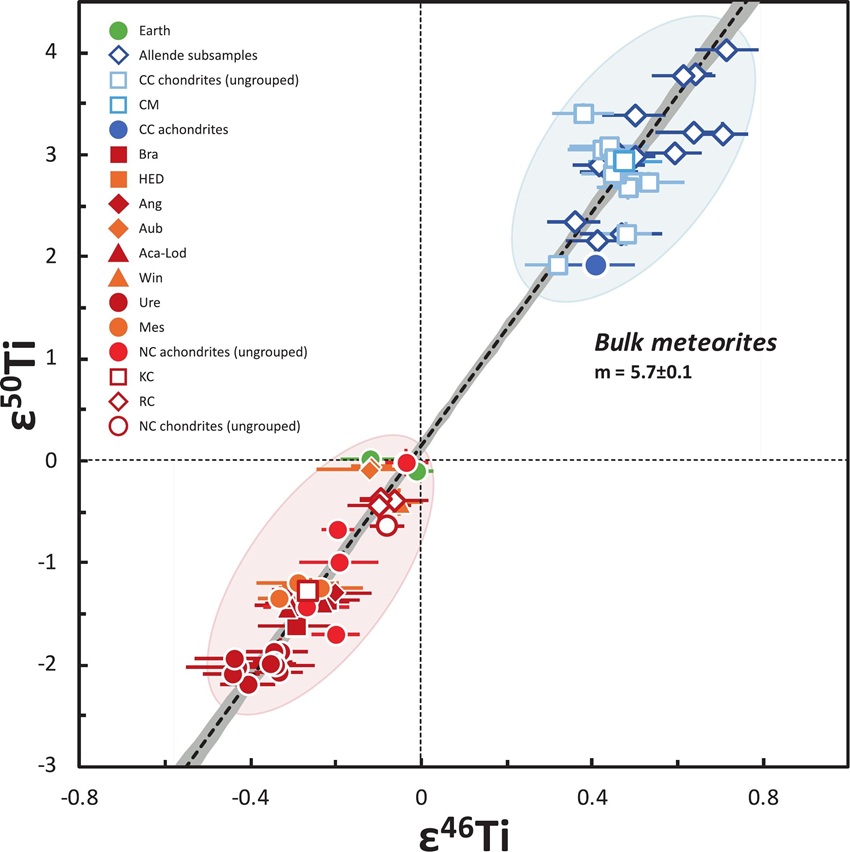
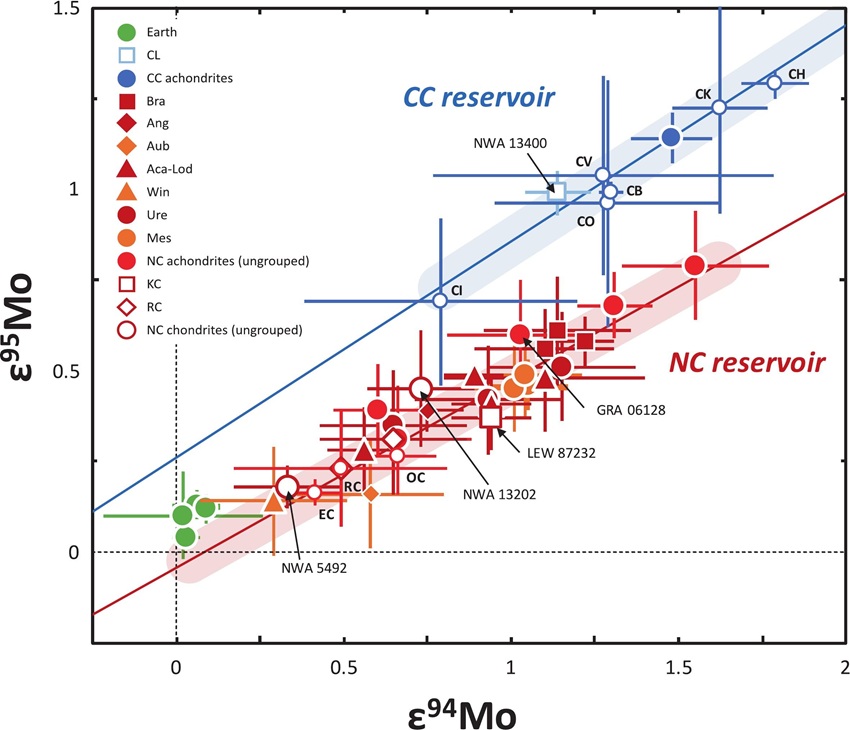
It was asserted by Agee et al. (2020) that the similarity in O, Cr, and Ti values among the CR2 carbonaceous chondrites and these ungrouped equilibrated meteorites is coincidental, and that significant geochemical differences (e.g., olivine Fa content and Fe/Mn) and other discrepancies (e.g., petrologic type discontinuity) exist that make a common parent body untenable. They contend that the thermally metamorphosed CC meteorites represent a unique group for which they propose the name 'ténéréites' (see list and oxygen isotope diagram below).

standby for ténéréite oxygen isotopes diagram
Diagram credit: Agee et al., 51st LPSC, #2292 (2020)
'Northwest Africa 12869: Primitive Achondrite From the CR2 Parent Body or Member of a New Meteorite Group?'

standby for ténéréite fa vs fe/mn diagram
Diagram credit: Dr. Carl Agee, IOM Seminar Sept 1, 2020
'Dr. Carl Agee: Some New Meteorites from the Sahara Desert'

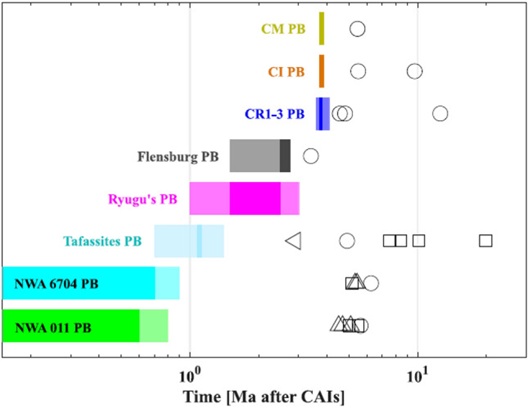
Ma et al. (2021, 2022) and Neumann et al. (2021) investigated the suite of ténéréites, for which they proposed the name 'tafassites'. They employed numerical modeling to constrain the formation and thermal history of the parent body, which they found was most consistent with an accretion age of 0.9 (±0.1) m.y. after CAIs—significantly earlier than that of the CR chondrite parent body at 3–4 m.y. after CAIs. In addition, they determined the diameter of the tafassite parent body to be 200–400 km. Moreover, based on stable isotope systematics and the distinct accretion ages obtained for the NWA 011 and NWA 6704 grouplets of 1.5 and 1.7 m.y. after CAIs, respectively, they argued that these meteorites derive from one or more additional parent bodies associated with a common reservoir (see top diagrams below). At the other end of the lumping–splitting spectrum, Jiang et al. (2021) contend that the CR parent body once comprised all of the meteorites that are isotopically and geochemically similar, composing a now disaggregated, at least partially differentiated body with a metallic core, achondritic mantle, and chondritic crust (see schematic illustration below).

ε54Cr vs. Δ17O for Tafassites and the NWA 011 and NWA 6704 grouplets
standby for o-cr diagram
click on image for a magnified view

Diagrams credit: Ma et al., Geochemical Perspectives Letters, vol. 23, pp. 33–37, fig. S-13 (2022 open access link)
'Early formation of primitive achondrites in an outer region of the protoplanetary disc'
(https://doi.org/10.7185/geochemlet.2234)

standby for cr parent body illustration
Schematic illustration credit: Jiang et al., 84th MetSoc, #6062 (2021)

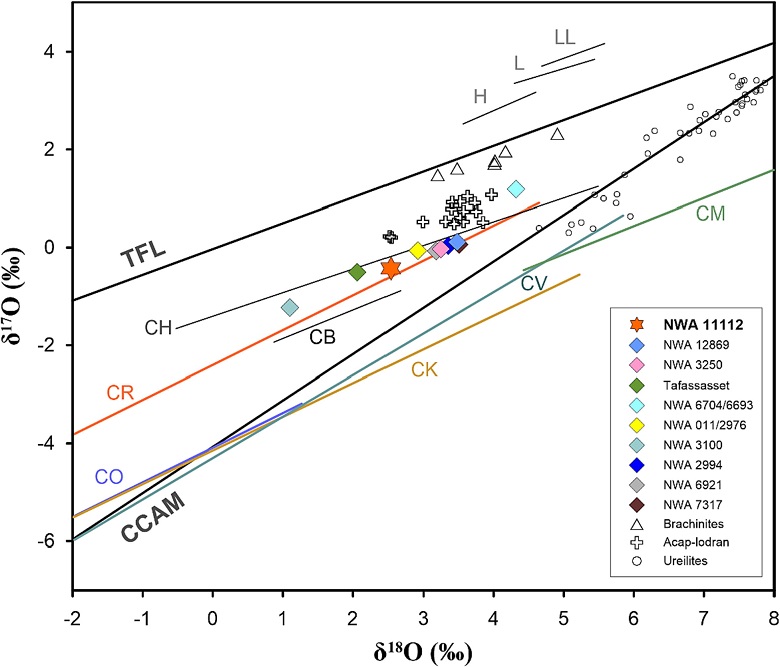
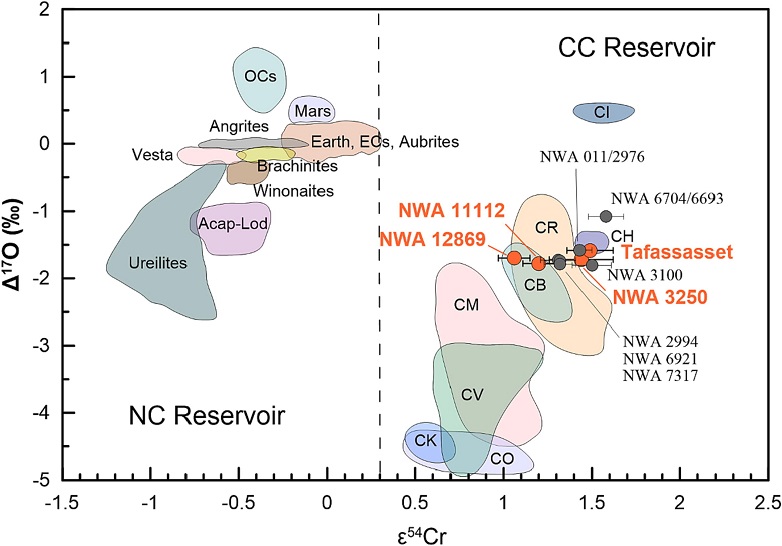
A more comprehensive investigation of the suite of four ungrouped primitive achondrites (NWA 3250, NWA 11112, NWA 12869, and Tafassasset) was undertaken by Jiang et al (2023) with an expanded team having relevant expertise in Cr and O isotope systematics, Mn–Cr chronometry, nucleosynthetic anomalous isotopes, and geothermometry. Employing advanced petrographic and mineralogical techniques, including high resolution X-ray tomographic microscopy, their analyses led to the conclusion that NWA 3250, NWA 11112, and NWA 12869 compose a grouplet of primitive achondrites that derive from a small parent body (tens of km in diameter) which accreted very early (<1 m.y. after CAIs) from a nebular reservoir that would later produce the CR chondrite parent body. Importantly, they determined that Tafassasset should be removed from inclusion in this grouplet due to significant mineralogical differences in comparison with the other three members (see diagrams below). Therefore, a potential 'tafassite clan' comprised of up to 4 parent bodies, each of which formed early in the CR reservoir, may be represented in our collections as (1) Tafassasset grouplet, (2) Jiang et al. grouplet, (3) NWA 011 basalt grouplet, and (4) NWA 6704 orthopyroxene grouplet.

Triple Oxygen Isotopes for CR-like Primitive Achondrites
standby for triple oxygen isotopic diagram
click on image for a magnified view

ε54Cr vs. Δ17O for CR-like Primitive Achondrites
standby for o-cr diagram
click on image for a magnified view

Diagrams credit: Jiang et al., GCA, In Press (2023)
'Tracking and dating incipient melting of a new grouplet of primitive achondrites'
(https://doi.org/10.1016/j.gca.2023.01.022)

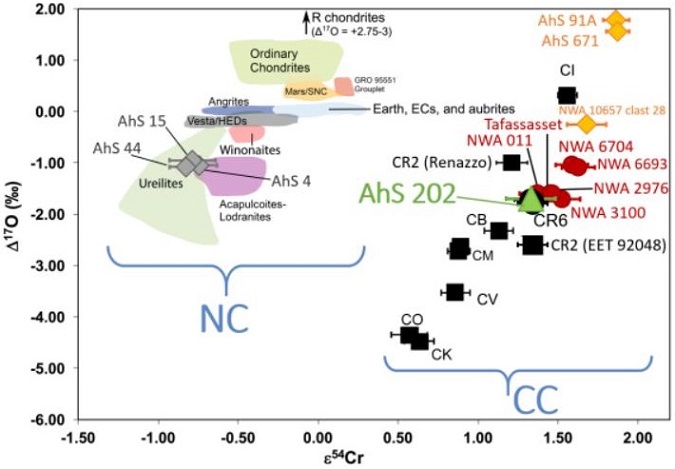
Miller et al. (2021) utilized a coupled ε54Cr vs. Δ17O diagram (see diagram below) to determine the genetic provenance of the ungrouped carbonaceous chondrite AhS 202, which was found as a xenolithic clast in the Almahata Sitta polymict ureilite. Based on its plot, AhS 202 could represent the unmelted chondritic lid surrounding a Ceres-sized (~640–1,800 km-diameter as indicated by evident prograde metamorphism involving the amphibole tremolite [Hamilton et al., 2020; Hamilton et al., 2021]; Dodds et al., 2022 [#2158]) differentiated asteroid, possibly associated with the proposed ténéréite group (Agee et al., 2020). Alternatively, AhS 202 may derive from an asteroid that formed in the CR reservoir and was previously unrepresented in our collections. Interestingly, the tremolite-bearing C1-ung chondrite MIL 090292 may be a second sample from the same parent body (Hamilton and Goodrich, 2023 #6137).

ε54Cr vs. Δ17O Diagram for AhS 202
standby for o-cr diagram
click on image for a magnified view

Diagram credit: Miller et al., 52nd LPSC, #2360 (2021)
'Stalking a Large Carbonaceous Chondrite Asteroid Using ε54Cr–Δ17O
Isotope Systematics of the Unique Xenolith Almahata Sitta 202'

Further details about this meteorite are presented on the NWA 6704 page. The specimen of NWA 6926 shown above is a 1.88 g polished end-cut.