A SYSTEMATIC CLASSIFICATION OF METEORITES
PART V

PART I: CHONDRITES, METACHONDRITES
PART II: PRIMITIVE ACHONDRITES, ACHONDRITES, STONY-IRONS, IRONS
PART III: MARTIAN METEORITES—GEOCHEMICAL CLASSIFICATION
PART IV: DIOGENITES—IUGS TAXONOMY
PART VI: STONY METEORITES—METAMORPHIC FACIES SERIES

*NEW* 'Meteorite petrology versus genetics: Toward a unified binominal classification', by Emmanuel Jacquet
Meteoritics & Planetary Science, vol. 57, #9, pp. 1774–1794 (2022, open access link)

'The secondary classification of unequilibrated chondrites', by Emmanuel Jacquet, and Béatrice Doisneau
Meteoritics & Planetary Science, vol. 59, #12, pp. 3150–3180 (2024, open access link)


ENSTATITE (E) CHONDRITES

I. Subgroup classification after Weyrauch et al.
Meteoritics and Planetary Science, vol. 53, #3, pp. 394–415 (2018 open access link)
'Chemical variations of sulfides and metal in enstatite chondrites—Introduction of a new classification scheme'

Weyrauch et al. (2018) analyzed the mineral and chemical data from 80 enstatite chondrites representing both EH and EL groups and spanning the full range of petrologic types for each group. They found that a bimodality exists in each of these groups with respect to both the Cr content in troilite and the Fe concentration in niningerite and alabandite (endmembers of the [Mn,Mg,Fe] solid solution series present in EH and EL groups, respectively). In addition, both the presence or absence of daubréelite and the content of Ni in kamacite were demonstrated to be consistent factors for the resolution of four distinct E chondrite groups: EHa, EHb, ELa, and ELb (see table below).

ENSTATITE CHONDRITE SUBGROUPS
Weyrauch et al., 2018
  EHa EHb ELa ELb
Troilite Cr <2 wt% Cr >2 wt% Cr <2 wt% Cr >2 wt%
(Mn,Mg,Fe)S Fe <20 wt% Fe >20 wt% Fe <20 wt% Fe >20 wt%
Daubréelite Abundant Missing Abundant Missing
Kamacite Ni <6.5 wt% Ni >6.5 wt% Ni <6.5 wt% Ni >6.5 wt%

ENSTATITE CHONDRITES
(4 subgroups plus ungrouped/anomalous members, based on mineral and chemical data [see below])
ELa
ELa3 (e.g. AhS MS-189, MAC 88136 [3.8/3.9], MAC 02747 [3/4], NWA 12308, QUE 94594)
ELa4 (e.g. DaG 734, Grein 002 [4/5])
ELa5 (e.g. AhS MS-201, TIL 91714)
ELa6 (e.g. Atlanta, Daniel's Kuil, Hvittis, Khairpur, Neuschwanstein, NWA 3134, Pillistfer, Sah 00025, Sah 99456, Yilmia)
ELa7/impact-melt phase (e.g. Ilafegh 009 [7/MR])
ELb
ELb3 (e.g. AhS MS-17 [3/4], AhS MS-164 [3/4], AhS MS-177, AhS MS-200 [3/4], AhS MS-MU-002 [3/4], AhS MS-MU-003 [3/4], AhS MS-MU-039 [3/4 + melt])
ELb4 (e.g. Y-793246)
ELb5 (e.g. AhS MS-7 [5/6], AhS MS-196, RKPA80259)
ELb6 (e.g. AhS MS-52, AhS MS-79, AhS MS-150, AhS MS-159, AhS MS-172, AhS MS-174, AhS MS-D, AhS MS-MU-007, EET 90102, LEW 87119)
ELb7/impact-melt phase (no sample classified)
EHa
EHa3 (e.g. AhS MS-14, AhS MS-224, ALH 84206, GRO 95517, MIL 07028, Parsa, Qingzhen, Sah 97096 [3.1–3.4])
EHa4 (e.g. AhS MS-259 [4/5], EET 87746, EET 96135 [4/5], Indarch, MET 00636, PCA 82518, Y-74370)
EHa5 (e.g. QUE 93372, St. Mark's)
EHa6 (NWA 12945, NWA 15893)
EHa7/impact melt phase (e.g. LAP 02225 [IM], NWA 4799 [IM], NWA 7214 [IM], NWA 7809 [IM], NWA 11071 [IM])
EHb
EHb3 (no sample classified)
EHb4 (e.g. Adhi Kot [or IMB], AhS MS-MU-009 [4/5])
EHb5 (e.g. AhS MS-13, AhS MS-155, AhS MS-163, AhS MS-192, AhS MS-MU-041, AhS MS-MU-044, LEW 88180, Saint-Sauveur [IMB])
EHb6 (e.g. Y-8404 and pairings [or IMB/MR], Y-980211, Y-980223)
EHb7/impact melt phase (e.g. Abee [IMB])

ENSTATITE CHONDRITES—NOT YET CLASSIFIED BY SUBGROUP
EL
EL3 (e.g. Kaidun IV, NWA 305, NWA 3132, NWA 2965 and pairings [3/6 IMB], QUE 93351)
EL4 (e.g. DaG 1031, FRO 03005, HaH 317, QUE 94368)
EL5 (e.g. Adrar Bous, NWA 1222, Tanezrouft 031)
EL6 (e.g. Eagle, Forrest 033)
EL7/impact-melt phase (e.g. Happy Canyon [MR], Y-980524 [IMB])
EH
EH3 (e.g. Galim (b) [IMB], Hadley Rille [IM])
EH4 (e.g. Bethune [4/5], Dhofar 1015, LAP 031220, Y-791810)
EH5 (e.g. A-881475, Kaidun-III, Oudiyat Sbaa)
EH6 (e.g. MIL 090846, NWA 6363, NWA 7976, NWA 8513 [IMB])
EH7/impact melt phase (e.g. NWA 7324 [MR], NWA 10237 [MR], QUE 94204 [7], Y-82189 [IM], Y-8414 [IM])
UNGROUPED E CHONDRITES
E-ung (e.g. LAP 031220 [4], LEW 87223 [3-anom], PCA 91020 [3-anom; poss. rel. to LEW 87223], QUE 94204 [7], Y-793225 [6-anom])

A few other E chondrites with intermediate mineralogy have been identified, including LAP 031220 (EH4), QUE 94204 (EH7), Y-793225 (E-an), LEW 87223 [EL3-an; abs], and PCA 91020 (possibly related to LEW 87223). Studies have determined that these meteorites were not derived from the EH or EL source through any metamorphic processes, and some or all of them could represent separate E chondrite asteroids.

A number of the meteorites in the tables above were subsequently determined by Mc Ardle et al. (2025) to be impact-melt rocks, and they have reevaluated the respective petrologic types as follows (see also their alternative quantitative subgroup classification scheme below):


II. Subgroup classification after Mc Ardle et al.
Meteoritics and Planetary Science, Early View (2025 open access link)
'Parent body thermal metamorphism of enstatite chondrites: Disentangling the effects of shock melting'

A comprehensive study was conducted by Mc Ardle et al. (2025) which utilized geochemical and mineralogical data for a large sampling of enstatite chondrites representing a broad range of petrologic types within the two established chemical groups, EL and EH. They first determined which of the meteorites had experienced shock melting followed by either quenching or slow cooling, as well as possible annealing. These impact-melt rocks were eliminated from their study, while the remainder, which experienced only parent body thermal heating and related metamorphism, were reevaluated as to petrologic type.

Mc Ardle et al. (2025) concluded that previous classification schemes proposed by Weyrauch et al. (2018) and others had included shock-melted meteorites among the samples, and therefore could only distinguish the quenched impact-melt rocks on the one hand (ELb and EHb), and the slowly cooled impact-melt rocks (ELa and EHa) together with the nonimpact-melted samples on the other hand. After excluding all shock-melted meteorites, and considering only those which experienced parent body thermal metamorphism, certain trends became evident such as the following (see all newly defined EC petrologic type classification parameters proposed by Mc Ardle et al. [2025]):

A new quantitative petrologic type classification scheme was proposed by Mc Ardle et al. (2025) that only applies to those enstatite chondrites (EL and EH) which experienced parent body thermal metamorphism without shock melting. Their classification scheme uses mineralogic, petrographic, and geochemical insights utilizing the glass/feldspar, olivine, enstatite, sulfide, and metal components present in each meteorite (see their Table 11 and 12).

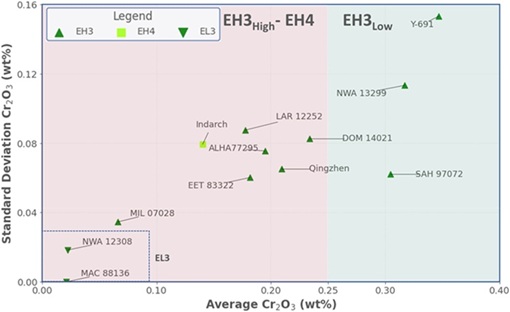
In addition, after a thorough investigation of both the pros and cons of all previously proposed subgrouping schemes for type 3 ECs, Mc Ardle et al. (2025) developed a simplified subtype classification based on the Cr2O3 content of olivine, which is presently applicable to the EH3 group. Two distinct subtypes were considered to be resolvable within reason, with the boundary between them established at 0.25 wt% average Cr2O3 content in olivine (see diagram below):

  1. more primitive EH3Low subtype:
    (e.g. Y-691, NWA 13299, SAH 97072)
  2. less primitive EH3High–EH4 subtype:
    (e.g. DOM 14021, Qingzhen, ALHA77295, EET 83322, LAR 12252, Indarch, MIL 07028)

Standard Deviation vs. Average Cr2O3 Content in Olivine
(boundary between EH3Low and EH3High–EH4 at 0.25 wt% average Cr2O3)
standby for diagram
Diagram credit: Mc Ardle et al., Meteoritics and Planetary Science, Early View, fig. 16 (2025 open access link)
'Parent body thermal metamorphism of enstatite chondrites: Disentangling the effects of shock melting'
(https://doi.org/10.1111/maps.70065)


PART I: CHONDRITES, METACHONDRITES
PART II: PRIMITIVE ACHONDRITES, ACHONDRITES, STONY-IRONS, IRONS
PART III: MARTIAN METEORITES—GEOCHEMICAL CLASSIFICATION
PART IV: DIOGENITES—IUGS TAXONOMY
PART VI: STONY METEORITES—METAMORPHIC FACIES SERIES

You must collect things for reasons you don't yet understand.
Daniel J. Boorstin–Librarian of Congress


© 1997–2025 by David Weir