A SYSTEMATIC CLASSIFICATION OF METEORITES
PART IV
PART I: CHONDRITES, METACHONDRITES
PART II: PRIMITIVE ACHONDRITES, ACHONDRITES, STONY-IRONS, IRONS
PART III: MARTIAN METEORITES—GEOCHEMICAL CLASSIFICATION
PART V: ENSTATITE CHONDRITES—SUBGROUP CLASSIFICATION
PART VI: STONY METEORITES—METAMORPHIC FACIES SERIES
*NEW* 'Meteorite petrology versus genetics: Toward a unified binominal classification', by Emmanuel Jacquet
Meteoritics & Planetary Science, vol. 57, #9, pp. 1774–1794 (2022, open access link)
'The secondary classification of unequilibrated chondrites', by Emmanuel Jacquet and Béatrice DoisneauMeteoritics & Planetary Science, vol. 59, #12, pp. 3150–3180 (2024, open access link)
See also 'Chondrite Subtypes Unified', by Emmanuel Jacquet and Béatrice Doisneau (2026 #5012)
DIOGENITES
A rock type of ultramafic composition (olivine+orthopyroxene ≥90 vol%), historically considered to be associated with Vesta
Classification Based on IUGS Taxonomy
|
1. ORTHOPYROXENITE: ≥90 vol% orthopyroxene (e.g. Bilanga, Johnstown, NWA 1821, NWA 3329, QUE 99050, Tatahouine) |
|
2. OLIVINE–ORTHOPYROXENITE: orthopyroxene + 10–40 vol% olivine (e.g. ALHA77256, GRA 98108, LEW 88679, NWA 5312, NWA 5405) |
|
3. HARZBURGITE: >40 vol% olivine (e.g. EETA79002, MIL 07001, NWA 1459, 1877 and pairings, NWA 4223, NWA 5480, NWA 6157) |
|
4. DUNITE: ≥90 vol% olivine (e.g. MIL 03443, NWA 2968, NWA 12319 and pairings [dun/lherz brec]) |
|
5. NORITE: orthopyroxene + <5 vol% olivine + >10 vol% plagioclase (e.g. Al Bir Lahlou 001, NWA 5315, NWA 6928, NWA 8000, NWA 8367, NWA 8744, NWA 10268, NWA 10388, Wan Zawatin 001 [76 vol% anorthite; paired with NWA 15118], NWA 18200 [abs]) |
|
6. ANORTHOSITE: orthopyroxene + <5 vol% olivine + >90 vol% anorthitic plagioclase (e.g. NWA 15118 [~94 vol% anorthite; paired with Wan Zawatin 001]) |
|
7. POLYMICT: dunite ± harzburgite ± orthopyroxenite ± eucrite (<10 vol%)
(e.g. ALH 85015, LEW 88008, NWA 1239, NWA 1648, NWA 4473, NWA 6945 [w/ noritic clasts]) |
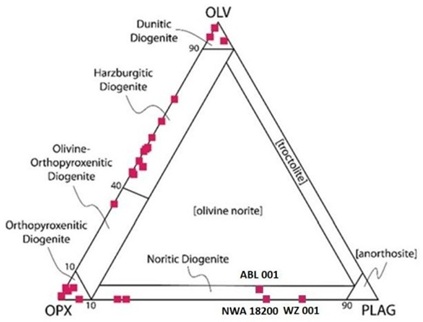
Diagram credit: Irving et al., 57th LPSC, #1529 (2026)
See also Carpenter et al., 54th LPSC, #2278 (2023)
See also Irving et al., 47th LPSC, #2264 (2016)